


Maurice Duverger
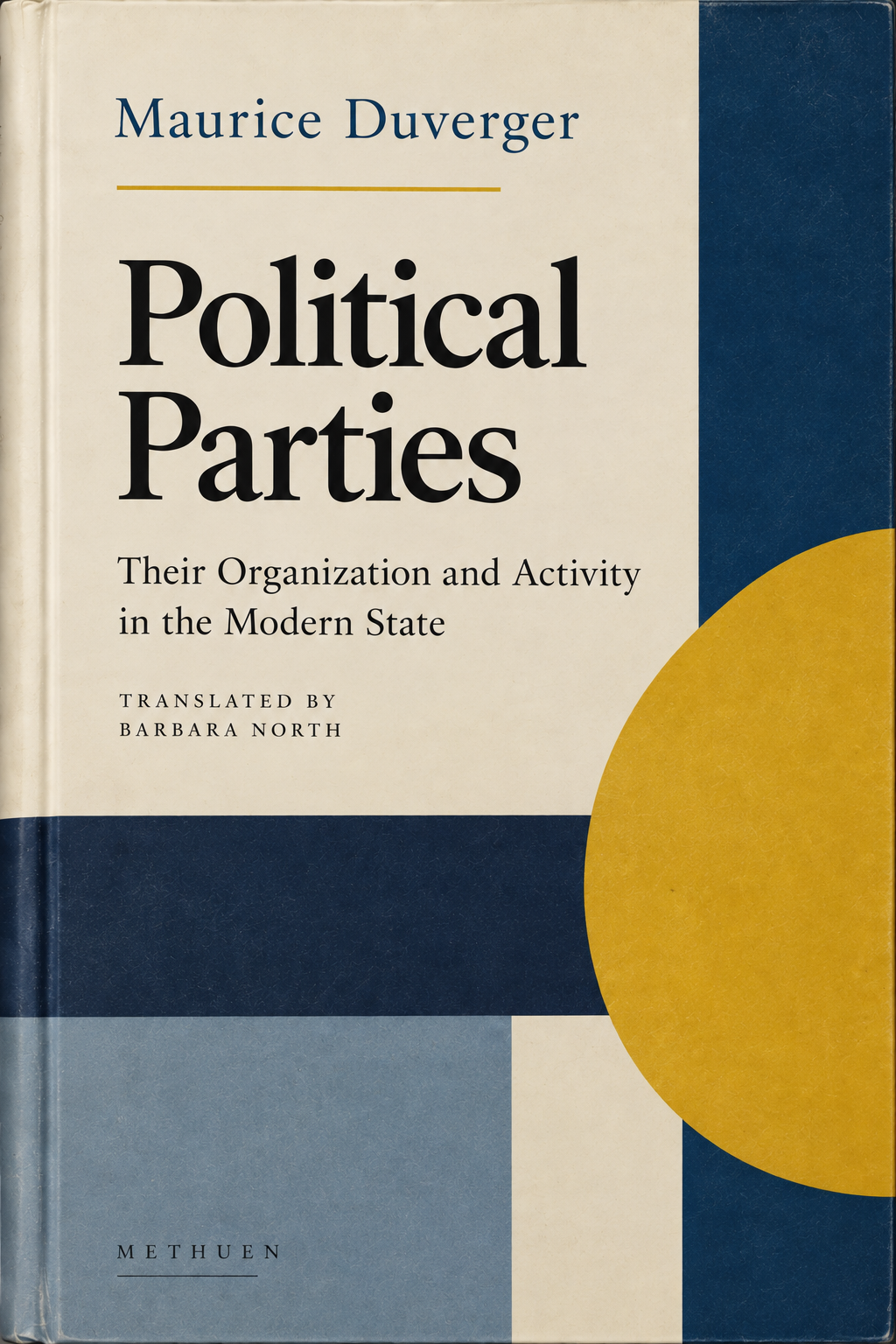
Maurice Duverger (1917–2014) established the foundational causal link between electoral systems and party systems through Duverger's Law: plurality-rule elections tend to produce two-party systems, while proportional representation tends to produce multiparty systems. In *Les Partis Politiques* (1951), he distinguished between the 'mechanical effect' (wasted votes for third parties) and the 'psychological effect' (strategic voting), providing the causal mechanism for his famous proposition. Beyond electoral systems, Duverger coined the term 'semi-presidential system' and founded one of France's first political science faculties at Bordeaux in 1948. His empirical, comparative approach transformed political science from constitutional formalism into a behavioral discipline focused on measurable institutional consequences.






✦What is Duverger's Law and what are its two causal mechanisms?
Duverger's Law states that plurality-rule (first-past-the-post) electoral systems tend to produce two-party systems, while proportional representation tends to produce multiparty systems. Duverger identified two mechanisms: the 'mechanical effect'—third-party voters waste their votes on candidates who cannot win—and the 'psychological effect'—voters and donors anticipate this waste and strategically abandon third parties before the election. This dual mechanism makes the law one of the few genuinely predictive propositions in political science.
✦What are the main exceptions or challenges to Duverger's Law?
Duverger's Law faces significant empirical exceptions: Canada and India use plurality voting but sustain multiparty systems, while Spain has proportional representation with a stable two-party dynamic (until recently). Critics argue the law is overly deterministic and ignores social cleavages, regional parties, and strategic coordination by elites. Some scholars treat it as a probabilistic tendency rather than an iron law, noting that the mechanical effect is strong but the psychological effect depends on voter sophistication and accurate polling information.
✦How does Duverger's concept of 'semi-presidentialism' differ from presidential and parliamentary systems?
Duverger coined 'semi-presidentialism' to describe systems where a directly elected president coexists with a prime minister and cabinet responsible to parliament—as in France's Fifth Republic. Unlike pure presidentialism (US), the prime minister governs with parliamentary confidence; unlike pure parliamentarism (UK), the president holds significant independent powers. Duverger identified three subtypes based on whether president and parliament majority align, creating a constitutional hybrid that has since been adopted by over fifty countries worldwide.
✦What was Duverger's political trajectory, and why was he controversial?
Duverger's political journey was remarkably volatile. In 1936 he joined the extreme-right Parti populaire français; in 1941 he published an article on Vichy's anti-Semitic public service rules, which critics labeled collaborationist (though he won defamation suits against this charge). After WWII he became a left-of-centre commentator for *Le Monde*, opposed de Gaulle, and in 1989 was elected to the European Parliament on the Italian Communist Party list, later joining the Social Democratic group. This zigzagging path made him a divisive figure in French intellectual life.
✦Why did Duverger's work have less impact in France than internationally?
Paradoxically, Duverger's greatest influence was outside France. French political science remained dominated by constitutional law and historical narrative, resistant to his empirical, comparative methods. Few French scholars studied parties comparatively or electoral systems systematically, and the concept of semi-presidentialism was largely ignored by French public lawyers. Meanwhile, English-speaking political scientists embraced his work, making it a cornerstone of comparative politics—a classic case of a prophet honored abroad but not at home.
✦What did Duverger get right and what remains contested in his electoral systems theory?
Duverger correctly identified that electoral rules have systematic, predictable consequences—a breakthrough against the then-dominant view that institutions were merely reflections of social forces. His mechanical effect is well-established: plurality systems do penalize smaller parties. However, the psychological effect is harder to measure and varies with electoral proximity, polling accuracy, and voter rationality. Contemporary research finds the law holds most strongly in single-member districts with homogeneous populations but weakens in ethnically fragmented or federal states where regional parties thrive despite plurality rules.
✦How is Duverger's work applied in electoral system design today?
Duverger's framework is the default reference for constitutional designers choosing between plurality and proportional systems. Electoral reformers in the UK, Canada, and the US routinely invoke his predictions about party fragmentation and coalition governance. Proponents of proportional representation cite his finding that PR produces more representative multiparty systems; defenders of plurality point to the stability and accountability of two-party outcomes. His work also informs simulations of electoral reform impacts, helping policymakers anticipate how changes in district magnitude or electoral formulas will reshape party competition.