


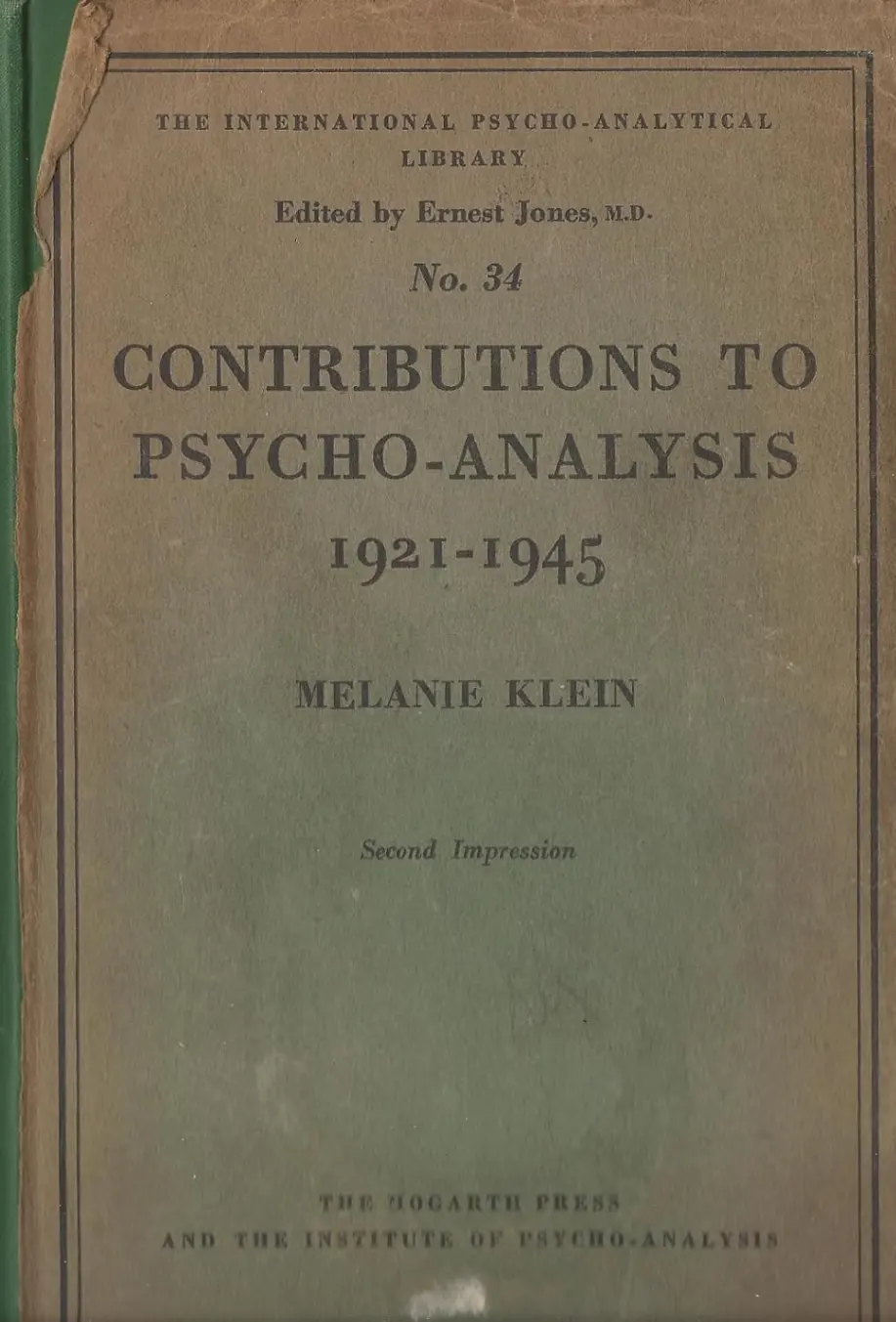
Contributions to Psycho-Analysis, 1921–1945
 Melanie Klein
This collection gathers Melanie Klein's foundational papers from her first quarter-century of work, including 'The Development of a Child' (1921) and 'A Contribution to the Psychogenesis of Manic-Depressive States' (1935). The volume's central contribution is the clinical demonstration that children's play, drawings, and silences carry the same latent unconscious content as dreams and verbal associations, making the psychoanalysis of small children possible. From this technique Klein derives her distinctive theoretical claims: the paranoid-schizoid and depressive positions, the primitive superego, and projective identification—formulations that shifted psychoanalytic attention from instinctual vicissitudes toward early object relations.
Key Details
Book Archives
View AllExplore detailed research articles, summaries and analyses from this book.


Related Books
View AllSimilar books from the same category, ranked by shared topics and reader engagement.



Key Insights — Read in 10 Minutes
What is the central clinical innovation that unifies these collected papers?
The unifying innovation is Klein's systematic use of play as the child's equivalent of free association. Where her contemporary Anna Freud held that young children could not be psychoanalyzed because they lack the verbal capacity and transference readiness of adults, Klein demonstrated that all behavior—play, drawing, and even silence—carries latent unconscious fantasy that can be interpreted in the same way as verbal communications and dreams . This technique made the analysis of small children possible and opened the door to understanding nonverbal communication in all patients, including those with psychosis and borderline personality disorder . The papers in this collection, especially 'The Development of a Child' (1921), document the first sustained application of this method.
What are the paranoid-schizoid and depressive positions, and where do they first appear in this volume?
The paranoid-schizoid position is Klein's term for the earliest phase of infant mental life, in which the ego splits its world into good and bad objects and experiences persecutory anxiety about the bad. The depressive position, emerging later, is the phase in which the infant recognizes the good and bad mother as the same whole person, producing guilt, mourning, and the desire for reparation . The key papers introducing these concepts are 'A Contribution to the Psychogenesis of Manic-Depressive States' (1935) and 'Mourning and Its Relation to Manic-Depressive States' (1940), both included in this collection. The positions displaced Freud's libidinal stage model as the primary developmental framework for Klein and her followers.
How did the psychoanalytic community receive Klein's early papers, and what was Ernest Jones's role?
Reception was initially enthusiastic but soon divided. Ernest Jones, who wrote the introduction to this volume, had invited Klein to London and recognized her as a recruit of extreme value for the British Psycho-Analytical Society . But as Jones himself acknowledged in later prefaces, her work was 'attacked and defended with almost equal vehemence' from the start . Critics found her formulations 'far-fetched' and 'one-sided,' charges Jones noted had also been leveled at Freud's own early work . Some colleagues felt she went 'too far' or 'too fast,' as Jones put it . The papers in this collection were thus the seedbed of the disputes that would culminate in the Controversial Discussions of 1941–1945.
How does Klein's child analysis differ from Anna Freud's approach?
The two approaches are rooted in opposing emphases on theory versus practice. Anna Freud held to the Freudian theory of child development and was consequently forced to limit the scope of child analysis, focusing on the actual mother-child relationship and educational elements. Klein, by contrast, applied Freudian practice with children and discovered processes that Freud had not postulated—the paranoid-schizoid and depressive positions emerging in the first year of life, and a primitive superego far earlier than the Oedipal superego described by Freud . Klein analyzed transference from the beginning and interpreted deep unconscious fantasy without reassurance or re-education, while Anna Freud believed such direct interpretation was inappropriate for children. The debate between them shaped the institutional history of child psychoanalysis.
What does Klein mean by 'projective identification,' and in which paper is it introduced?
Projective identification is a primitive defense in which parts of the self—good or bad—are split off and projected into an object, initially the mother, who then becomes identified with those parts . Klein introduced the concept in 'Notes on Some Schizoid Mechanisms' (1946), which falls just outside the chronological range of this collection but is the direct theoretical continuation of the papers gathered here. The mechanism plays a major role in all developmental processes, normal and pathological, and excessive projective identification can lead to severe difficulties in establishing identity and normal relations . Klein's followers, especially Rosenfeld, developed the concept further in the direction of psychotic transference and the analyst's countertransference entanglements.
What is the editorial history of this volume, and how does it relate to the later collected Writings of Melanie Klein?
Contributions to Psycho-Analysis, 1921–1945 was first published by Hogarth Press in 1948 as volume 34 of the International Psycho-Analytical Library, running 416 pages with an introduction by Ernest Jones . A McGraw-Hill paperback edition appeared in 1964 . The volume is not a complete record of Klein's output for those years; it is a selection of papers, with one exception reprinted from journals, as the original subtitle indicated . The definitive collection is The Writings of Melanie Klein, published by Hogarth in four volumes (1975), which superseded this volume in scope and editorial consistency. Reading Contributions alongside the Writings allows scholars to trace how Klein's own formulations changed between the original papers and her later revisions.
Wealthy Psyche is an intellectual archive. We do not host, distribute, or sell book copies — physical or digital. We provide structured knowledge to help you think better, faster.