



Crises of Democracy
 Adam Przeworski
Przeworski's central argument is that democracy's survival depends not on wealth or institutional design alone, but on the willingness of political losers to accept defeat and of winners to refrain from permanent entrenchment. Drawing on historical data and case studies of Weimar Germany, Allende's Chile, the French Fourth Republic, and Watergate-era America, he identifies the mechanisms by which democracies erode 'by stealth'—through formally legal measures that subvert electoral competition without a dramatic rupture. He contends that this gradual corrosion can occur even in wealthy, established democracies, making the future of global democracy genuinely uncertain.
Key Details
Related Books
View AllSimilar books from the same category, ranked by shared topics and reader engagement.

Key Insights — Read in 10 Minutes
What is the central claim of Crises of Democracy, and what does it reject?
Przeworski argues that democracies do not contain institutional mechanisms safeguarding them from subversion by duly elected governments observing constitutional norms. He rejects the comforting assumption that wealth or repeated peaceful alternations of power make democracies immune to collapse. The book's core analytical move is distinguishing between sudden coups and gradual 'subversion by stealth'—a process in which elected incumbents use formally legal measures to make elections non-competitive or inconsequential for those in power [citation:2][citation:11].
What specific concept does Przeworski develop to describe contemporary democratic erosion?
Przeworski develops the concept of 'subversion by stealth,' the process by which democratic erosion occurs gradually through formally legal and constitutional measures that imperceptibly change the nature of the regime over time. Unlike sudden coups, this form of backsliding can unfold even in comparatively wealthy, established democracies like the United States. He argues that opposition forces can only mobilize successfully against such stealth subversion if they correctly foresee the ultimate authoritarian consequences of early antidemocratic moves from the outset—a condition unlikely to be met given political uncertainty and short citizen attention spans [citation:2][citation:11].
How does Crises of Democracy differ from Przeworski's earlier Democracy and Development?
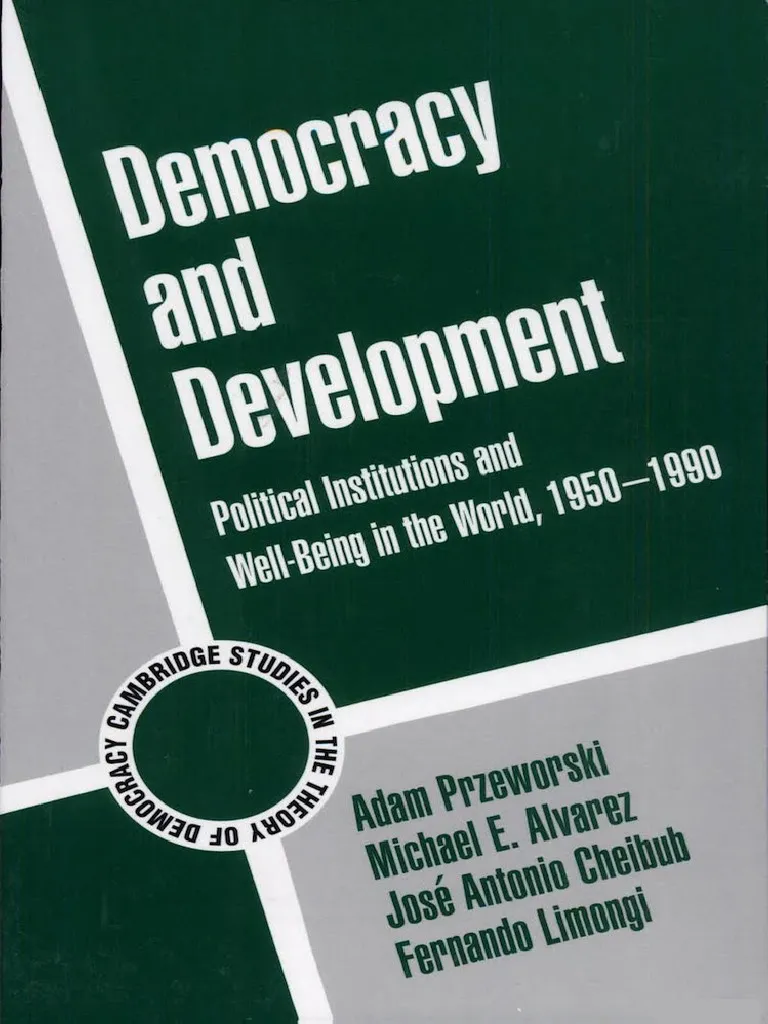
Democracy and Development (2000) was a statistical study of 135 countries testing whether economic development causes democracy, concluding that income stabilizes democracies without causing them to emerge. Crises of Democracy (2019) shifts focus to the quality and vulnerability of established democracies, asking whether contemporary conditions mirror those that preceded past collapses. The earlier book's finding that 'no democracy above Argentina's 1975 per capita GDP has ever collapsed' still stands with one exception—Thailand's 2006 coup—but Przeworski now emphasizes that gradual erosion can occur without formal collapse, a possibility the earlier statistical framework could not capture [citation:2][citation:7].
What historical cases does Przeworski use to illustrate democratic breakdown and survival?
Przeworski examines four cases: two collapses (Weimar Germany 1928–33 and Chile 1970–73) and two crises that democracy survived (France 1954–62 and 1968, and the United States 1964–76). His conclusion from these 'stories' is that the survival of democracy in France may have been a historical accident. The cases demonstrate that while certain conditions—economic crisis, polarization, weak institutions—increase the risk of breakdown, outcomes ultimately depend on the actions of political actors, not deterministic structural forces [citation:7][citation:8].
How does Przeworski define democracy, and why is this definition contested?
Przeworski adopts a minimalist, electoralist definition: democracy is 'a political arrangement in which people select governments through elections and have a reasonable possibility of removing incumbent governments they do not like' [citation:11]. Critics argue this definition is too narrow, questioning whether regimes that systematically exclude women, racial minorities, or the colonized—as the United States did before 1965—should count as democracies even by minimalist standards. Przeworski treats violations of liberal rights and the rule of law as potential threats to electoral competition rather than as definitional features of democracy [citation:1][citation:11].
What role do economic factors play in Przeworski's analysis of democratic crisis?
Przeworski identifies economic inequality and income stagnation as facilitating factors for democratic decline. He argues that the post-World War II compromise—unions, safety nets, and moderate taxation enabling productivity and wages to rise together—fell apart when Reagan and Thatcher attacked unions, leading to wage stagnation and inequality. This, combined with the politics of resentment attacking social programs seen as benefiting minorities and immigrants, produced polarization that disabled consensus and started cycles of governmental failure. However, he emphasizes that economic factors are enabling conditions, not deterministic causes [citation:2][citation:16].
Show 2 more insights
What is a common criticism of Przeworski's approach in this book?
Critics point to two theoretical lacunae. First, Przeworski does not sustain discussion of how patriarchy, slavery, and imperialism were entangled in the origins of Western democracies, leaving unclear whether regimes that systematically excluded large populations truly qualify as democracies even by minimalist standards. Second, he assumes politicians are driven purely by power maximization, a claim that sits uneasily with his acknowledgment elsewhere that people are motivated by ideology, religion, and belief in democracy itself. He never develops an explicit argument for why all politicians would be systematically power-maximizing [citation:1].
What makes Crises of Democracy distinctive among recent books on democratic backsliding?
Unlike many recent contributions that argue for a specific perspective on democracy's decline, Przeworski's book is a critical tour through academic debates that often refrains from firm conclusions. He acknowledges that 'some readers will be disappointed by how often' the book fails to arrive at definitive answers, stressing that 'one should not believe the flood of writings that have all the answers.' The book is best understood as an invitation to engage critically with evidence rather than a polemic, combining statistical analysis, formal theory, and historical case studies in a compact, accessible format [citation:8][citation:15].
Wealthy Psyche is an intellectual archive. We do not host, distribute, or sell book copies — physical or digital. We provide structured knowledge to help you think better, faster.