


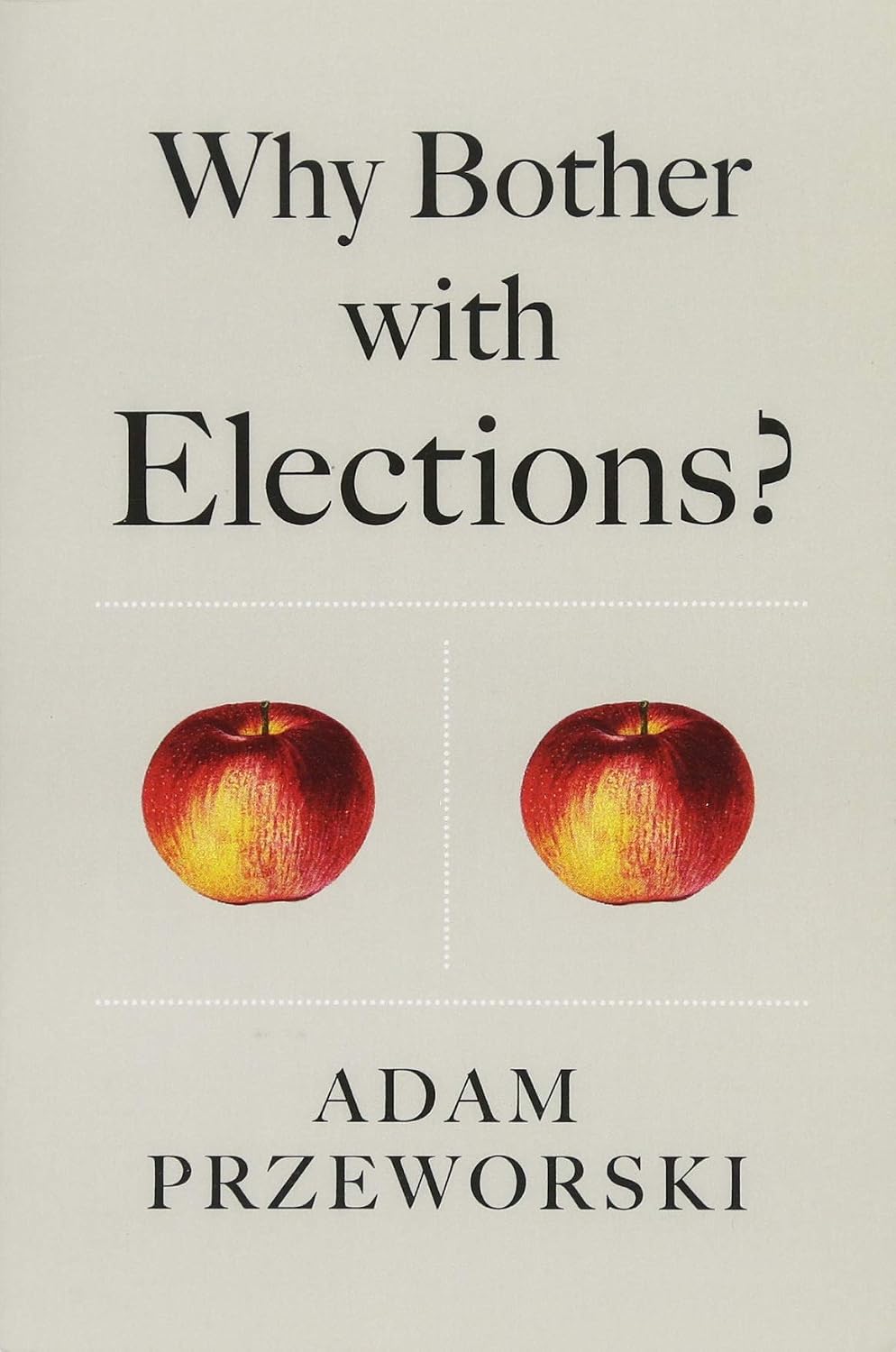
Why Bother with Elections?
 Adam Przeworski
Przeworski's central argument is that elections are inherently imperfect but remain the least bad method for selecting rulers because they peacefully process societal conflicts. He rejects the romanticized view that elections achieve popular self-government or political equality; instead, they are merely a mechanism for appointing leaders who then govern with substantial autonomy. The book's core contribution is its clear-eyed analysis of what elections can and cannot achieve—they do not generate social justice or economic equality, but their greatest value lies in maintaining relative liberty and civil peace by replacing violence with periodic competition for power.
Key Details
Related Books
View AllSimilar books from the same category, ranked by shared topics and reader engagement.


Key Insights — Read in 10 Minutes
What is Przeworski's central claim about elections, and what does it reject?
Przeworski argues that elections are inherently imperfect and should not be expected to achieve popular self-government or political equality. They are merely a means of appointing leaders who then govern with significant autonomy. He rejects the idealization of elections as instruments of collective self-rule, insisting instead that their greatest virtue is procedural: they process societal conflicts peacefully, maintaining relative liberty and civil order by allowing losers to wait for future rounds rather than resort to violence [citation:1][citation:5].
What specific concept does Przeworski use to describe the historical function of elections regarding property?
Przeworski argues that the protection of property has been the central axis of political conflict for two centuries. The initial advocates of representative government feared that extending suffrage to the poor would result in the confiscation of private property. Historical devices such as unelected upper houses, restrictions on opposition, and property qualifications were designed to protect the wealthy from majority rule. Even today, constitutional courts and independent central banks serve as counter-majoritarian mechanisms protecting property rights against temporary electoral majorities [citation:7].
How does Przeworski explain why incumbents manipulate electoral rules?
Przeworski argues that it is unreasonable to expect competing parties to abstain from doing whatever they can to enhance their electoral advantage. The opportunities for manipulation are legion: moving constituency boundaries, controlling polling day and locations, media manipulation, party and campaign financing rules, and even constitutional amendments extending term limits. The incentive is especially strong when what is at stake exceeds mere political office—when losing means losing everything. Przeworski notes that even mature democracies are not immune to such opportunistic strategies [citation:1][citation:2].
How does this book relate to Przeworski's earlier Democracy and the Market?
Democracy and the Market (1991) analyzed the strategic dynamics of transitions from authoritarianism, defining democracy as institutionalized uncertainty and examining the tension between market reform and democratic survival. Why Bother with Elections? (2018) returns to the core question of what elections actually accomplish once democracy is established. It distills arguments developed in Democracy and the Limits of Self-Government (2010) into an accessible synthesis, focusing on the limits of electoral control over governments and the inescapable tension between political equality and economic inequality [citation:3][citation:4].
What is a common criticism of Przeworski's realist approach to elections?
Critics argue that Przeworski's exclusive focus on elections' pacifying function is too thin a justification for democratic institutions. If civil peace is the only defense of elections, then technocratic government might also preserve peace, leaving no grounds to object to a slow shift toward unelected bodies. Some reviewers also note that he underplays the historical progress competitive elections have enabled in formal rights and recognition for marginalized groups—advances that, while incomplete, are real and irreducible to economic inequality .
What does Przeworski mean by the 'miracle of democracy'?
Przeworski describes the 'miracle' as the peaceful replacement of weapons with votes—the substitution of paper stones for barricades in regulating social conflict. When incumbents call elections at the risk of losing power, winners assume office, losers return home to await the next round, and conflict is regulated without violence. This miracle is not guaranteed; it depends on conditions that vary across societies and time periods. But when it occurs, it transforms potentially violent conflicts into peaceful competition [citation:4][citation:10].
Wealthy Psyche is an intellectual archive. We do not host, distribute, or sell book copies — physical or digital. We provide structured knowledge to help you think better, faster.