


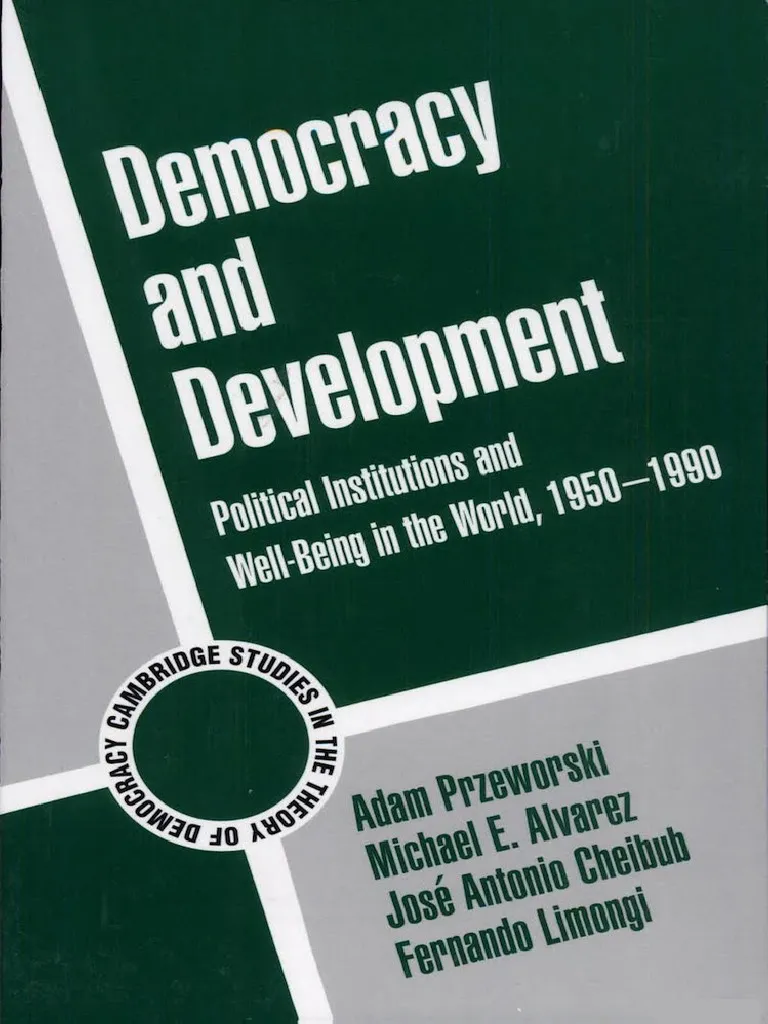
Democracy and Development: Political Institutions and Well-Being in the World, 1950–1990
 Adam Przeworski
Przeworski and his co-authors challenge modernization theory's central claim: economic development does not cause countries to become democratic. Instead, they argue that once a democracy emerges for whatever reason, higher per capita income dramatically increases its chances of survival. Using data on 135 countries from 1950 to 1990, the book finds that democracies are more likely to endure in wealthy societies, while income has little effect on whether dictatorships transition. A complementary finding is that regime type has no significant impact on economic growth in poor countries, but democracies grow faster in wealthier ones.
Key Details
Related Books
View AllSimilar books from the same category, ranked by shared topics and reader engagement.


Key Insights — Read in 10 Minutes
What is the central claim of Democracy and Development, and what does it reject?
The book argues that economic development does not cause democracies to emerge; instead, higher per capita income makes democracies more likely to survive once they appear. It rejects the modernization hypothesis, most associated with Seymour Martin Lipset, that development itself generates democratic transitions. Using data on 135 countries from 1950 to 1990, Przeworski and colleagues find that income levels predict democratic survival with striking accuracy, while the probability of a dictatorship transitioning to democracy does not rise consistently with wealth [citation:18][citation:6].
What specific methodological approach distinguishes this book from earlier democratization research?
The authors adopt a minimalist, procedural definition of democracy—a system in which incumbents lose elections and leave office when the rules so dictate—reducing it to observable facts about executive and legislative elections and alternation [citation:6]. They then apply dynamic probit models to nearly 4,000 country-years, controlling for numerous variables. A key methodological innovation is the counterfactual framing: instead of asking what causes democracy, they ask what makes it endure, isolating survival from emergence [citation:11][citation:13].
How does this book relate to Przeworski's earlier Democracy and the Market?
Democracy and the Market (1991) focused on transitions in Eastern Europe and Latin America, treating democracy as institutionalized uncertainty and examining the tension between market reform and democratic survival. Democracy and Development (2000) is a broader statistical study of 135 countries over four decades, shifting from the strategic dynamics of transition to the structural determinants of democratic durability. The later book's finding that income stabilizes democracies without causing them to emerge can be seen as extending the earlier work's skepticism about economic preconditions for democracy.
What is the most contested finding in the book, and how have critics responded?
The most contested claim is that economic development does not increase the likelihood of transitions to democracy. Boix and Stokes argued this conclusion rests on shaky inferences from a small number of wealthy dictatorships and fails to hold for periods before 1950 [citation:14]. A review noted that the authors' own dynamic probit model found lagged per capita income significantly predicted democratic transitions, contradicting their chapter conclusion [citation:1]. Epstein and colleagues similarly argued that using a three-category regime typology rather than a binary one reveals development does promote democratization [citation:9].
How does the book's finding on economic growth challenge conventional wisdom about democracy and development?
Przeworski and colleagues find no evidence of a tradeoff between democracy and economic growth: in poor countries, regime type does not significantly affect growth rates; in wealthier countries, democracies actually grow faster than dictatorships [citation:6]. This directly contradicts the long-standing argument that authoritarian regimes are better at promoting rapid development. The finding has been influential in policy debates, suggesting that developing countries need not sacrifice political freedom for economic progress.
What is the significance of the book's analysis of presidentialism versus parliamentarism?
The book includes a chapter examining how different democratic institutional designs affect regime survival. The authors find that presidential democracies are more vulnerable to breakdown than parliamentary ones, a finding that became a central contribution to the debate over constitutional design. This analysis extended the book's reach beyond the democracy-development question into institutional choice, influencing subsequent research on why presidential systems face higher risks of democratic collapse.
Wealthy Psyche is an intellectual archive. We do not host, distribute, or sell book copies — physical or digital. We provide structured knowledge to help you think better, faster.