


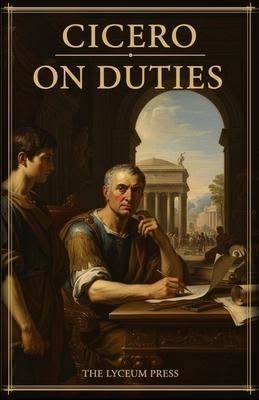
De Officiis (On Duties)
 Marcus Tullius Cicero
Cicero's De Officiis argues that the honourable (honestum) and the expedient (utile) can never truly conflict, and that any apparent clash between moral right and practical advantage is a failure of understanding, not a genuine dilemma. Written as a letter to his son Marcus in late 44 BC, the treatise adapts the Stoic ethics of Panaetius into a practical Roman guide for public life, organized around the four cardinal virtues: wisdom, justice, magnanimity, and propriety. The third book's central move is to collapse the supposed tension: nothing is expedient that is not honourable, and nothing honourable that is not expedient.
What is the central argument of De Officiis, and what does it reject?
The treatise's core thesis is that honestum (the honourable or morally right) and utile (the expedient or advantageous) can never genuinely conflict. Where they appear to, the error lies in mistaking a false advantage for a real one. Cicero rejects the position, associated in the text with the Academic Carneades, that justice is merely conventional and that a wise man may act unjustly when it profits him without detection. The third book dismantles this view by arguing that nothing can be truly expedient that is morally wrong, and nothing morally right that is not in fact advantageous.
How does De Officiis differ from Cicero's earlier political works, De Re Publica and De Legibus?
De Re Publica asks what the best commonwealth is and grounds its answer in Rome's mixed constitution and the ideal statesman. De Legibus asks what law must be, locating it in right reason and nature. De Officiis shifts from institutional and legal questions to individual conduct, offering principles for how a person — particularly an aspiring politician — should act. The earlier works address the structure of the state; this one addresses the moral formation of those who would serve it. The natural-law framework remains, but the focus is the practical duties that follow from it.
What is the role of the Stoic Panaetius in the argument?
Cicero explicitly bases De Officiis on Panaetius's treatise on duty, adapting its Stoic framework for a Roman audience. He follows Panaetius in structuring the first two books around the four virtues and the question of what is honourable and what is expedient, but he departs from him by adding a third book on the conflict between them — a topic Panaetius had promised to treat but left unfinished. The result is a work that is Stoic in its foundations but Roman in its practical orientation, with examples drawn from Roman history and contemporary politics rather than Greek philosophy alone.
Why did De Officiis become so influential in the Middle Ages and Renaissance?
De Officiis offered a systematic, practical ethics that could be adapted to Christian moral teaching without fundamental revision. Ambrose's De officiis (c. 385) modeled itself directly on Cicero's work, effectively baptizing its structure for the Church. By the twelfth century, it was a staple of medieval grammar schools, surviving in numerous manuscript copies. With the printing press, it was among the first classical texts issued, and Erasmus reportedly said he could not read it without kissing the book. Its combination of Stoic virtue ethics with Roman civic examples made it uniquely suited to educational use.
What is the common misconception about De Officiis as a personal letter to Cicero's son?
While Cicero addresses the work to his son Marcus and the father-son frame provides its literary form, scholars argue the intended audience is wider — aspiring young statesmen of the Roman aristocracy generally. Cicero himself states that the discussion is 'not concerned with you personally, but with the whole category of youths.' The addressee provides a rhetorical conceit rather than a private communication, allowing Cicero to address public moral questions under the guise of paternal advice. Reading it as merely personal correspondence understates its philosophical and political ambitions.
How does De Officiis treat the question of private property and political obligation?
Cicero argues that political society arises partly from the need to protect property, and that safeguarding each person's holdings is a central moral imperative for the state. He does not claim private property exists by nature — the natural world belongs originally to all in common — but holds that occupation, conquest, agreement, and lot have legitimately carved out individual holdings. The statesman's duty is to ensure that neither the poor are cheated through their low station nor the rich suffer envy for holding their own. This emphasis on property protection distinguishes his practical ethics from more radical ancient proposals.
Wealthy Psyche is an intellectual archive. We do not host, distribute, or sell book copies — physical or digital. We provide structured knowledge to help you think better, faster.