


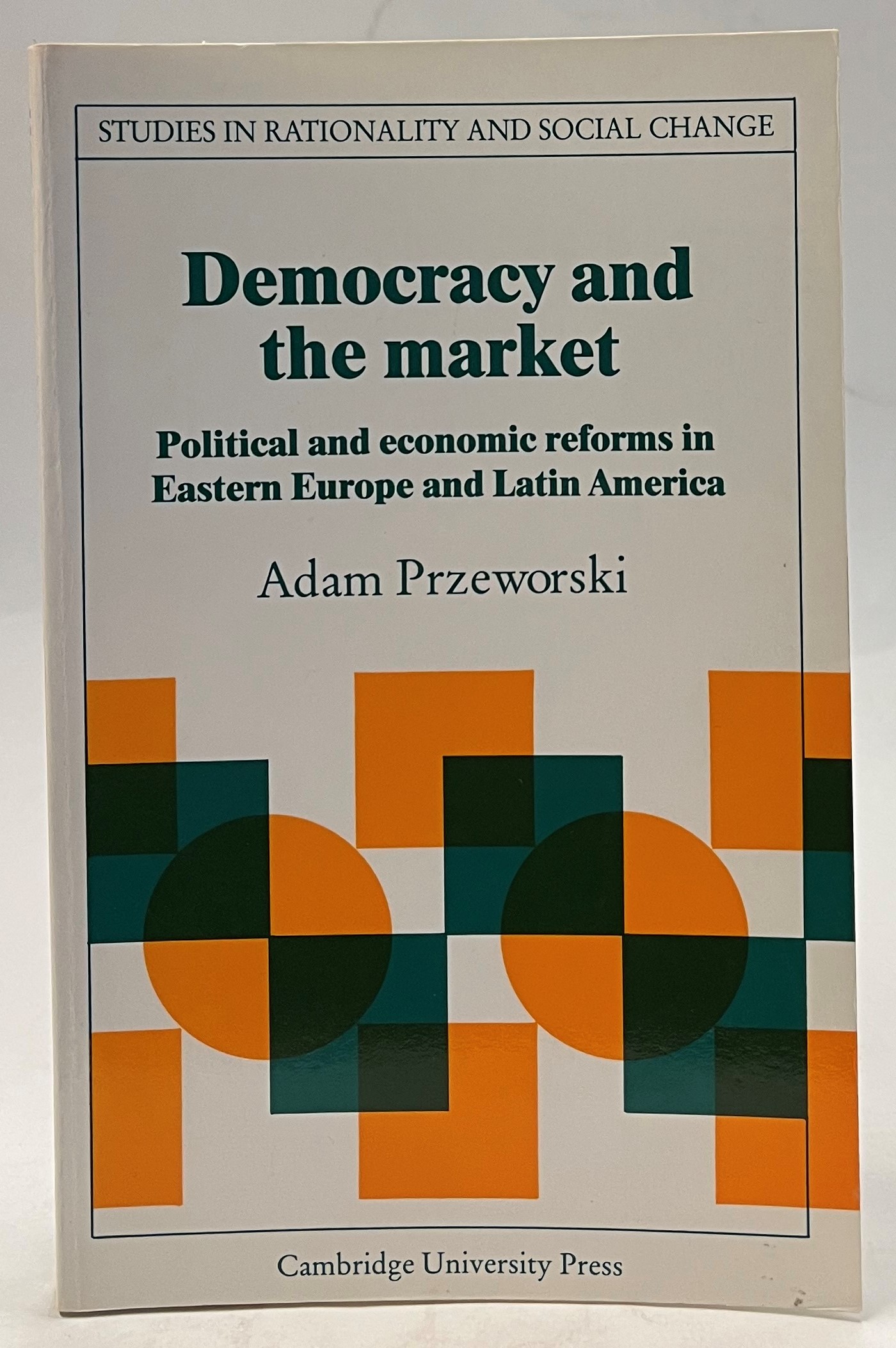
Democracy and the Market: Political and Economic Reforms in Eastern Europe and Latin America
 Adam Przeworski
Przeworski's central thesis is that democracy is best understood as 'institutionalized uncertainty'—a system in which parties lose elections and all interests are subjected to open competition. Drawing on game theory and comparative evidence from Eastern Europe and Latin America, he argues that democratic consolidation depends on losers accepting present defeats because they believe the institutional framework will let them advance their interests in the future. Simultaneously, market-oriented reforms impose temporary but severe social costs that threaten democratic stability, creating a fundamental tension between economic liberalization and political survival.
Key Details
Related Books
View AllSimilar books from the same category, ranked by shared topics and reader engagement.

Key Insights — Read in 10 Minutes
What is the central claim of Democracy and the Market, and what does it reject?
Przeworski defines democracy as a system in which parties lose elections and all interests are subjected to competition—what he calls 'institutionalized uncertainty' [citation:4]. He rejects the assumption that democracy represents the implementation of a fixed 'common will'; instead, preferences are formed and transformed through democratic deliberation. The book's core analytical contribution is showing that democratic stability depends on losers complying with present defeats because they believe they can win in the future under the same institutional rules [citation:4].
What specific concept did Przeworski introduce that transformed comparative politics?
Przeworski introduced 'institutionalized uncertainty' as the defining feature of democracy: a system where outcomes are unknown ex ante, parties compete without knowing who will win, and all interests are subject to competition [citation:4]. This framework allowed scholars to distinguish democracy from other regimes not by outcomes (who governs) but by process (how uncertainty is structured). The concept became foundational for analyzing democratic transitions and consolidation across Eastern Europe and Latin America [citation:1][citation:8].
How does Przeworski explain the relationship between economic reform and democratic survival?
Przeworski argues that market-oriented reforms—deregulating prices, reducing expenditures, selling public assets—necessarily cause a temporary fall in aggregate consumption and hurt large social groups [citation:9]. This creates a fundamental tension: reforms are socially costly and politically risky, yet democracy may be undermined if opposition succeeds or reforms are abandoned. The book's fourth chapter examines whether structural transformations of economic systems can be accomplished under democratic conditions, concluding that the sequencing and political management of reform are critical to democratic survival [citation:9].
How does this book differ from earlier modernization theory approaches to democracy?
Modernization theory, associated with Lipset and others, treated democracy as a product of socioeconomic development—richer countries become democratic and stay democratic. Przeworski shifts the analytical focus to institutions and strategic choices, using game theory to model how political actors with competing interests negotiate transitions. Rather than asking what preconditions produce democracy, he asks how institutional frameworks can make democratic competition self-sustaining. His conclusion that the emerging institutions were often 'haphazard,' adopted under pressure to terminate conflicts quickly, challenges the assumption that democratic consolidation is automatic [citation:2].
What does Przeworski conclude about the prospects for Eastern European democracies after communism?
Przeworski is cautiously skeptical. In his conclusions, he notes that the syllogism 'if it had not been for the system, we would have been like the West' is flawed: many capitalist countries remain poor and unstable, with half the world's population living under governments that are capitalist but intermittently violent [citation:2]. He argues that to consolidate, democratic institutions must simultaneously protect all major interests and generate economic results—a difficult combination. The institutions emerging from transitions were often adopted under pressure, so he predicts continual conflict over basic institutional design in the new democracies [citation:2].
What is the significance of the game-theoretic models in the book?
Przeworski uses game theory to model the strategic interactions between hardliners and reformers within authoritarian regimes and moderates and radicals outside them [citation:4]. The models show that democratization would never occur if preferences and knowledge were perfect; it becomes possible only when radicals become less radical or moderates decide they fear radicals more than reformers. This formal approach allows Przeworski to identify the precise conditions under which transitions to stable democracy, limited democracy, or renewed authoritarianism become likely, moving beyond descriptive accounts of transition events [citation:4].
Show 1 more insights
How has the book's argument held up since the post-communist transitions it analyzed?
The book's central insight—that democratic consolidation requires losers to believe they can win under the same rules—has proven durable, but its optimism about the specific Eastern European transitions has been qualified by subsequent events. Przeworski's warning that haphazard institutions would produce continual conflict proved accurate in countries like Hungary and Poland, where democratic backsliding has occurred. His analysis of the tension between market reform and democratic survival anticipated the political costs of rapid liberalization. The book remains widely cited in comparative politics and is considered a foundational text in the study of democratization [citation:6].
Wealthy Psyche is an intellectual archive. We do not host, distribute, or sell book copies — physical or digital. We provide structured knowledge to help you think better, faster.