


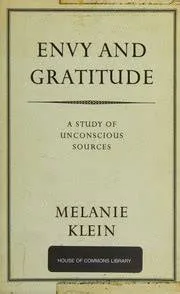
Envy and Gratitude: A Study of Unconscious Sources
 Melanie Klein
Klein's final major work argues that envy—the angry feeling that another possesses and enjoys something desirable, with the impulse to take it away or spoil it—is an innate expression of the death instinct, present from the earliest relation to the mother's breast. Gratitude, its opposite, arises from full gratification and becomes the basis for love, concern, and reparation. Klein's central claim is that the ratio between envy and gratitude in infancy determines the organization of the early ego and the capacity for psychological flourishing; excessive envy interferes with splitting and the depressive position itself.
Key Details
Book Archives
View AllExplore detailed research articles, summaries and analyses from this book.


Related Books
View AllSimilar books from the same category, ranked by shared topics and reader engagement.



Key Insights — Read in 10 Minutes
What is primary envy, and how does it differ from jealousy and greed?
Klein defines envy as the angry feeling that another person possesses and enjoys something desirable—the envious impulse being to take it away or spoil it . Primary envy is her distinctive claim: envy is present from the beginning of life, directed at the mother's breast as the primal good object. It differs from jealousy, which involves a third party and a triangular relation, and from greed, which seeks to possess and consume rather than to spoil. The envious impulse is specifically to destroy the goodness of the object because it is good and because the subject depends upon it. Klein connected this to the death instinct, treating envy as its earliest manifestation in the infant's relation to the object .
What role does gratitude play in Klein's theory, and why has it been comparatively neglected?
Gratitude, for Klein, arises from full gratification at the breast: the infant feels it has received a unique gift it wants to keep, and this becomes the basis for gratitude . Gratitude is the particular affect towards an object that produces appreciation and satisfaction, and it mitigates envy . Jonathan Lear observed that while Klein named gratitude at one pole of an axis of human suffering and flourishing, the 1957 essay stimulated research overwhelmingly into envy, with only a few notable exceptions exploring gratitude itself . This asymmetry is itself a phenomenon: envy is the more clinically urgent and theoretically gripping concept, while gratitude tends to be assumed rather than analyzed. Edna O'Shaughnessy argues that split-off gratitude supports an analysis through an affirmation that is often kept outside the session .
Why did the book generate controversy when it appeared?
The controversy centered on Klein's postulation of constitutional envy—envy as innate, present from birth, with a constitutional basis that makes it resistant to change . Critics objected that this biologized a relational phenomenon and risked blaming the infant for its own psychic difficulties. Priscilla Roth notes that Klein emphasized from the beginning that envy interacts with external conditions, but the constitutional claim remained controversial . A Spectator reviewer in 1957 captured the challenge: Klein writes with the cumulative concentration of an analyst used to turning interpretations this way and that, and there is no jargon to buffer our outraged feelings—unpalatable truths are conveyed in words that are the nearest possible to our actual experience . The reviewer also noted that interpretations based on envy arouse the deepest resistance .
How does primary envy relate to the paranoid-schizoid and depressive positions?
Primary envy is interwoven with both positions. In the paranoid-schizoid position, envy operates through splitting and projective identification, and excessive envy interferes with the bipolar splitting essential for organizing and strengthening the early ego . When envy is intense, the good breast cannot be reliably established as an internal anchor, and the movement toward the depressive position—where good and bad can be integrated—is obstructed. Klein suggests that frustration may paradoxically lead to envy, and that when envy is counteracted by love and gratitude it becomes manageable, so the need to split it off or project it is less strong . The ratio between envy and gratitude thus determines whether the depressive position can be achieved.
What is the publication history of Envy and Gratitude, and where does it sit in Klein's collected works?
The book was first published in 1957 by Tavistock Publications as Envy and Gratitude: A Study of Unconscious Sources, a short monograph of 91 pages . It was Klein's last major writing before her death in 1960 . The work was later included as the title essay in Volume 3 of The Writings of Melanie Klein, published by Hogarth in 1975, where it appears alongside other works from 1946–1963 . Tavistock/Routledge reissued the original volume in 2001 as part of The International Behavioural and Social Sciences Library: Classics from the Tavistock Press, a facsimile reproduction . The 1977 Dell edition, Envy and Gratitude & Other Works, 1946–1963, collects the monograph with related late papers .
How has the concept of envy been extended in post-Kleinian clinical work?
Herbert Rosenfeld developed the role of envy in narcissistic pathology, showing how the persistence of narcissistic object relations depends on the intensity of envy toward the primary object, and how in destructive narcissism envy becomes the central dynamic . Ronald Britton has written on the pathologically envious personality, and Michael Feldman on envy and the negative therapeutic reaction . Contemporary analysts have extended Klein's concept to a clinical spectrum ranging from healthy envy—admiring another's talent while feeling the urge to compete—to malignant envy that is egosyntonic, deeply unconscious, and destructive . The shame accompanying envy has also been recognized as a factor that keeps patients from bringing it into analysis .
Show 1 more insights
What does Klein mean when she says the envious impulse is to spoil the good object precisely because it is good?
This is the core of Klein's originality and the source of much of the concept's clinical power. The envious subject does not merely want the good object's qualities for themselves; the object's very goodness is intolerable because it exposes the subject's lack and dependence. Klein's phantasy is that the infant wishes to enter the primal good object—the good breast—and debase it specifically because it is good . The good object is then internalized in a spoiled form, becoming part of the ego, and roles are reversed. This is a manifestation of the death instinct, where bad feelings are directed toward both good and bad objects, leading to confusion between them . The result is that the envious person cannot reliably keep goodness inside.
Wealthy Psyche is an intellectual archive. We do not host, distribute, or sell book copies — physical or digital. We provide structured knowledge to help you think better, faster.