


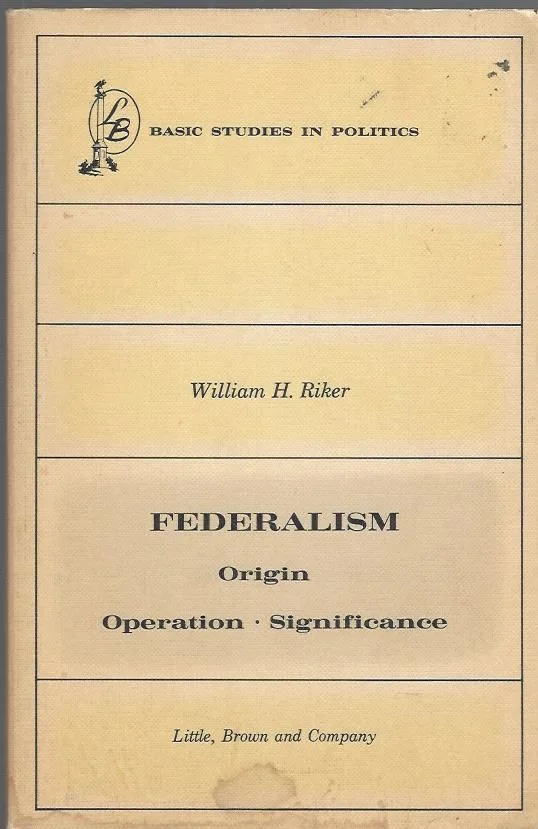
Federalism: Origin, Operation, Significance
 William H. Riker
William Riker's Federalism: Origin, Operation, Significance argues that federalism is not a normative ideal or a response to popular demands for local autonomy, but a bargain among political elites. Its central claim is that federal systems emerge when politicians seeking territorial expansion or military security cannot achieve their goals through unitary rule and therefore offer constituent units autonomy in exchange for union. Riker rejects cultural, ideological, and economic explanations of federal origins, insisting that the "federal bargain" is driven by strategic calculations of office-seeking elites. He also argues that federalism survives only when a party system sustains it, and that it has no inherent connection to liberty or democracy.
Key Details
Related Books
View AllSimilar books from the same category, ranked by shared topics and reader engagement.
.webp?alt=media&token=aa57557c-98c6-4edb-ba61-0189bc741142)
.webp?alt=media&token=fe90549a-9842-4d96-b442-a481f7724ad7)
Key Insights — Read in 10 Minutes
What is the central claim of Federalism: Origin, Operation, Significance, and what does it reject?
Riker argues that federalism originates in a bargain among political elites: politicians who want to expand territory or secure military defense but cannot do so under unitary rule offer constituent units autonomy in exchange for union. He rejects cultural, ideological, and economic explanations—that federalism arises from shared values, local loyalties, or economic interests. He also rejects the assumption that federalism is inherently linked to liberty or democracy. For Riker, federalism is a strategic institutional outcome, not a normative achievement, and its survival depends on continuing political incentives.
What specific concepts did Riker introduce in this book?
Riker introduced the federal bargain as the core mechanism of federal origins: a offer of autonomy by central elites in exchange for union, driven by external military threat or expansionist ambition. He also developed the party-system condition for federal survival—federalism endures only if the party system maintains the territorial division of power, and collapses if one party dominates both levels. His distinction between federalism's origins, operation, and significance structures the book and shaped subsequent comparative research. These concepts are standard reference points in federalism scholarship.
How does Riker's approach differ from Daniel Elazar's covenantal theory of federalism?
Riker treats federalism as a strategic bargain among self-interested politicians seeking territorial expansion or security; Elazar treats it as a normative partnership rooted in covenant, shared values, and the preservation of distinct communities. Riker is empirical and skeptical of normative claims, arguing federalism has no inherent connection to liberty; Elazar is normative, presenting federalism as a morally valuable diffusion of power. Riker asks what incentives produce and sustain federal bargains; Elazar asks what traditions and commitments make federal politics meaningful. Their contrast frames the positivist-normative divide in federalism studies.
What does Riker mean when he says federalism has no inherent connection to liberty?
Riker argues that federalism is a structural arrangement for dividing power, not a guarantee of freedom. A federal system can be as repressive as a unitary one—apartheid South Africa and the antebellum United States are his examples of federal systems that protected slavery and racial hierarchy. He rejects the assumption, common in American political thought, that federalism naturally protects individual rights. For Riker, whether federalism serves liberty depends on the political forces operating within it, not on the federal structure itself.
How has Riker's theory held up in comparative federalism research?
Riker's federal bargain and party-system condition remain foundational and are widely tested in comparative research. Studies of the United States, Canada, Australia, Germany, and India have found the military-security and expansion motives persuasive in many cases, though scholars have documented federal origins that do not fit the model—such as federations formed through devolution rather than aggregation, including Belgium, Spain, and India in part. His skepticism about federalism's link to liberty is broadly accepted, but his dismissal of cultural and ideological factors is contested.
What is a common misconception about Riker's argument?
A common misconception is that Riker denies any role for ideas or culture in federalism. He does not claim culture is irrelevant; he argues it is insufficient to explain why federal bargains are struck, which he attributes to elite strategic calculation. Another misreading treats his theory as a defense of federalism. Riker is largely skeptical, arguing federalism is neither inherently good nor inherently democratic. His book is an analytical account of origins and survival, not a normative case for federal arrangements.
Wealthy Psyche is an intellectual archive. We do not host, distribute, or sell book copies — physical or digital. We provide structured knowledge to help you think better, faster.