


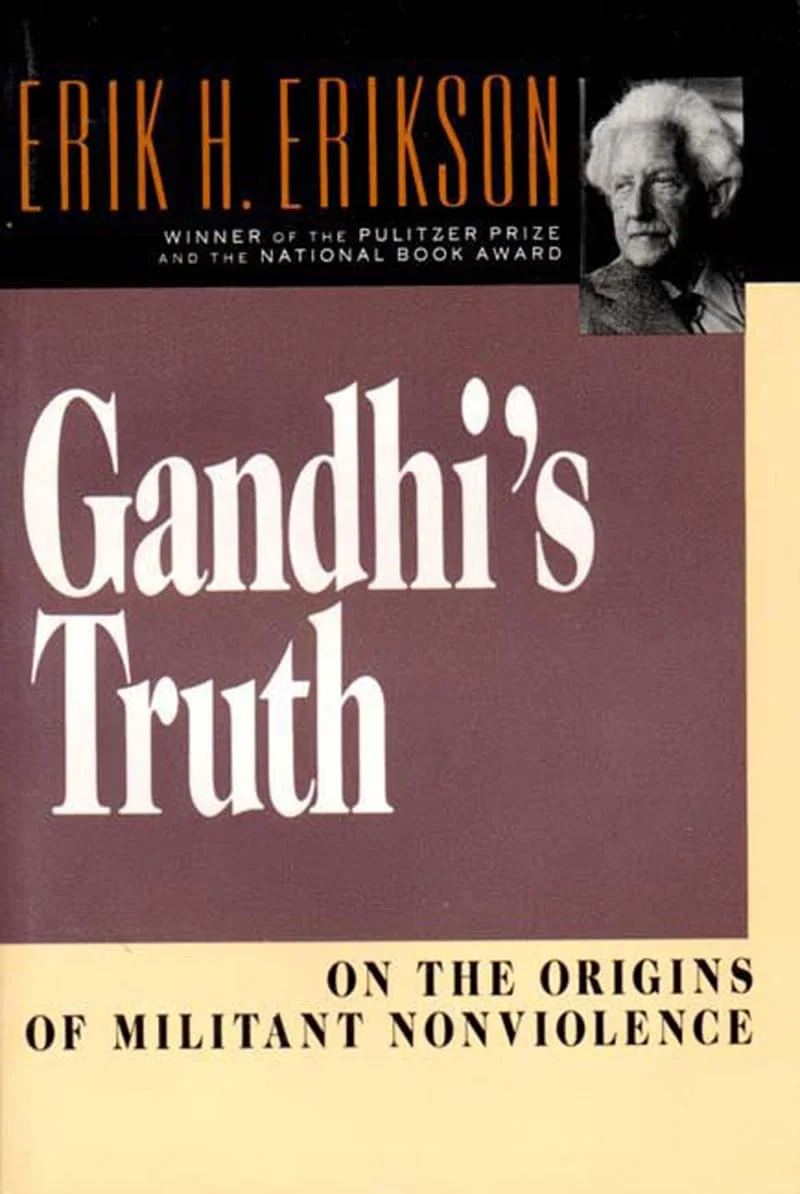
Gandhi's Truth: On the Origins of Militant Nonviolence
 Erik Erikson
Erikson's second psychobiography argues that the origins of Gandhi's militant nonviolence are legible in the 1918 Ahmedabad textile strike—a discrete event Erikson treats as a psychohistorical laboratory. Rather than tracing nonviolence to abstract ethics or Indian tradition alone, Erikson reads the fast as a ritualized resolution of Gandhi's lifelong struggle to master ambivalence toward his father, sexuality, and the exercise of power. The book extends Erikson's identity-crisis framework into political history, proposing that Gandhi's method worked precisely because it channeled personal conflict into a disciplined public form.
Key Details
Book Archives
View AllExplore detailed research articles, summaries and analyses from this book.


Related Books
View AllSimilar books from the same category, ranked by shared topics and reader engagement.



Key Insights — Read in 10 Minutes
What is the central claim of Gandhi's Truth, and what does it reject?
Erikson argues that Gandhi's method of militant nonviolence crystallized during the 1918 Ahmedabad textile strike, and that its psychological origins lie in Gandhi's lifelong negotiation of ambivalence toward his father, his sexuality, and his own capacity for aggression. The book rejects two prevailing explanations: that nonviolence was simply an inherited ethical doctrine, and that psychoanalytic biography must reduce greatness to pathology. Against the latter, Erikson insists that psychoanalysis can illuminate rather than dissolve a figure's moral authority. The Ahmedabad fast functions as what Erikson calls a 'revolutionary kind of human ritualization,' transforming inner conflict into a publicly disciplined political instrument.
How does Gandhi's Truth relate to Erikson's earlier work, particularly Young Man Luther?
The book is the second of Erikson's self-described experiments in 'psychohistory,' following Young Man Luther (1958). Where Luther examined the identity crisis of a young man in revolt against paternal and ecclesiastical authority, Gandhi's Truth shifts focus to a middle-aged leader and the consolidation, rather than the eruption, of identity. Erikson himself frames the later book as an extension of the earlier method: both treat a discrete historical episode as the prism through which a life's developmental logic becomes legible. But Gandhi's Truth is more explicitly political, concerned with how a private resolution of ambivalence becomes a public technique of power. Critics have noted that this shift also exposes the method to a different order of objection—not debunking, but overextension.
What specific concept or framework did the book introduce or popularize?
Gandhi's Truth did not coin 'psychohistory,' but it is the work that most forcefully demonstrated the method's ambition to interpret political action through the lens of individual psychosexual development. More specifically, it introduced the analysis of nonviolence as 'ritualization'—a concept Erikson uses to describe how Gandhi converted private compulsion into a repeatable, transmissible public form. The book also advanced Erikson's mature thinking on 'negative identity,' exemplified by Gandhi's adolescent friendship with Mehtab, the Muslim youth who tempted him toward meat and brothels. Erikson argues that embracing the negative identity is a necessary phase in identity formation, not merely a deviation to be corrected. The framework has been taken up by scholars of political ritual and leadership.
How has Gandhi's Truth been received and criticized since its publication?
The book won the 1970 Pulitzer Prize for General Nonfiction and the National Book Award in Philosophy and Religion, and was widely praised by figures including Christopher Lasch, Robert Jay Lifton, and Clifford Geertz. Lasch called it a work that 'shows that psychoanalytic theory, in the hands of an interpreter both resourceful and wise, can immeasurably enrich the study of great lives.' But the 'psychohistory' label soon attracted skepticism. A later review in Psychological Medicine dismissed its larger claim to explain 'the origins of militant nonviolence' as 'grossly inflated,' characterizing the method as 'little more than a piece of imaginative fiction.' The criticism crystallized a broader debate: whether Erikson's reconstructions illuminate or merely speculate, and whether the evidence base—Gandhi's autobiography and interviews with aging acquaintances—can sustain the interpretive weight placed upon it.
What did Erikson identify as the psychohistorical significance of the 1918 Ahmedabad strike?
Erikson treats the Ahmedabad textile strike as the 'event' that unlocks Gandhi's political method. Gandhi was forty-eight, recently returned from South Africa, and still not the Mahatma. The strike, over wages and working conditions, became the occasion for his first major public fast in India. Erikson reads the fast not as a tactic of coercion but as a ritual act of self-purification that Gandhi deployed to discipline both himself and his followers. The 'truth' of the title refers to Gandhi's insistence on the inseparability of means and ends, and Erikson's psychological wager is that this inseparability was lived before it was theorized—that Gandhi's own struggle to master desire, anger, and dependence produced the form of action he later articulated as satyagraha.
Is Gandhi's Truth a psychoanalytic biography in the traditional sense, and how does it treat its sources?
It is a psychoanalytic biography, but not of the debunking variety Erikson associated with early Freudian practitioners. Erikson's stated aim is to explain greatness rather than to reduce it to neurosis. He works primarily from Gandhi's autobiography and from interviews with surviving associates—'the witnesses,' as he calls them—conducted during visits to India. The book's structure reflects this: an 'Inquiry' section presents the sources and their limitations, followed by the 'Past' and the 'Event.' Erikson acknowledges the constructed nature of his reconstruction. The result reads less like a clinical case history than an extended essay on how a life becomes exemplary, and this hybrid form is precisely what later critics found both compelling and methodologically vulnerable.
Wealthy Psyche is an intellectual archive. We do not host, distribute, or sell book copies — physical or digital. We provide structured knowledge to help you think better, faster.