


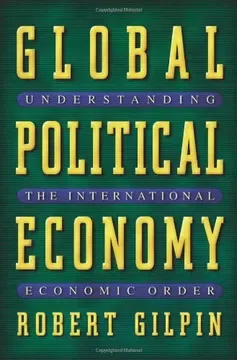
Global Political Economy: Understanding the International Economic Order
 Robert Gilpin
Gilpin's central argument is that national policies and domestic economies remain the most critical determinants of international economic affairs, and that economic globalization—while real—has been exaggerated and misunderstood. His state-centric realist framework holds that the nation-state is the dominant actor in both domestic and international economic affairs, and that markets and state policies together constitute the driving forces of the global economy. The book surveys the major approaches to international political economy and applies them to trade, money, finance, multinational corporations, development, and regional integration, concluding that globalization rests on a political foundation that could disintegrate if major powers fail to maintain it.
Key Details
Related Books
View AllSimilar books from the same category, ranked by shared topics and reader engagement.



Key Insights — Read in 10 Minutes
What is the central claim of Global Political Economy, and what does it reject?
Gilpin argues that national policies and domestic economies remain the most critical determinants of economic affairs, and that economic globalization has been exaggerated and misunderstood. He rejects the view—associated with writers like Thomas Friedman and Kenichi Ohmae—that globalization is rendering the nation-state obsolete. His 'state-centric realism' holds that the nation-state remains the dominant actor in both domestic and international economic affairs, and that the interactions of markets and state policies constitute the driving forces of the international economy [citation:6][citation:18].
What does Gilpin mean by 'state-centric realism,' and how does it differ from Kenneth Waltz's systemic realism?
Gilpin's state-centric realism emphasizes the nation-state as the primary actor in international economic affairs and identifies with the classical realist tradition of Thucydides, Machiavelli, and Hans Morgenthau. A reviewer notes that Gilpin 'identifies with authors like Thucydides, Machiavelli, and Hans Morgenthau, but not with what he calls the systemic realism of authors like Kenneth Waltz' [citation:6]. Where Waltz focuses on the structure of the international system as the determinant of state behavior, Gilpin gives more weight to domestic policies, national systems of political economy, and the interaction between states and markets.
How does this book relate to Gilpin's earlier The Political Economy of International Relations (1987)?
Global Political Economy is explicitly the successor to Gilpin's 1987 classic. The world economy and political system changed dramatically in the intervening years—the end of the Cold War unleashed new forces, new regionalisms emerged, and computing power transformed economic affairs. Gilpin wrote the 2001 book to account for these developments. One reviewer described it as 'an outstanding update of the author's earlier book' and 'a major and successful updating of The Political Economy of International Relations' [citation:1][citation:6]. While the 1987 book forecast benign mercantilism, the 2001 book offers a more comprehensive survey of the new global economy.
Why does Gilpin argue that economic globalization has been exaggerated?
Gilpin contends that many claims about globalization—both from its defenders and its critics—are false or exaggerated. He notes that globalization is not new (a similar wave occurred in the late nineteenth century), is not irreversible, and does not replace the differences between states. He emphasizes that 'globalization rests on a political foundation that could disintegrate if the major powers fail to strengthen their economies and political ties' [citation:18]. He also points out that the state was actually stronger in the twentieth century than in the nineteenth, as measured by public sector share of GDP, which rose from around 10 percent to nearly 50 percent.
What is the common misconception about Global Political Economy that Gilpin's framework corrects?
A common misconception is that globalization is an impersonal force eroding national sovereignty and making the nation-state irrelevant. Gilpin's state-centric realism directly challenges this view. He argues that domestic policies largely determine the effects of globalization, and that politicians often blame impersonal global forces for changes that are actually driven by domestic political choices. A review in the Spanish journal ICE notes that Gilpin believes 'the domestic effects of globalization are, in large part, determined by the states themselves, although they blame impersonal processes' [citation:18]. This reframing restores agency to national governments.
How has the book been received by scholars in international political economy?
Reception has been strongly positive. Jeffrey Hart in the Journal of Politics wrote that it is 'an excellent book' and 'a major and successful updating' of Gilpin's earlier work [citation:1][citation:6]. Martin Rhodes called it 'magisterial,' praising Gilpin as 'second to none in his capacity to integrate political with economic analysis' [citation:1]. Christopher Layne in The Atlantic Monthly described it as 'a needed antidote to Thomas Friedman's The Lexus and the Olive Tree and other facile works about the subject' [citation:1][citation:10]. Arthur Cyr in Orbis praised it as 'extremely well written, lucid, and persuasive' [citation:1].
Wealthy Psyche is an intellectual archive. We do not host, distribute, or sell book copies — physical or digital. We provide structured knowledge to help you think better, faster.