


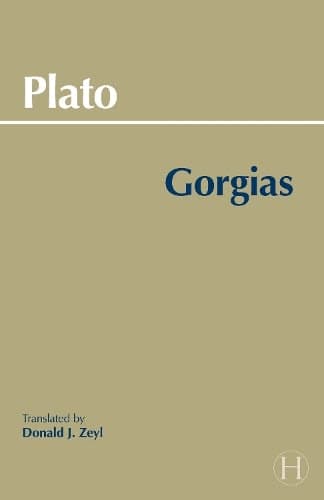
Gorgias

Plato's Gorgias is not a treatise on rhetoric but a dramatic indictment of the life devoted to power without knowledge. Its mechanism is a sequence of escalating confrontations: Gorgias defends rhetoric as the art of persuasion, Polus defends the tyrant's happiness, and Callicles defends the law of nature whereby the strong rightly dominate the weak. Socrates counters each with the paradox that it is better to suffer wrong than to do it, and that the unjust man who escapes punishment is more miserable than the one who is punished. The dialogue ends with a myth of judgment, leaving rhetoric exposed as flattery and philosophy vindicated as the only true art of living.
Key Insights
✦What is the central claim of the Gorgias, and what does it reject?
The dialogue's spine is the argument that rhetoric, as practiced by Gorgias and his associates, is not an art (technē) but a knack of flattery, a shadow of politics that aims at pleasure rather than the good of the soul . Socrates rejects the assumption that power—the ability to do what one likes—is the same as happiness. Against Polus, he argues that it is better to suffer wrong than to do it, and that the unjust man who escapes punishment is more miserable than the one who is punished, since punishment is a release from evil . Against Callicles, he argues that the life of unbridled desire is not freedom but slavery, and that temperance and order are the true conditions of a well-lived life.
✦Who is Callicles, and why is his confrontation with Socrates the dialogue's dramatic core?
Callicles is the most formidable of Socrates' three interlocutors, a young Athenian democrat who advances a radical position: nature reveals that the strong and capable should have more than the weak, and conventional morality is merely a conspiracy of the many to enslave the few . He explicitly rejects temperance, arguing that the good life consists in the maximum fulfillment of desire. His confrontation with Socrates is the dialogue's core because he articulates a position that is both coherent and deeply opposed to Socratic ethics. Unlike Polus, who is easily refuted and ashamed, Callicles is unashamed and willing to say what most people think but will not admit . The dialogue's vindication of philosophy depends on defeating him.
✦What are the paradoxes Socrates defends, and how does he justify them?
Socrates defends two paradoxes that Polus finds absurd: first, that it is better to suffer wrong than to do wrong; second, that the unjust man who is punished is happier than the one who escapes punishment . The justification turns on a distinction between what is disgraceful and what is evil. Polus admits that doing wrong is more disgraceful than suffering it, which implies it is also more evil, since the disgraceful is a species of the evil. From this it follows that the wrongdoer is worse off than the victim. The second paradox follows from the first: punishment is a cure for the soul, a release from the disease of injustice, and therefore beneficial to the one punished. To escape punishment is to remain diseased.
✦How does the Gorgias relate to the Phaedrus, and is it a rejection of rhetoric altogether?
The Gorgias is often read as a blanket condemnation of rhetoric, with the Phaedrus supplying a later, more balanced reassessment. This reading is too simple. The Gorgias distinguishes between rhetoric as flattery—the mere knack of producing gratification—and a true art of rhetoric grounded in knowledge of the soul, though Socrates says no practitioners of the latter can be found . The Phaedrus, written later, develops this possibility more fully, describing a genuine rhetoric that leads souls toward truth through dialectic. The two dialogues are not contradictory but complementary: the Gorgias clears away the false claim to art, and the Phaedrus sketches what a legitimate art of discourse would require .
✦What are the main English translations of the Gorgias, and how do they differ?
The Gorgias has been translated many times, with notable editions including Terence Irwin's Clarendon translation (1979), which is known for its philosophical notes and literal fidelity; Donald Zeyl's Hackett edition (1987), widely used in classrooms; Robin Waterfield's Oxford World's Classics version (1994), which balances readability with accuracy ; and James Arieti and Roger Barrus's Focus edition (2007), which includes an interpretive essay. E. R. Dodds's 1959 Oxford edition remains the standard scholarly commentary on the Greek text . The main translation challenges concern the dialogue's rhetorical register—Socrates' long speeches toward the end, which some readers find un-Socratic—and the technical vocabulary of the arts and flatteries distinction.
✦What is the significance of the myth that concludes the dialogue?
The Gorgias ends with a myth of judgment in which naked souls are judged by naked judges after death, with the wicked sent to Tartarus for punishment and the good to the Isles of the Blessed. The myth is not an afterthought but a structural necessity. Socrates has argued throughout that justice matters more than power and that punishment is a cure, but he cannot demonstrate the full consequences of these claims within the limits of this life. The myth supplies the eschatological frame that makes the argument complete: it shows that the unjust man who thrives in this world will not escape in the next. The myth also links the dialogue to the Republic's closing myth of Er, which performs a similar function .
Wealthy Psyche is an intellectual archive. We do not host, distribute, or sell book copies — physical or digital. We provide structured knowledge to help you think better, faster.