


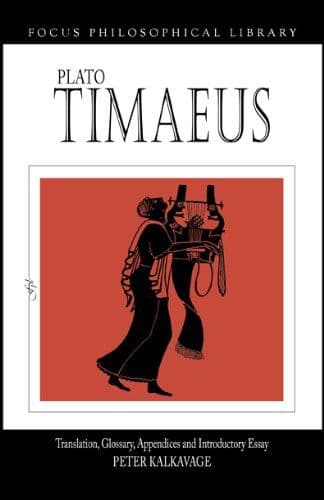
Timaeus

Plato's Timaeus is not a creation story in the familiar sense but a 'likely account' of how Intellect imposes order on Necessity. Its mechanism is a cosmological genealogy: a Craftsman (Demiurge), looking to an eternal model, fashions a living, spherical universe by persuading brute material necessity to serve rational purpose. The dialogue introduces the Receptacle—a 'third kind' that is neither Being nor Becoming but the spatial field in which becoming occurs—and derives the four elements from geometric solids composed of triangles. The result is a cosmology that grounds physics in mathematics and ethics in cosmic order, while repeatedly disclaiming its own certainty.
Key Insights
✦What is the central claim of the Timaeus, and what does it reject?
The dialogue's spine is the claim that the visible cosmos is the product of Intellect (nous) persuading Necessity (anankē)—that reason, not blind chance, is the primary cause of order, though reason must work with the intractable properties of its materials . Timaeus rejects the materialist assumption that physical causes alone explain the world; he insists that a proper account must first invoke intelligent purpose and only then the 'contributing causes' of necessity. Equally, the dialogue rejects any claim to certainty about its own story. Timaeus repeatedly calls his account a 'likely story' (eikōs muthos), acknowledging that a treatise about becoming can only be probable, not demonstrable like a mathematical proof.
✦What is the Receptacle, and why is it so difficult to interpret?
The Receptacle (chōra) is introduced as a 'third kind' alongside the eternal Forms and their sensible images, and it is described as the 'nurse of all becoming'—a featureless, spatial medium that receives impressions without itself having any character . Its difficulty is structural: Timaeus says it is grasped 'without sense perception, by a kind of bastard reasoning,' and his own account of it is admittedly obscure. Interpreters have long disputed whether it is best understood as matter, as space, or as a combination of both, and the Stanford Encyclopedia notes that the account 'presents several interpretive difficulties' . The uncertainty is not a defect to be corrected but part of the dialogue's demonstration of the limits of cosmological discourse.
✦How does the dialogue's 'likely story' status affect its philosophical authority?
The 'likely story' framing is not a modesty trope but a methodological commitment. Timaeus explicitly distinguishes between the unchanging realm of Being, which can be known with certainty, and the changing realm of Becoming, of which only a probable account is possible. This means the cosmology is not presented as a rival to mathematics or dialectic but as a discourse appropriate to its object. The Internet Encyclopedia of Philosophy notes that Timaeus even describes his own conclusions as a 'vote' (psēphos) rather than a demonstration, inviting his audience to judge the beauty and persuasiveness of his story rather than its truth . Readers who demand certainty from the Timaeus misunderstand what kind of text it is.
✦How does the Timaeus relate to the Republic, and is it a sequel?
The Timaeus is the first part of a projected trilogy, followed by the Critias (itself unfinished) and a never-written Hermocrates . In the dialogue's opening, Socrates recalls a conversation from 'yesterday' that closely matches the Republic, and Critias proposes to show the ideal state of that conversation in action against Atlantis. The Timaeus thus supplies the cosmological and anthropological groundwork for the political narrative that was to follow: the creation of the universe, the human soul, and the body provide the context within which the ideal city's citizens are to be understood. The connection is thematic rather than dramatic, but it positions the cosmology as a foundation for political philosophy rather than a standalone natural science.
✦What are the main English translations and commentaries on the Timaeus?
The Timaeus has a rich translation history. The Loeb Classical Library edition by R. G. Bury (1929) provides the Greek text with a facing English translation. The most influential twentieth-century English commentary is F. M. Cornford's Plato's Cosmology (1937), which remains a standard reference . A. E. Taylor's Commentary on Plato's Timaeus (1928) is also historically important. More recent translations include Donald Zeyl's Hackett edition (2000) and Peter Kalkavage's Focus edition (2001), both widely used in classrooms. The main translation challenges concern the technical vocabulary—chōra, anankē, eikōs muthos—and the mathematical passages describing the world-soul and the geometric solids, where English must render a Greek that is itself highly compressed and technical.
✦What is a common misreading of the Timaeus's creation story?
A persistent misreading treats the Demiurge as a creator God in the monotheistic sense, bringing the universe into being ex nihilo at a specific moment in time. The text does not support this. The Demiurge is better understood as a personification of Intellect or rational ordering, and the question of whether the creation is a temporal event or a metaphor for an eternal dependence is one of the oldest interpretive problems in the dialogue's reception . The Greek word often translated as 'created' can mean 'ordered' or 'established,' and the pre-cosmic state Timaeus describes is not absolute nothingness but a disorderly motion of traces. Reading the Timaeus through later theological categories distorts its philosophical project.
Wealthy Psyche is an intellectual archive. We do not host, distribute, or sell book copies — physical or digital. We provide structured knowledge to help you think better, faster.