


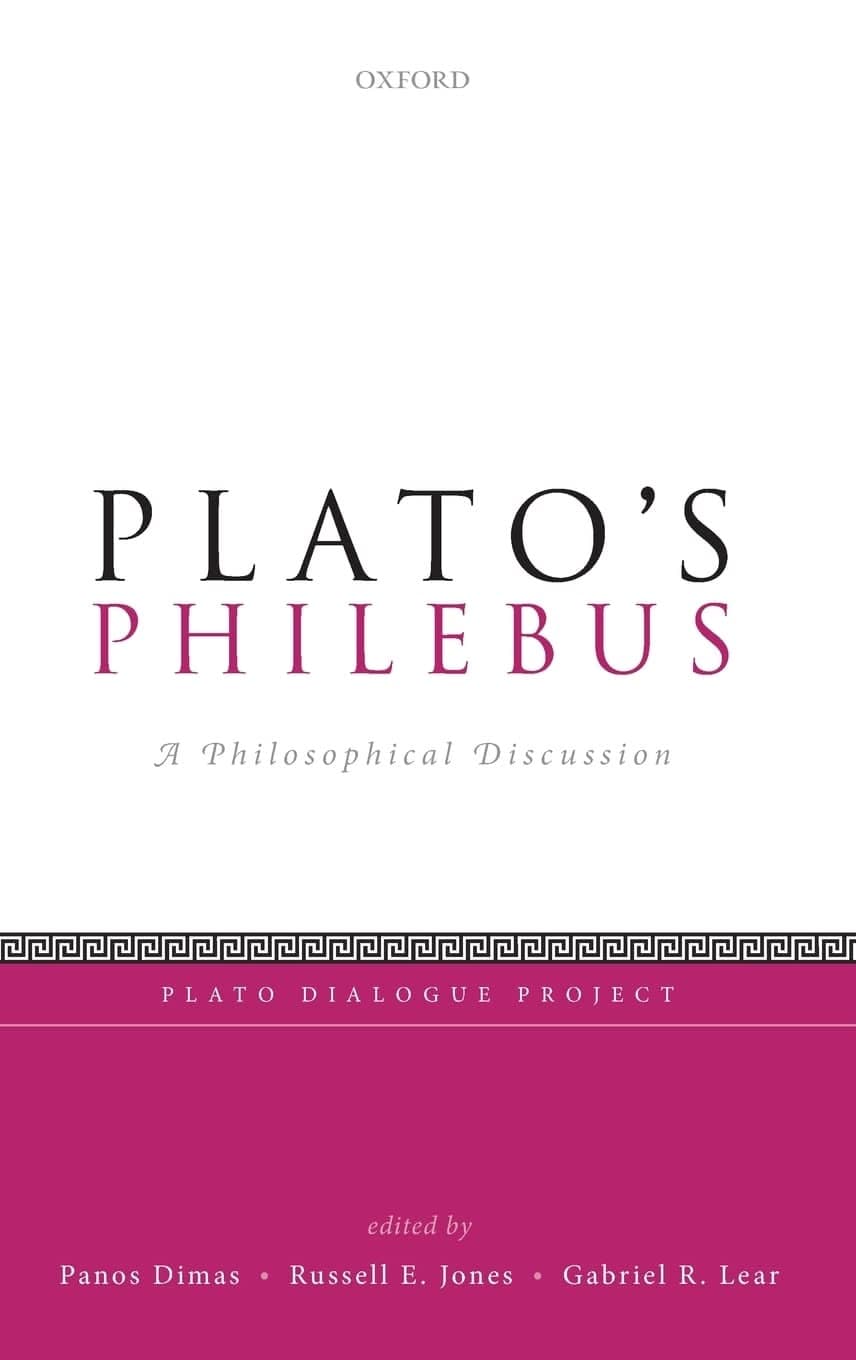
Philebus

Plato's late dialogue stages a contest between pleasure and wisdom for the title of the human good, but its real mechanism is a metaphysical classification. Socrates does not simply side with mind against pleasure; he argues that the good life is a measured mixture of both, with mind as the cause that orders the mixture and pleasure relegated to the indefinite class that requires limit. The dialogue introduces the fourfold ontology of Limit, the Unlimited, their Mixture, and the Cause of mixture—a framework that makes the good intelligible as measure and proportion rather than as a single sensation or cognition. The result is a philosophy of the good as structured harmony.
Key Insights
✦What is the central claim of the Philebus, and what does it reject?
The dialogue's spine is the argument that neither pleasure nor intelligence alone constitutes the human good; the good life is a measured mixture of both, ordered by mind. Socrates rejects Philebus' hedonism, which treats pleasure as the supreme good, by showing that a life of pure pleasure without memory or intelligence would be no better than an oyster's . He equally rejects a life of pure thought devoid of pleasure as insufficient. The compound life is superior to either element alone, but within that compound, mind is the cause of order and is more akin to the good than pleasure, which belongs to the indefinite class requiring limit .
✦What specific ontological framework does the Philebus introduce to analyze the good?
The dialogue introduces a fourfold classification of all that exists: the Limit (peras), the Unlimited (apeiron), the Mixture (meikton) generated by their union, and the Cause (aitia) of that mixture . Limit includes all that has number and measure; the Unlimited is the class of the more and less, the indefinite. Health, strength, harmony, and beauty belong to the Mixture, where limit gives law to the indefinite. Mind or intelligence is identified with the Cause, the agent that orders the mixture. This framework allows Socrates to locate pleasure in the Unlimited—it is inherently indefinite and requires limit to become good—while locating mind in the Cause, which is akin to the good itself .
✦How does the Philebus relate to the Republic's account of the Form of the Good?
The Philebus has been read as the dialogue in which Plato finally puts to work the science of the good that the Republic programmatically announces but does not fully elaborate. Delcomminette argues that the Republic shows dialectic can be a science of the Good, but Socrates explicitly refuses to embark on that path there; the Philebus is where that discussion is actually carried out . Corrigan similarly treats the Philebus as a companion piece to the Republic, returning to the problem of the Good in a new way . The later dialogue does not present a vision of the Good beyond being, as the Republic's analogy of the sun does, but analyzes the good as measure, proportion, and ordered mixture—a more discursive and structural account.
✦What role does the 'one and many' method play in the dialogue?
The method of collection and division—grasping a single Form and then dividing it into its natural kinds—is introduced as a divine gift, a way of proceeding that distinguishes dialectic from eristic . Socrates insists that one must not pass directly from unity to infinity or from infinity to unity, but must find the intermediate number and kinds. The example of music illustrates the point: knowing that sound is one is not enough; one must know the intervals, the systems, and the rhythms. This methodological passage is crucial for the dialogue's argument because it establishes the procedure by which pleasure and knowledge must be analyzed before their claims to the good can be adjudicated.
✦What are the main English editions and translations of the Philebus?
R. Hackforth's translation and commentary, first published in 1945 as Plato's Examination of Pleasure and reprinted in 1958, remained a standard scholarly edition for decades and was reissued in paperback in 2011 . The Hackforth edition includes a running commentary on the argument and a full introduction explaining the dialogue's philosophical background . Benjamin Jowett's nineteenth-century translation is widely available in public-domain editions . More recent translations include those by Dorothea Frede and C. C. W. Taylor, which incorporate developments in Platonic scholarship. The main translation challenges concern the technical vocabulary of the fourfold ontology—peras, apeiron, meikton, aitia—and the precise rendering of the distinction between true and false pleasures in the middle section of the dialogue.
✦What is a common misreading of the dialogue's treatment of pleasure?
A persistent misreading treats the Philebus as a simple rejection of pleasure in favor of reason, a late Platonic restatement of asceticism. This misses the dialogue's compound conclusion. Socrates explicitly grants that the good life includes pleasure; what he denies is that pleasure is the good or that it can be pursued without measure. The critique of hedonism targets the view that pleasure is sufficient for happiness, not the presence of pleasure in a well-ordered life. Some pleasures—those that accompany measure and understanding—are admitted into the mixed life. The dialogue's complexity lies in its discrimination among kinds of pleasure, not in a blanket condemnation. Reading it as anti-hedonist simpliciter flattens its argument.
Wealthy Psyche is an intellectual archive. We do not host, distribute, or sell book copies — physical or digital. We provide structured knowledge to help you think better, faster.