


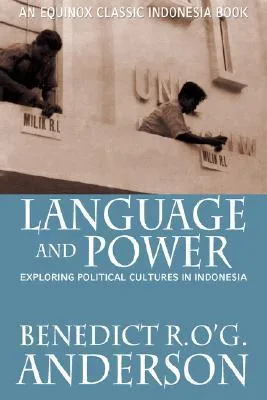
Language and Power: Exploring Political Cultures in Indonesia
 Benedict Anderson
Published in 1990, Language and Power collects eight of Benedict Anderson's influential essays on Indonesian political culture, written between the 1960s and 1980s. Anderson's central argument is that Indonesian politics cannot be understood without grasping the tension between two opposed cultural systems: the hierarchical, 'fossilised' Javanese court culture inherited from the precolonial past, and the egalitarian, modern national language Bahasa Indonesia through which the nation was imagined. Power in traditional Java was conceived not as an abstract force but as a concrete, finite substance concentrated in the ruler. Anderson shows how the New Order state revived this older idiom, 'kramanising' official language and symbolism to legitimate authoritarian rule.
Key Details
Related Books
View AllSimilar books from the same category, ranked by shared topics and reader engagement.



Key Insights — Read in 10 Minutes
What is the central argument of Language and Power about Indonesian politics?
Anderson argues that Indonesian politics is shaped by the clash between two cultural systems: the hierarchical, Javanese court culture of the precolonial past and the egalitarian national language, Bahasa Indonesia, through which the modern nation was imagined. In traditional Javanese thought, power was a concrete, finite substance concentrated in the ruler rather than an abstract capacity. The New Order state revived this older idiom, 'kramanising' official language and symbolism to legitimise authoritarian rule, even as the national language remained the vehicle for modern, egalitarian political imagination.
What does Anderson mean by the 'idea of power in Javanese culture'?
In the book's foundational first essay, Anderson argues that Javanese tradition conceives of power as a concrete, homogeneous substance that exists in fixed quantity. It is not a relationship or an abstract capacity but something possessed and concentrated in a person. The ruler's authority depends on accumulating and conserving this substance through ascetic practice, ritual, and the display of wahyu (divine radiance). This contrasts sharply with Western political thought, where power is relational and generated through institutions. Anderson uses this Javanese concept to explain why post-independence Indonesian politics often appeared irrational or chaotic from a Western analytic perspective.
How does Anderson explain the 'kramanisation' of Indonesian political language?
Anderson argues that the New Order regime under Suharto revived archaic Javanese linguistic forms to create social distance between rulers and ruled. The official language became increasingly 'krama inggil' — high Javanese — filled with Sanskrit fossils and elaborate abbreviations like ipoleksosbudhankam. This 'kramanisation' served to lend 'additional wahyu' to state power, wrapping authoritarian rule in the aura of traditional Javanese legitimacy. Meanwhile, Bahasa Indonesia, originally a bazaar Malay lingua franca and an egalitarian 'ironising' language, became the medium for modern nationalist imagination. The two linguistic registers coexisted in tension within the same political system.
Why did Anderson write that contemporary Javanese had no words for politics, colonialism, or society in the early nineteenth century?
Anderson observes that the Javanese language lacked indigenous vocabulary for concepts like 'politics,' 'colonialism,' 'society,' and 'class' until the nineteenth century. This absence reveals how fundamentally different the traditional Javanese conceptual world was from the modern political vocabulary introduced through colonial contact and nationalist mobilisation. It also underscores Anderson's broader argument that modern Indonesian political culture is not a simple continuation of tradition but a complex negotiation between inherited Javanese categories and imported modern concepts, mediated by language.
How does this book relate to Anderson's more famous Imagined Communities?
Language and Power and Imagined Communities were written around the same period, but they differ in scope. Imagined Communities offers a general theory of nationalism centred on print capitalism and the Americas. Language and Power is exclusively focused on Indonesia and Java, offering fine-grained analyses of specific texts, monuments, and cartoons. Yet the concerns overlap: both explore how national consciousness is formed and how language mediates political imagination. Reviewers noted that the essays in Language and Power, while written for Southeast Asianists, address themes with parallels throughout the world.
How was Language and Power received by scholars?
Reviews were generally positive but noted the book's lack of cohesion. A CHOICE review observed that the essays 'lack cohesion' and might have been organised into a more unified book, though the fourteen-page introduction was found to be the most interesting section. Robert Hefner praised the essays as offering 'new insights into traditional political culture and its modern reformulation' but noted that Anderson's analysis did not extend to political economy or ethnographic literature. The volume was republished in 2006 as part of Equinox Publishing's Classic Indonesia series.
Wealthy Psyche is an intellectual archive. We do not host, distribute, or sell book copies — physical or digital. We provide structured knowledge to help you think better, faster.