


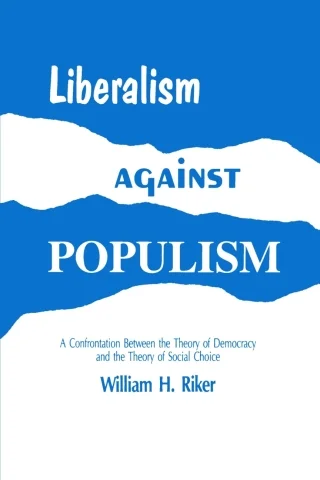
Liberalism Against Populism
 William H. Riker
Liberalism Against Populism argues that the populist conception of democracy—that voting reveals a collective will or public good—is incoherent, because social choice theory shows that majority rule can be arbitrary, cyclical, and manipulable. Riker's central claim is that democracy should be understood instead as a liberal mechanism for removing officials, not for discovering a popular will. Its federalism significance is indirect but important: Riker's skepticism about a single national popular will undermines the case for centralized majoritarian government and supports constitutional restraints, divided institutions, and federal checks as devices that limit the arbitrariness of democratic outcomes.
Key Details
Related Books
View AllSimilar books from the same category, ranked by shared topics and reader engagement.
.webp?alt=media&token=aa57557c-98c6-4edb-ba61-0189bc741142)
.webp?alt=media&token=fe90549a-9842-4d96-b442-a481f7724ad7)
Key Insights — Read in 10 Minutes
What is the central claim of Liberalism Against Populism, and what does it reject?
Riker argues that populist democracy—the idea that voting discovers a collective will or public good—is incoherent because social choice theory shows majority rule can be arbitrary, cyclical, and manipulable through heresthetics. He rejects the notion that elections reveal a determinate popular will. Instead, he defends liberal democracy, understood as a set of institutions for removing officials and checking power, not for expressing a unified popular voice. Democracy's value lies in its ability to reject rulers, not in discovering what the people truly want.
What specific concepts did Riker develop in this book?
Riker developed heresthetics—the strategic manipulation of political dimensions and agendas to win, sometimes against majority preference—and applied social choice results such as Condorcet cycles and Arrow's theorem to democratic theory. He distinguished liberal from populist democracy, arguing the former is defensible and the latter not. These concepts became central to positive political theory, and heresthetics is widely used in studies of agenda-setting, coalition-building, and constitutional design. The book is a landmark in applying formal theory to normative democratic questions.
How does Liberalism Against Populism connect to Riker's work on federalism?
Riker's skepticism about a single national popular will supports the federalist case for divided institutions. If majority rule can be arbitrary and manipulable, then constitutional restraints, separated powers, and federal checks acquire a liberal justification: they limit the damage democratic majorities can do. Federalism becomes a device for preserving multiple arenas of decision rather than expressing one popular will. This connects to Riker's earlier coalition and federal bargain work, though the connection is analytic rather than explicit in the text itself.
How has Liberalism Against Populism been received since its publication?
The book is widely regarded as a major statement of the rational-choice critique of populist democracy and is standard reading in democratic theory. It has been criticized for overreading social choice results—arguing from the possibility of cycles to a sweeping indictment of majoritarian democracy—and for underestimating deliberation and institutional stability. Defenders say it exposes genuine incoherence in populist claims. Its influence is broad in political science, though its normative conclusions remain contested by deliberative and participatory democrats.
What is a common misconception about Riker's argument?
A common misconception is that Riker is against democracy altogether. He defends liberal democracy as a system for removing officials and checking power; what he rejects is the populist claim that voting reveals a collective will. Another misreading treats his use of social choice theory as proving majorities are always irrational. He argues that majority outcomes can be arbitrary and manipulable, not that they always are. His target is a specific conception of democracy, not democratic government as such.
What real-world practices does Riker's argument help explain?
Heresthetics helps explain agenda control in legislatures, strategic sequencing of votes, constitutional design that constrains majorities, and the role of courts in reviewing democratic decisions. Riker's liberal-democratic account is invoked in debates over judicial review, referendum design, and institutional checks. His skepticism about a single popular will also informs arguments for federalism and separation of powers as restraints on arbitrary majority rule. The book is used in positive political theory, constitutional political economy, and comparative studies of democratic institutions.
Wealthy Psyche is an intellectual archive. We do not host, distribute, or sell book copies — physical or digital. We provide structured knowledge to help you think better, faster.