


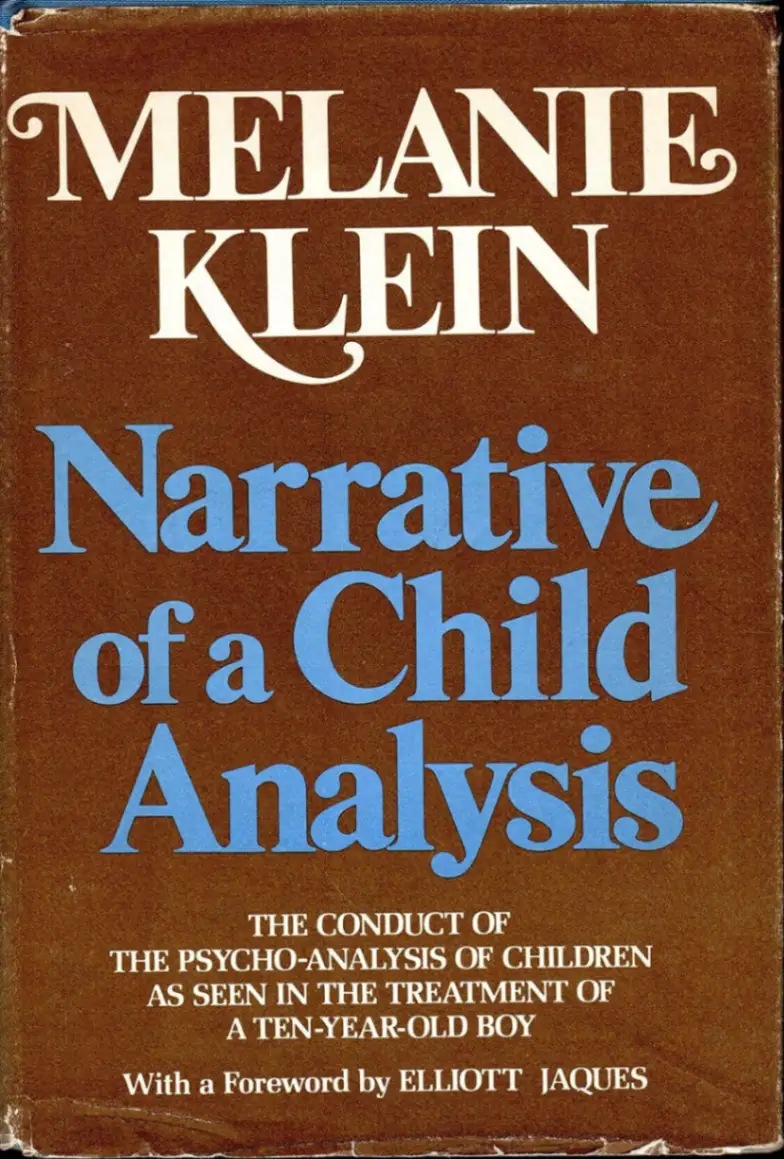
Narrative of a Child Analysis: The Conduct of the Psycho-Analysis of Children as Seen in the Treatment of a Ten-Year-Old Boy
 Melanie Klein
Klein's last book is a session-by-session record of her 1941 analysis of a ten-year-old boy called Richard, conducted in a Girl Guides' hut in Pitlochry during the London Blitz. The book's central claim is that children's play, drawings, dreams, and verbal associations carry the same latent unconscious content as adult free association, and that interpreting them directly—including negative transference and primitive fantasy—can alleviate anxiety without educative guidance. Klein adds retrospective notes indicating where her views had changed, making the volume a document of technique-in-action rather than a polished theoretical treatise.
Key Details
Book Archives
View AllExplore detailed research articles, summaries and analyses from this book.


Related Books
View AllSimilar books from the same category, ranked by shared topics and reader engagement.



Key Insights — Read in 10 Minutes
What is the central claim this book is designed to demonstrate?
The book is Klein's deliberate demonstration that play analysis works with a latency-age child in the same way free association works with adults. Richard's drawings, play with toys, dreams, and verbal slips are all treated as vehicles of unconscious fantasy—primitive Oedipal wishes, aggression, and anxiety about parental sexuality. Klein's technique, as shown across 93 sessions, involves direct interpretation of both positive and negative transference from the very beginning, without a preparatory phase or educative influence. The volume was planned as a companion to The Psycho-Analysis of Children (1932), where Klein had described the technique and its findings; the Narrative shows the technique in action, session by session, rather than restating theory .
What were the circumstances under which the analysis took place, and how do they shape the record?
The analysis was conducted in 1941 in Pitlochry, Scotland, where both Klein and Richard's family had relocated to escape the London Blitz. Sessions took place in a Girl Guides' hut, and the war is a continuous presence in the material—Richard's fantasies of submarines, battleships, and air raids dominate many sessions . Richard was ten years old, separated from his parents for periods, and unable to attend school due to anxiety. Klein records that she had enquired about his birth, weaning, and earliest years before beginning, but in the sessions she works entirely with the child Richard presents in the room, not with a reconstructed infantile history . The wartime setting gives the narrative its distinctive layering: analyst and patient, child and parents, and the war itself.
How did Melanie Klein's followers and later analysts receive the Narrative?
Hanna Segal and Donald Meltzer, reviewing it in the International Journal of Psycho-Analysis in 1963, described it as a volume that comes 'as a gift and as a responsibility' to analysts for whom Kleinian developments were central . They noted it could be read in different ways depending on the reader's familiarity with Klein's line of development, and that for students it would be 'overwhelming in detail' . Peter Blos, reviewing it alongside The Psycho-Analysis of Children in 1976, called both volumes 'a veritable gold mine of useful information' for psychotherapeutic work with children and adults . More critical reception emerged from analysts like André Green, who argued that Klein's constant transference interpretation placed the patient under 'unbearable pressure,' giving the analysis 'an aspect of persecution' even when interpretations were designed to help .
What is the most contested aspect of Klein's interpretations in this book?
The frequency and content of Klein's Oedipal interpretations have drawn sustained criticism. In one session, Richard looks at a map of Europe upside-down and says the shape is 'not proper,' 'muddled and mixed up'; Klein interprets this as his parents' sexual intercourse and his wish to have intercourse with her . André Green's critique is that such interpretations, delivered in rapid succession, impose the analyst's theoretical framework on the child's material rather than following it. Peter Blos noted that Klein did not speak to Richard of fears of father hitting or scolding him, but referred everything to the most primitive level of attack via the phallus . He also found it objectionable that Klein attributed complex Oedipal thought to the first year of life, calling it 'patently absurd' to attribute such reasoning to an infant's mind .
What is the publication and editorial history of the Narrative?
Klein composed the book from her session notes approximately fifteen years after the analysis, and it was published posthumously in 1961 by Hogarth Press . The volume runs 496 pages and includes 74 drawings by Richard, reproduced in the text . Klein added notes indicating where her views had changed since the analysis, making the book a layered document of technique and retrospective self-commentary . A 1975 edition was published by Delacorte Press/S. Lawrence as part of The Writings of Melanie Klein series, with a foreword by Elliott Jaques . The book is written in the third person, with Klein referring to herself as 'Mrs K.,' a stylistic choice that lends the narrative a clinical distance while still recording her feelings and technical dilemmas.
What does the book reveal about Klein's technique in contrast to Anna Freud's approach?
The Narrative is a practical demonstration of the technique Klein had defended in her disputes with Anna Freud since the late 1920s. Anna Freud held that children required a preparatory phase to establish positive transference before 'real analysis' could begin, and she dealt with negative impulses by strengthening the positive attachment . Klein rejected both positions. In the Narrative, she interprets negative transference from the first session, without educative or reassuring measures. The book thus serves as evidence in the long-running Controversial Discussions: it shows what Klein's technique actually looks like in practice, across nearly a hundred sessions, with a child who is articulate, anxious, and caught in the upheaval of wartime separation.
Show 1 more insights
What happened to Richard after the analysis, and does the book's publication raise ethical questions?
Richard, whose real identity remained private for decades, attended the 1987 unveiling of a plaque commemorating Klein's work in Pitlochry. According to accounts, he had been unaware that his analysis had been published as a book until Phyllis Grosskurth, Klein's biographer, told him and gave him a copy of the Narrative . His presence at the ceremony was low-key, and he watched discreetly from the back . The episode raises the question of consent: Richard was a child when the analysis took place, and the book was published after Klein's death without the patient's knowledge or authorization. The Narrative remains a foundational clinical document, but its status as a detailed record of a named individual's childhood therapy is ethically complicated in ways Klein's contemporaries did not confront.
Wealthy Psyche is an intellectual archive. We do not host, distribute, or sell book copies — physical or digital. We provide structured knowledge to help you think better, faster.