


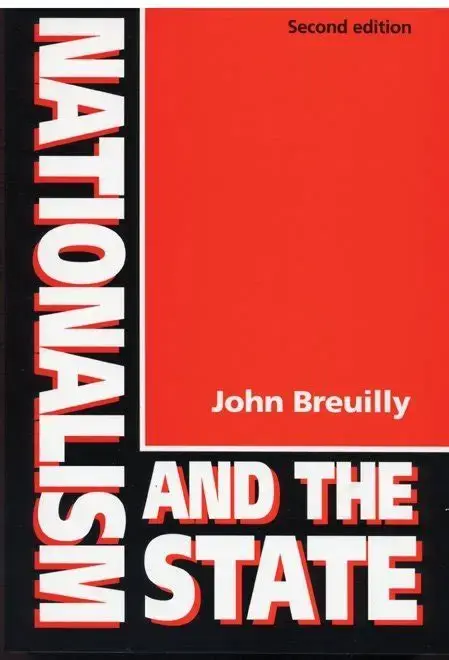
Nationalism and the State
 John Breuilly
John Breuilly's 1982 study advances a distinctive political theory of nationalism: nationalism should be understood as a form of politics that arises in opposition to the modern state, not as an expression of pre-existing cultural identity. Breuilly argues that elites, social groups, and foreign governments use nationalist appeals to mobilize popular support against the state. Nationalism, on this account, is a means of creating a sense of identity rather than a reflection of it. The book develops a typology of nationalist movements—separatist, reform, and unification—and supports its argument with comparative historical analysis spanning early modern Europe to post-Soviet resurgence.
Key Details
Related Books
View AllSimilar books from the same category, ranked by shared topics and reader engagement.



Key Insights — Read in 10 Minutes
What is the central claim of Nationalism and the State?
Breuilly argues that nationalism should be understood as a form of politics that arises in opposition to the modern state, not as an expression of pre-existing cultural identity . He challenges the conventional view that nationalism emerges from a sense of cultural identity. Rather, elites, social groups, and foreign governments use nationalist appeals to mobilize popular support against the state. Nationalism, then, is a means of creating a sense of identity. This political theory of nationalism places the state—and the struggle for or against state power—at the center of analysis, distinguishing Breuilly from culturalist and structuralist accounts alike.
What specific typology of nationalism does Breuilly develop?
Breuilly develops a typology of nationalist movements based on their aims and their relationship to existing political organization. He identifies three main types: separatist nationalism, which seeks independence from an existing state; reform nationalism, which seeks to transform an existing state from within; and unification nationalism, which seeks to merge separate political units into a single new state . He further distinguishes movements opposing states from those opposing non-state political organizations. This typology enables comparative historical analysis across cases ranging from German and Italian unification to anti-colonial movements and post-Soviet resurgence.
How does Breuilly's approach differ from Ernest Gellner's and Benedict Anderson's theories?
Breuilly shares with Gellner and Anderson the view that nations are modern and nationalism is not primordial. But his causal mechanism is distinctly political. Gellner locates nationalism in industrialisation's structural demand for cultural homogeneity; Anderson traces it to print capitalism and the decline of religious community. Breuilly instead foregrounds the state as the central arena of political contestation. Nationalism is a strategy used by political actors to mobilize support against or for the state. This political theory places agency, strategy, and institutional context at the center, rather than economic structure or cultural technology.
What is Charles Tilly's main criticism of Breuilly's book?
Charles Tilly, reviewing the second edition, praised Nationalism and the State as an indispensable guide to the history of nationalist doctrines and practices since 1800. However, he argued that Breuilly misses a crucial dynamic: top-down nationalizing efforts by European rulers generated bottom-up demands for autonomy or independence by political entrepreneurs claiming to represent distinct nations . These demands gained credibility when third parties such as great powers and international organizations validated them. This process established an evolving international procedure and incentive structure promoting top-down suppression of minorities and bottom-up bids for recognition.
How was Nationalism and the State received by reviewers?
The book was widely recognized as a major contribution. Peter J. Fliess reviewed it in the American Political Science Review, and Charles Tilly called it an indispensable guide to the history of nationalist doctrines and practices since 1800 . A Goodreads reviewer noted that Breuilly has a comprehensive grasp of the literature on nationalism up to the early 1980s, though the reviewer was frustrated by the absence of serious archival case study research before tackling such a massive comparative project . The book became established as a central work on modern nationalism.
What is the most common misconception about Breuilly's argument?
A frequent misreading treats Breuilly as arguing that nationalism is merely a cynical tool manipulated by elites with no genuine popular appeal. His position is more nuanced. Breuilly argues that nationalist appeals are used by political actors to mobilize support, but this does not mean the resulting national identities are false or insincere. Nationalism is a means of creating identity, but the identities it creates are real and consequential. The political theory is about the mechanisms through which nationalism operates, not about debunking national attachments as illusions. Breuilly's target is the assumption that nationalism simply expresses pre-existing cultural identity.
Wealthy Psyche is an intellectual archive. We do not host, distribute, or sell book copies — physical or digital. We provide structured knowledge to help you think better, faster.