


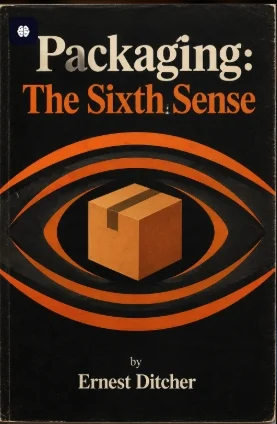
Packaging: The Sixth Sense?
 Ernest Dichter
Dichter's argument is that packaging functions as an unconscious perceptual channel—a 'sixth sense' through which consumers absorb symbolic meanings they cannot articulate. The book applies motivational research's depth-interview method to the package itself, treating typefaces, shapes, colors, and materials as carriers of latent emotional content. Dichter's central mechanism is the claim that consumers 'touch' packages with their eyes and 'read' them with their skin; a package succeeds or fails based on whether its sensory design harmonizes with drives the buyer never consciously names. The argument extends his consumer research from product choice to the material surface that mediates it.
Key Details
Related Books
View AllSimilar books from the same category, ranked by shared topics and reader engagement.



Key Insights — Read in 10 Minutes
What is the central claim of Packaging: The Sixth Sense?, and what does it reject?
Dichter argues that the package is not a neutral container but an active perceptual stimulus that communicates with consumers through channels they cannot consciously report. The 'sixth sense' of the title is this non-rational perceptual faculty: consumers absorb the symbolic meanings of shape, color, texture, and typography without deliberating over them. The book rejects the premise that packaging is primarily a functional or informational problem. For Dichter, the designer's task is not to describe the product accurately but to align the package's sensory signature with unconscious motivational structures. A detergent bottle's rounded silhouette, a cigarette pack's tactile finish, or a soap's color palette all speak to drives the buyer experiences as preference rather than persuasion. The argument extends Dichter's motivational research from product attributes to the material surface that frames them.
How does the book apply Dichter's depth-interview method to packaging specifically?
Dichter's standard method involved probing consumers' associations, fantasies, and resistances rather than asking them directly why they preferred a package. In Packaging, he treats the package as a projective stimulus: what consumers say about a detergent bottle's shape or a cereal box's typeface reveals latent attitudes about cleanliness, authority, indulgence, or guilt. The book presents case observations drawn from his Institute for Motivational Research studies, interpreting design elements as symbolic carriers. This application is consistent with his earlier work on product choice, but it shifts the analytical focus from the product's use to its visual and tactile surface. The package becomes a compressed communication system whose 'grammar' the designer must learn through psychological research rather than aesthetic intuition.
How did contemporary reviewers evaluate the book's execution?
Reviews were notably critical of the book's production values and evidentiary rigor. Writing in the Journal of Advertising, Charles H. Martin and Donald R. Holland provided a brief review in 1976, while a more detailed assessment in a marketing journal by Maurice I. Mandell of Bowling Green State University faulted the book's visual design as counterproductive for a volume about packaging. Mandell noted that the book was printed in black only, lacked color reproductions, and included amateurish photography—an ironic deficiency given the subject matter. He also described the text as containing hundreds of unspecified Dichter opinions and studies, with vague captions. Mandell concluded that the book offered little that was new or startling, though it might benefit graduate students in marketing who had not previously questioned packaging's psychological dimensions.
How does Packaging: The Sixth Sense? relate to Dichter's response to Vance Packard?
The book continues the defensive posture Dichter adopted in The Strategy of Desire against Packard's critique in The Hidden Persuaders. Where Strategy of Desire argued directly that motivational research was education rather than manipulation, Packaging enacts that argument by treating design as a form of consumer guidance. Dichter does not address Packard by name in this later work, but the underlying framework is the same: the package educates the consumer's unconscious, helping them recognize what they already desire. Critics like Mandell found the book's foreword promise that it would challenge cherished views unfulfilled. The relationship is one of revision and continuation rather than direct rebuttal—Dichter reframes the persuasive function of packaging as a service to consumer self-knowledge, a claim Packard's readers would have found familiar and suspect.
What does the book predict about packaging's future, and how accurate were those predictions?
Dichter's closing chapter addresses packaging in a world of dwindling energy resources, predicting a shift toward bulk purchasing of basic goods like paper towels and toilet paper, refillable monogrammed whiskey decanters, and packages that carry useful information such as language courses on cereal boxes. Reviewer Maurice Mandell assessed these forecasts skeptically, noting they hardly constituted the unsettling challenge the foreword promised. Some predictions anticipated later developments in sustainability discourse and package-embedded media, but the specific examples read as period-bound extrapolations rather than prescient analysis. The predictions are more valuable as a record of how motivational research positioned packaging within 1970s resource anxiety than as a reliable guide to subsequent industry practice.
Is Packaging: The Sixth Sense? representative of Dichter's most influential work?
No. The book appeared late in Dichter's career, after the peak influence of motivational research had passed. By the mid-1970s, Freudian depth psychology was losing ground in marketing research to cognitive and quantitative approaches, and Dichter's Institute for Motivational Research was no longer the center of methodological innovation it had been in the 1950s. The book is best understood as an application and restatement of his established framework rather than a new contribution. Scholars of consumer psychology and advertising history more commonly cite Dichter's earlier work and his consulting reports, many of which are archived in the Ernest Dichter papers at the Hagley Museum and Library. Packaging: The Sixth Sense? remains a minor entry in his bibliography, useful primarily for understanding how he extended his method to material design.
Wealthy Psyche is an intellectual archive. We do not host, distribute, or sell book copies — physical or digital. We provide structured knowledge to help you think better, faster.