


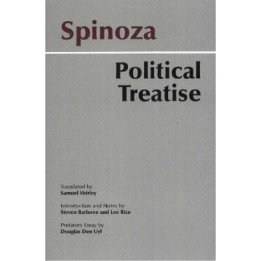
Political Treatise
 Baruch Spinoza
Spinoza's Political Treatise argues that right is coextensive with power, and that the most secure commonwealth is one whose institutions channel the passions of its citizens toward peace without relying on their virtue. The work's central mechanism is the deduction of political institutions from the natural condition of human beings as creatures of desire and imagination, not from reason alone. It examines monarchy, aristocracy, and democracy, showing how each can be ordered so that rulers, whether guided by reason or affect, cannot easily destroy the state. The unfinished final chapter on democracy was cut short by Spinoza's death in 1677.
Key Details
Key Insights — Read in 10 Minutes
What is the central claim of the Political Treatise, and what does it reject?
The central claim is that the most secure commonwealth is one whose institutions are ordered so that citizens, whether led by reason or by passion, cannot be induced to act disloyally. Spinoza rejects the idea that a stable state can rely on the virtue of its rulers or the rationality of its subjects. He insists that political theory must be deduced from 'the common nature, or condition, of men'—that is, from humans as creatures of passion and imagination—not from what reason alone prescribes . As the opening word of the treatise suggests, affects are the starting point.
What specific concept does the Political Treatise introduce, and how is it used today?
The work introduces the potentia multitudinis—the power of the multitude—as the ultimate foundation of political authority. Spinoza argues that a sovereign's right extends only as far as its actual power to command obedience, and that this power rests on the consent and cooperation of the governed. Contemporary scholars, especially in the 'Left Spinozist' tradition influenced by Negri and Hardt, use this concept to develop theories of democratic power and globalization that challenge liberal representative models . The multitudo is not a mere aggregate but a set of natural relations whose power determines the nature of imperium .
How does the Political Treatise differ from the Theological-Political Treatise?
The Theological-Political Treatise is polemical, opposing democracy to tyranny and arguing for freedom of philosophizing on religious grounds. The Political Treatise proceeds with a broader, more 'realistic' examination of monarchy, aristocracy, and democracy as equivalent alternatives, each of which can function positively under the right conditions . The TP also lacks the TTP's critique of religious ideology and instead deduces institutions directly from the theory of passions. Its aim is more ambitious: to outline conditions under which a commonwealth's affairs may be ordered so that rulers cannot easily act badly .
How has the Political Treatise's reputation changed since its posthumous publication?
For centuries the Treatise was overshadowed by the Ethics and the Theological-Political Treatise, dismissed as a Hobbesian apology for absolutism . Recent scholarship has reversed this assessment, with commentators like Edwin Curley arguing it offers 'the materials for a much deeper understanding of Spinoza's political philosophy than we could gain from his other works' . The work is now central to debates about democratic power, the multitude, and institutional design, and its remarks on international relations have drawn renewed attention from IR scholars.
Does the Political Treatise have a theory of international relations?
Yes, though it is brief. In Chapter 3 (paragraphs 11–17), Spinoza treats states as existing in a natural condition relative to one another, with no superior authority to enforce agreements—an international state of nature analogous to Hobbes's . However, scholars argue Spinoza should not be read as either a theorist of classical international law or a denier of international law, but as a precursor of a procedural theory of a confederation of states . His remarks on the right to war derive from the same principle that right is coextensive with power.
Wealthy Psyche is an intellectual archive. We do not host, distribute, or sell book copies — physical or digital. We provide structured knowledge to help you think better, faster.