


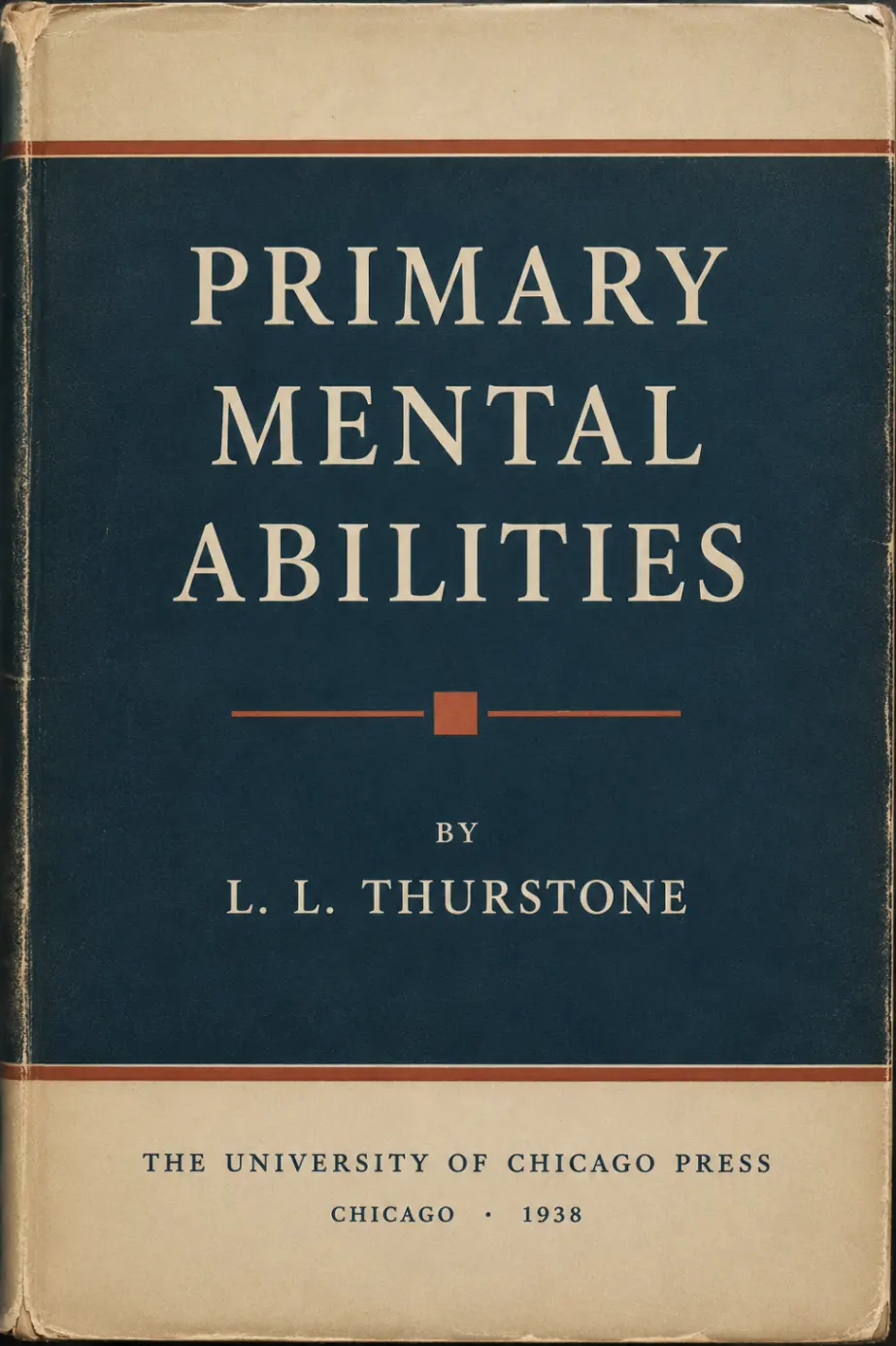
Primary Mental Abilities
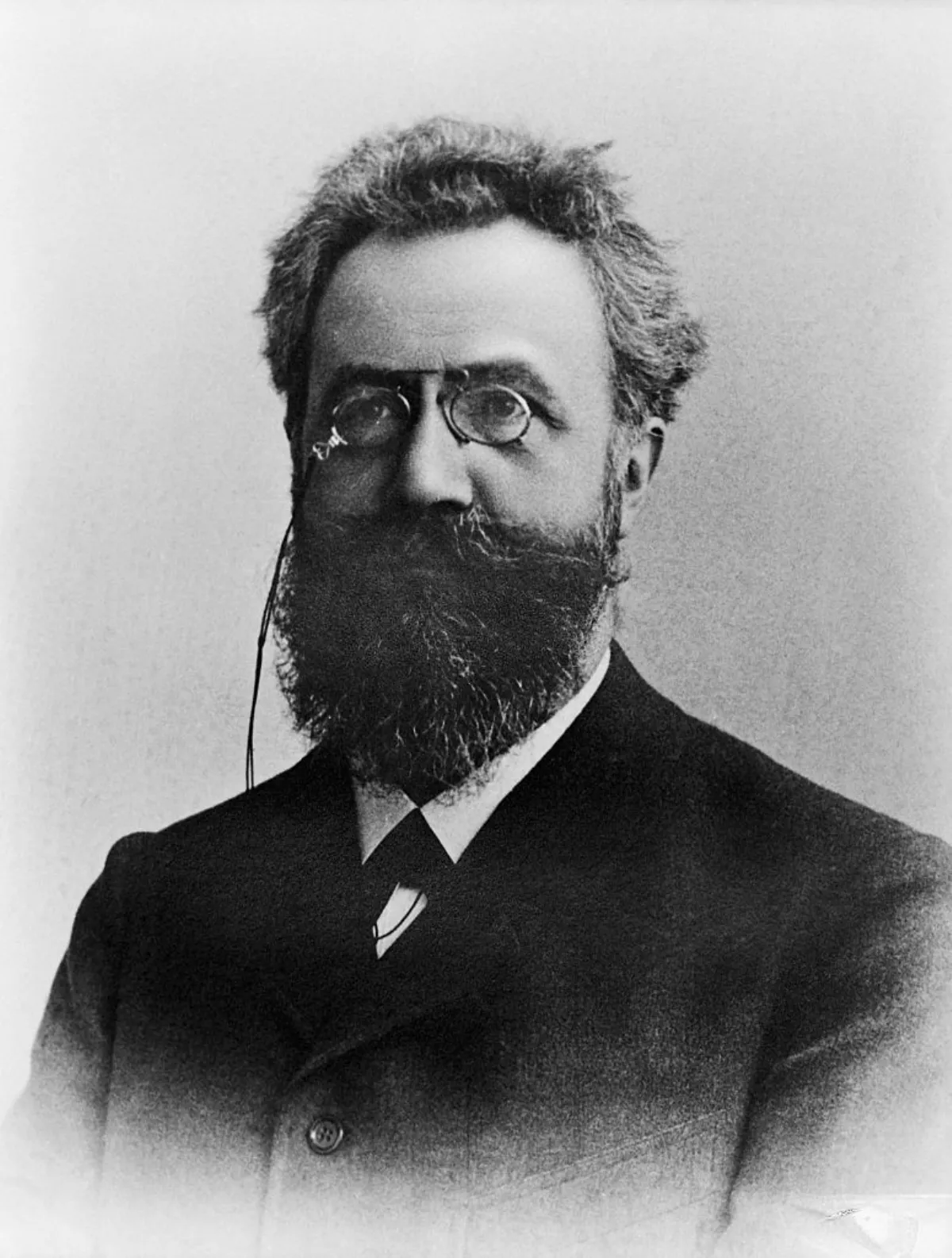 L.L. Thurstone
Thurstone's 1938 monograph applies multiple-factor analysis to a battery of fifty-seven tests administered to 240 University of Chicago students, extracting and rotating factors to reveal seven 'primary mental abilities' — verbal comprehension, word fluency, number, space, memory, perceptual speed, and reasoning. The central mechanism is Thurstone's 'simple structure' criterion, which he developed as an alternative to Spearman's single general factor. The book represents the first major application of the factorial methods Thurstone had introduced in The Vectors of Mind, and it directly challenged the reigning two-factor theory of intelligence.
Key Details
Related Books
View AllSimilar books from the same category, ranked by shared topics and reader engagement.



Key Insights — Read in 10 Minutes
What is the central claim of Primary Mental Abilities, and what rival theory does it reject?
Thurstone's central claim is that intelligence is not a single unitary entity but a set of several independent 'primary mental abilities' — verbal comprehension, word fluency, number, space, associative memory, perceptual speed, and reasoning . He rejects Spearman's two-factor theory, which held that all cognitive performance reflects one general factor 'g' plus task-specific factors. Thurstone's monograph explicitly states that he found no evidence for a general common factor in Spearman's sense . His alternative was grounded in multiple-factor analysis, a method he had developed to identify several common factors rather than one, and in the 'simple structure' criterion that gave psychological meaning to rotated factor axes .
What specific methodological innovation did the book introduce, and how was it used?
The book introduced the first large-scale application of 'simple structure' rotation to reveal interpretable psychological factors . After extracting thirteen centroid factors from the correlation matrix of fifty-seven tests, Thurstone rotated the axes to produce a display in which each test loaded highly on only one or two factors and near-zero on the rest . This rotation made the factors psychologically interpretable, yielding the seven primary abilities. Thurstone stressed that simple structure's invariance under different test samples was his most important contribution to factor analysis . The method became foundational for subsequent research on the structure of cognitive abilities.
How did Spearman respond to Thurstone's challenge, and what was the substance of the dispute?
Spearman accused Thurstone of having mathematically 'distributed' the general factor 'g' among several group factors, making each fragment too small to be perceptible . He argued that the primary mental abilities were not invariant vectors of the mind but artifacts of test selection: any ability could be dissolved by removing or reducing the tests that measured it, and any element could be converted into a group factor by adding redundant tests . Thurstone had already acknowledged that his factors were correlated, requiring a second-order analysis — a concession that some have read as effectively admitting a general factor at a higher level, even if not Spearman's 'g' .
What did later research reveal about whether the primary abilities are truly independent?
Subsequent research found moderate correlations among Thurstone's primary abilities, suggesting an underlying general factor even within his own system . Thurstone himself modified his position by introducing the concept of 'second-order factors,' derived from factoring the correlations among the first-order primary abilities. This second-order factor, he suggested, might correspond to Spearman's 'g,' though with larger loadings on reasoning, word fluency, and verbal comprehension than on memory, spatial, or perceptual speed factors . Stephen Jay Gould later argued that both Spearman's and Thurstone's systems suffer from the 'reification of factors' — treating mathematical constructs as concrete entities in the brain .
What was the specific experimental design of the study reported in this book?
Thurstone administered a battery of fifty-seven tests to 240 volunteer University of Chicago students, who spent roughly fifteen hours taking the tests during a week of vacation . The tests were predominantly pencil-and-paper and covered a wide range of abilities, including many newly constructed for the experiment . All intercorrelations and reliabilities were computed as tetrachoric coefficients, with the cut near the median . The correlation matrix was subjected to the centroid method of factor analysis, thirteen factors were extracted, and these arbitrary axes were then rotated to isolate the primary abilities . Scores were computed by hand, with electrical calculators, slide rules, and graphical aids .
How did Thurstone's primary abilities influence later intelligence testing and theory?
The primary abilities provided the foundation for test batteries designed to assess separate cognitive dimensions rather than a single IQ score. Thurstone and his wife Thelma developed the SRA Primary Mental Abilities tests for kindergarten through high school, measuring verbal, spatial, reasoning, numerical, and word fluency abilities . These measures were later adapted for cross-cultural use, including a French adaptation measuring five abilities in children aged 11 to 17 . In adult development research, the primary abilities experienced a revival as useful instruments for charting cognitive change over time, with factorial invariance demonstrated across age cohorts and genders . The multifactorial framework also shaped the hierarchical models of Cattell, Horn, and Carroll.
Wealthy Psyche is an intellectual archive. We do not host, distribute, or sell book copies — physical or digital. We provide structured knowledge to help you think better, faster.