


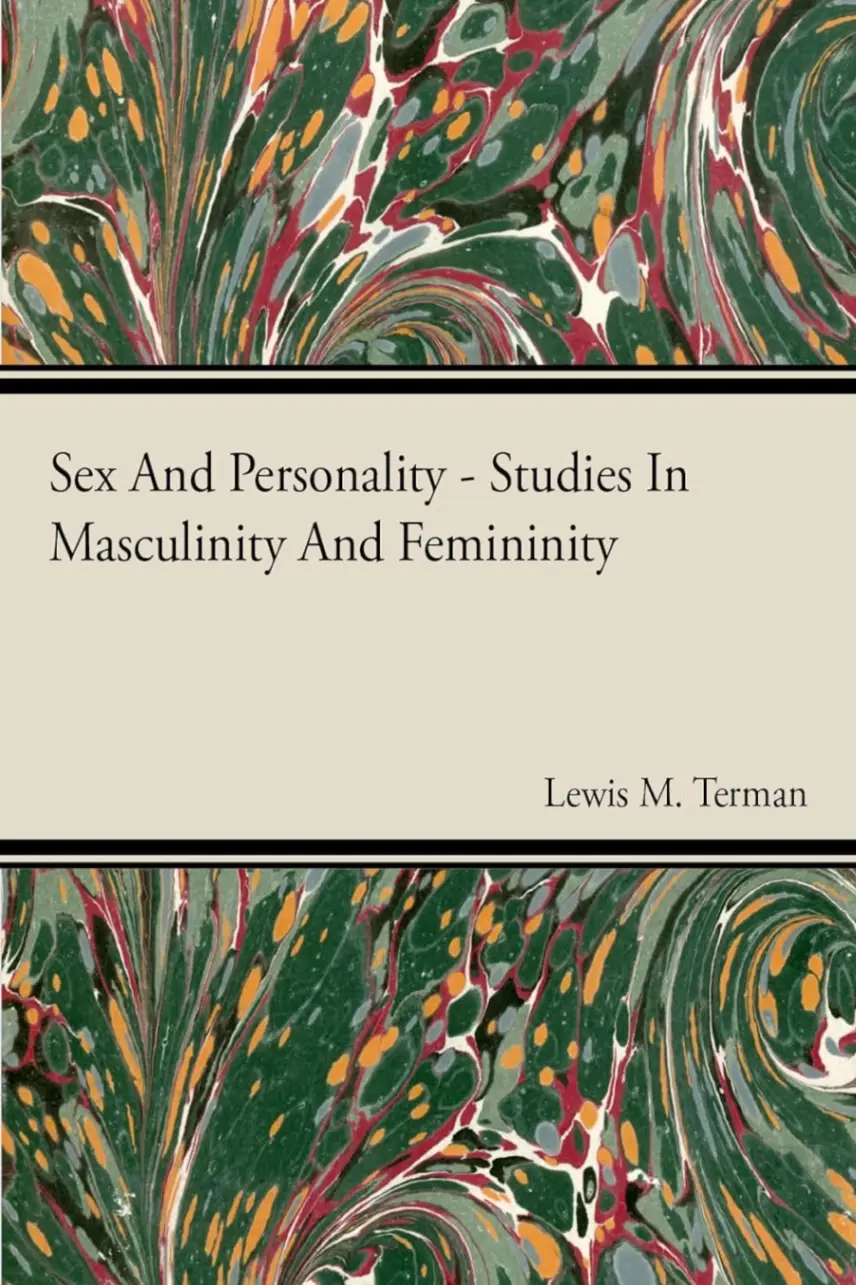
Sex and Personality: Studies in Masculinity and Femininity
 Lewis Terman
Terman and Miles's 1936 monograph applies psychometric scaling to sex temperament, constructing the Attitude-Interest Analysis Test (AIAS) — a 910-item questionnaire in two equivalent forms measuring masculinity and femininity as a continuous dimension. The book's central mechanism is the M-F scale, which scores each response as masculine (+1) or feminine (-1) based on demonstrated sex differences, locating individuals on a bipolar continuum from +200 to -200. Drawing on data from over 4,000 subjects including college students, athletes, delinquents, homosexuals, and prostitutes, the work treats masculinity and femininity as measurable psychological traits rather than fixed biological categories.
Key Details
Related Books
View AllSimilar books from the same category, ranked by shared topics and reader engagement.


Key Insights — Read in 10 Minutes
What is the central claim of Sex and Personality, and what does it reject?
The central claim is that masculinity and femininity can be quantified through a psychometric test, producing a scale that locates individuals on a continuum from masculine to feminine based on their responses to items known to differentiate the sexes. Terman and Miles reject the assumption that masculinity and femininity are rigid, all-or-nothing categories determined by biological sex. They explicitly acknowledge that sex differences in practical abilities are either nonexistent or far smaller than commonly supposed, and that cultural norms vary across societies . The test was designed to measure whatever psychological differences remain, not to justify traditional sex roles as natural or inevitable. The authors describe their work as a pioneer attempt at quantification, comparable in ambition to Binet's early intelligence testing .
What specific instrument did the book introduce, and how was it constructed?
The book introduced the Attitude-Interest Analysis Test (AIAS), a 910-item questionnaire in two equivalent forms (456 items in Form A, 454 in Form B) organized into seven subtests: word association, ink-blot association, information, emotional and ethical response, interests, personalities and opinions, and introvertive response . Items were selected because they differentiated men from women in the standardization sample. Each response scored +1 for masculine or -1 for feminine, producing a total score ranging from +200 to -200 . The test was administered as a group pencil-and-paper instrument taking forty to fifty minutes . The authors emphasized this was the simplest and roughest kind of quantification then possible, not precise measurement .
What were the M-F score distributions for men and women in the general population?
Terman and Miles reported that normal adult males in the general population ranged from +200 to -100 with a mean of +52 (SD 50), while normal adult females ranged from +100 to -200 with a mean of -70 (SD 47) . A review in the Eugenics Review noted the overlap was substantial, opening what it called the entertaining speculation that women may be more womanly than men are manly . The distributions showed that some men scored within the feminine range and vice versa. Scores varied systematically with age, occupation, intelligence, education, and social background. Male athletes and engineering students scored highest; clergy, physicians, and older men scored lower. The feminizing influence of age after adolescence was described as an interesting phenomenon .
How did Anne Constantinople's 1973 critique challenge the M-F framework?
Constantinople's landmark review in Psychological Bulletin attacked the theoretical foundations of masculinity-femininity scales including Terman and Miles's. She argued there was no single bipolar dimension with masculinity at one extreme and femininity at the other, that the traits assessed were not stable across development, and that they varied by social class and culture . She contended that men and women often presented characteristics associated with both masculinity and femininity, and that the literature did not support the assumption that homosexual men had feminine psychic functioning and lesbians masculine . Constantinople suggested these scales measured test-takers' expectations of how they should answer, based on stereotypes derived from data probably twenty years older than the test-takers themselves .
How has the Terman and Miles scale influenced subsequent gender measurement instruments?
The M-F framework remained a reference for more than three decades after its publication . Later instruments including the Bem Sex Role Inventory (BSRI) and the Personal Attributes Questionnaire (PAQ) built on the premise that masculinity and femininity could be measured, though they shifted from a bipolar to a dualistic model in which an individual could possess both masculine and feminine traits . The PAQ and BSRI were themselves criticized for measuring only desirable traits, leading to the Extended Personal Attributes Questionnaire incorporating negative sex-role traits . Lewin's 1984 critique identified eight erroneous assumptions in gender assessment, including the failure to distinguish between more and less masculine men and the confounding of gender role with sexual orientation .
Is the book still used as a measurement instrument, or only as a historical document?
The AIAS is no longer used in contemporary psychological research. The book is now primarily of historical interest, cited in reviews of gender measurement as the first systematic attempt to quantify masculinity and femininity . The construction procedure — selecting items that differentiate the sexes and scoring responses as +1 or -1 — was methodologically innovative for its time but has been superseded by item response theory and modern scale development practices. The book remains valuable for understanding how early twentieth-century psychology conceptualized sex differences, and for tracing the lineage of gender measurement instruments from the M-F scale through the BSRI and PAQ to contemporary approaches. Its treatment of homosexuality as a form of sex inversion is now recognized as scientifically invalid.
Wealthy Psyche is an intellectual archive. We do not host, distribute, or sell book copies — physical or digital. We provide structured knowledge to help you think better, faster.