


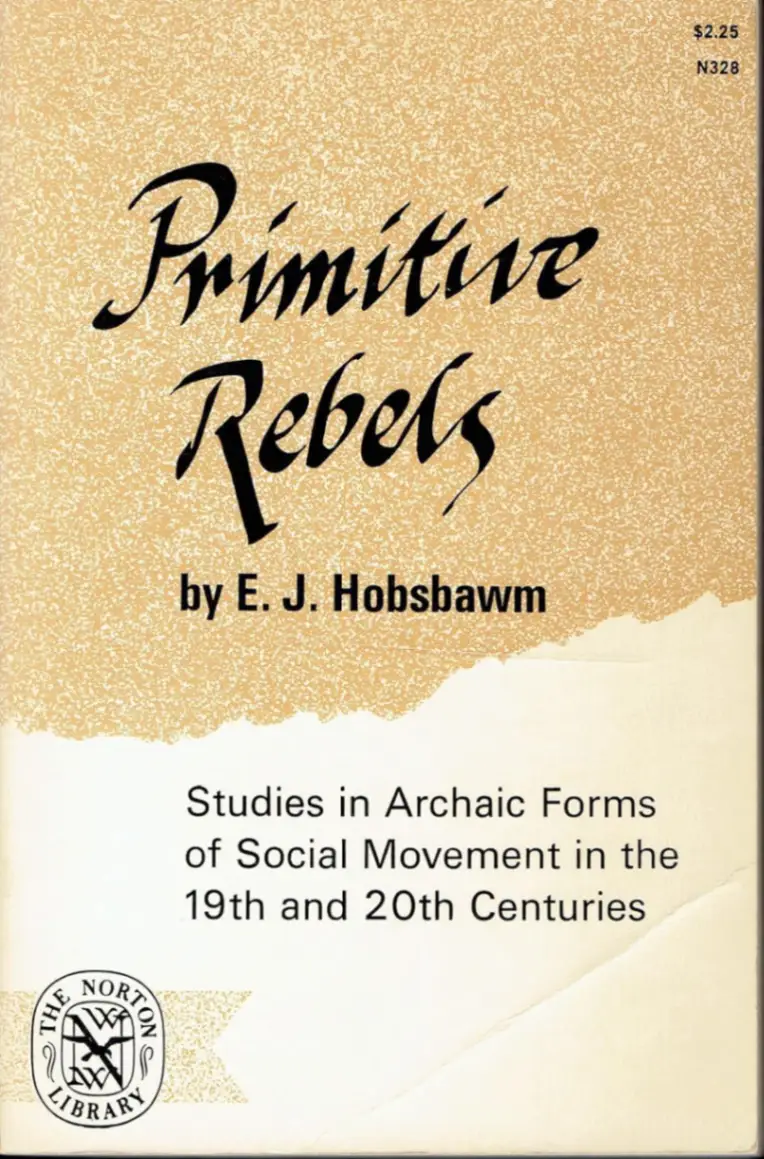
Primitive Rebels: Studies in Archaic Forms of Social Movement in the 19th and 20th Centuries
 Eric Hobsbawm
Eric Hobsbawm's 1959 study examines social movements that fall outside the classic patterns of labour or socialist agitation—movements he calls 'prepolitical' because they lacked organisation, ideology, and explicit class consciousness. Through case studies of social banditry, the Mafia, Andalusian anarchists, Sicilian peasant leagues, and millenarian sects, Hobsbawm shows how these archaic forms of revolt expressed the grievances of peasants and labourers against the 'conspiracy of the rich' before modern revolutionary politics existed. The book introduced the concept of 'social banditry,' which became a foundational term in peasant studies and historical sociology.
Key Details
Related Books
View AllSimilar books from the same category, ranked by shared topics and reader engagement.



Key Insights — Read in 10 Minutes
What is the central claim of Primitive Rebels?
Hobsbawm argues that before modern revolutionary movements existed, peasants and rural labourers expressed their grievances through 'archaic' or 'primitive' forms of social protest. These movements were 'prepolitical'—lacking organisation, ideology, and explicit class consciousness—yet they represented genuine resistance to exploitation. Hobsbawm examines social banditry, the Mafia, millenarian sects, Andalusian anarchists, and Sicilian peasant leagues to show how these movements fed into later, more organised revolutionary politics. The book challenges the assumption that only modern labour movements constitute meaningful social protest.
What specific concept did Primitive Rebels introduce?
The book introduced 'social banditry,' a term Hobsbawm coined to describe outlaws whom ordinary rural people regarded as heroes and champions of resistance. Social bandits—such as Robin Hood, Pancho Villa, and Lampião—robbed the rich and were celebrated in folklore, representing a form of 'pre-historic social movement' distinct from organised labour. The concept became foundational in peasant studies, historical sociology, and anthropology, generating decades of debate about whether such bandits were genuinely revolutionary or merely criminal.
What does Hobsbawm mean by calling these rebels 'primitive'?
Hobsbawm uses 'primitive' to mean 'prepolitical,' not inferior. These movements lacked the organisational structures, explicit ideologies, and class consciousness of modern revolutionary politics. They operated in pre-capitalist or transitional societies where peasants and labourers had no vocabulary for their grievances against the 'conspiracy of the rich.' The term carries an evolutionist assumption that Hobsbawm himself later acknowledged, and critics have noted its problematic connotations. Nevertheless, Hobsbawm's sympathy for these movements is evident throughout the book.
How does Primitive Rebels differ from Hobsbawm's later work on nationalism?
Primitive Rebels focuses on rural, prepolitical protest in Southern Europe and Latin America before modern nationalism became a dominant political force. Hobsbawm's later works, such as Nations and Nationalism Since 1780 and The Invention of Tradition, address the modern construction of national identities through state-led cultural engineering. The earlier book studies movements that lacked national consciousness or articulated it only in millenarian terms—'the Day of Change' rather than the nation. Together, they show Hobsbawm's evolving interest from archaic rural revolt to modern political ideologies.
How was Primitive Rebels received by critics?
The book was widely influential and established Hobsbawm's reputation as a historian of social movements. Michael Löwy notes that Hobsbawm's approach differs from 'progressive' orthodoxy in its interest, sympathy, and even fascination for primitive movements of peasant anti-capitalist resistance. The concept of social banditry was praised as a valuable tool that 'broke open a Pandora's Box' for readers. Some critics questioned the evolutionist framework and the genuine revolutionary potential of movements Hobsbawm described. The book remains a classic in peasant studies and historical sociology.
What is the most common misconception about Primitive Rebels?
A frequent misreading treats 'primitive' as a pejorative term implying these movements were backward or irrational. Hobsbawm intended it analytically, to describe movements that predated modern political organisation. He explicitly admired these rebels for their resistance to oppression, describing them as expressions of the 'pre-political' stage of social revolt. The book's sympathy for its subjects is evident throughout, and Hobsbawm's later work continued to explore the dignity and agency of ordinary people resisting exploitation, even without sophisticated ideologies.
Wealthy Psyche is an intellectual archive. We do not host, distribute, or sell book copies — physical or digital. We provide structured knowledge to help you think better, faster.