



Scientific Management: Comprising Shop Management, The Principles of Scientific Management, and Testimony Before the Special House Committee
 Frederick Winslow Taylor
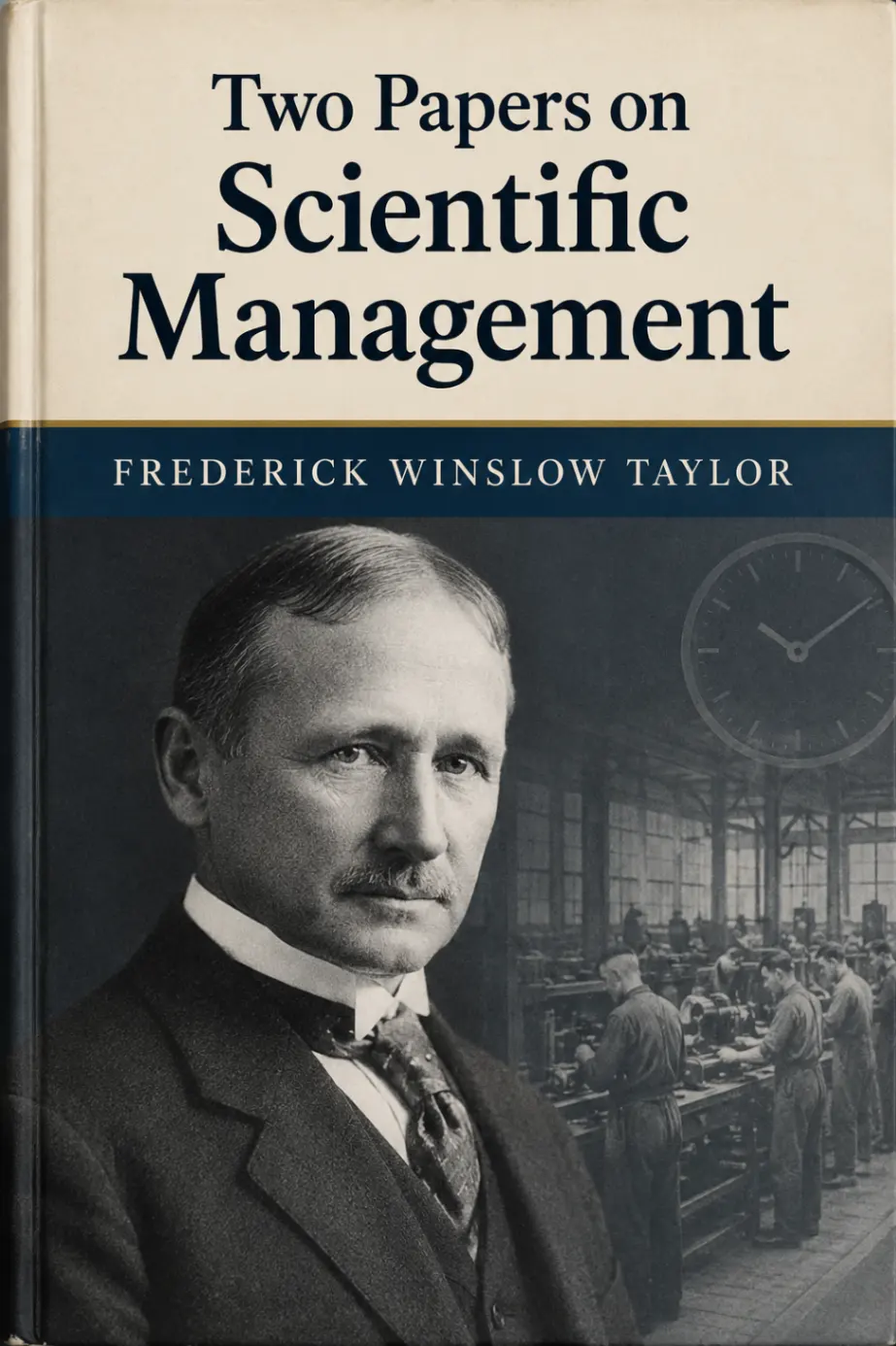
This compilation gathers three of Taylor's key texts into a single volume: Shop Management, The Principles of Scientific Management, and his testimony before a U.S. House committee investigating the system. Its distinctive value is documentary rather than theoretical — it lets readers see the doctrine stated, applied, and defended in sequence. Across the three texts, Taylor's central mechanism recurs: replace rule-of-thumb craft practice with systematically studied, standardized methods, and separate planning from execution so that managers determine the science of work. The testimony adds a crucial dimension, showing Taylor under adversarial questioning about worker welfare, incentive systems, and the limits of his claims.
Key Details
Related Books
View AllSimilar books from the same category, ranked by shared topics and reader engagement.


Key Insights — Read in 10 Minutes
What does this compilation contain, and why does the combination matter?
The volume gathers three of Taylor's central texts: Shop Management, The Principles of Scientific Management, and his testimony before the Special House Committee that investigated the system in the 1910s. The combination matters because it presents scientific management at three levels: as applied shop-floor practice, as a general managerial doctrine, and as a public defense under adversarial questioning. Reading only The Principles gives a polished programmatic statement; the testimony reveals how Taylor handled challenges about worker welfare, incentive systems, and the evidence behind his claims. The compilation therefore functions as a documentary record rather than a single treatise, letting readers compare what Taylor asserted, how he operationalized it, and how he defended it.
How does Shop Management differ from The Principles of Scientific Management?
Shop Management is earlier and more operational, focused on the practical organization of factory work — task assignment, routing, time study, and the role of functional foremen. The Principles of Scientific Management, published later, is shorter and more programmatic, framing scientific management as a general philosophy of management rooted in a claimed harmony of interests between workers and owners. The earlier text shows the machinery; the later text states the creed. Reading them together reveals that the doctrine's famous four principles were distilled from shop-floor practice rather than conceived abstractly. The compilation's arrangement allows this development to be traced, which is a reason scholars consult it rather than the Principles alone.
What is the significance of Taylor's testimony before the Special House Committee?
The testimony is significant because it places Taylor under formal, adversarial questioning about the system's effects and evidence. Congressional scrutiny in the 1910s followed labor objections and public controversy over scientific management, and Taylor's appearance was part of a broader investigation into the system's implications for workers. In the testimony, he addressed questions about incentives, worker welfare, and the basis for his claims, and he argued his case in a public forum rather than in a managerial manual. For historians, the testimony is valuable because it captures the doctrine in contested terms, showing where Taylor was pressed hardest and how he framed his defense. It is a primary source for the reception of scientific management.
How did the system's reception and critiques shape the way this compilation is read?
Scientific management spread widely but also attracted sustained opposition from labor and later from the human-relations tradition associated with Elton Mayo, which argued that Taylor's framework ignored social and psychological factors. Because the compilation includes Taylor's own defense against critics, readers can see the dispute as a contemporaneous debate rather than a retrospective judgment. Later historians have questioned the reliability of Taylor's reported evidence and the extent of productivity gains, and critics have argued that the system intensified managerial control and deskilled work. Reading the compilation with those critiques in mind reveals where Taylor anticipated objections and where he left assumptions unexamined, making it a document in a controversy rather than a settled doctrine.
What is a common misconception about this compilation?
A common misconception treats the volume as a single unified book with one argument, when in fact it is an edited gathering of separately written and separately occasioned texts. The three pieces differ in purpose, tone, and audience, and their claims are not always fully consistent. Shop Management is practical and technical; The Principles is programmatic and rhetorical; the testimony is defensive and responsive. Readers who treat the whole as a systematic treatise may overstate its coherence. The compilation's value lies in the contrast between the texts, showing how the doctrine was built, marketed, and defended. Recognizing its composite nature prevents attributing a single definitive formulation to the volume as a whole.
Wealthy Psyche is an intellectual archive. We do not host, distribute, or sell book copies — physical or digital. We provide structured knowledge to help you think better, faster.