


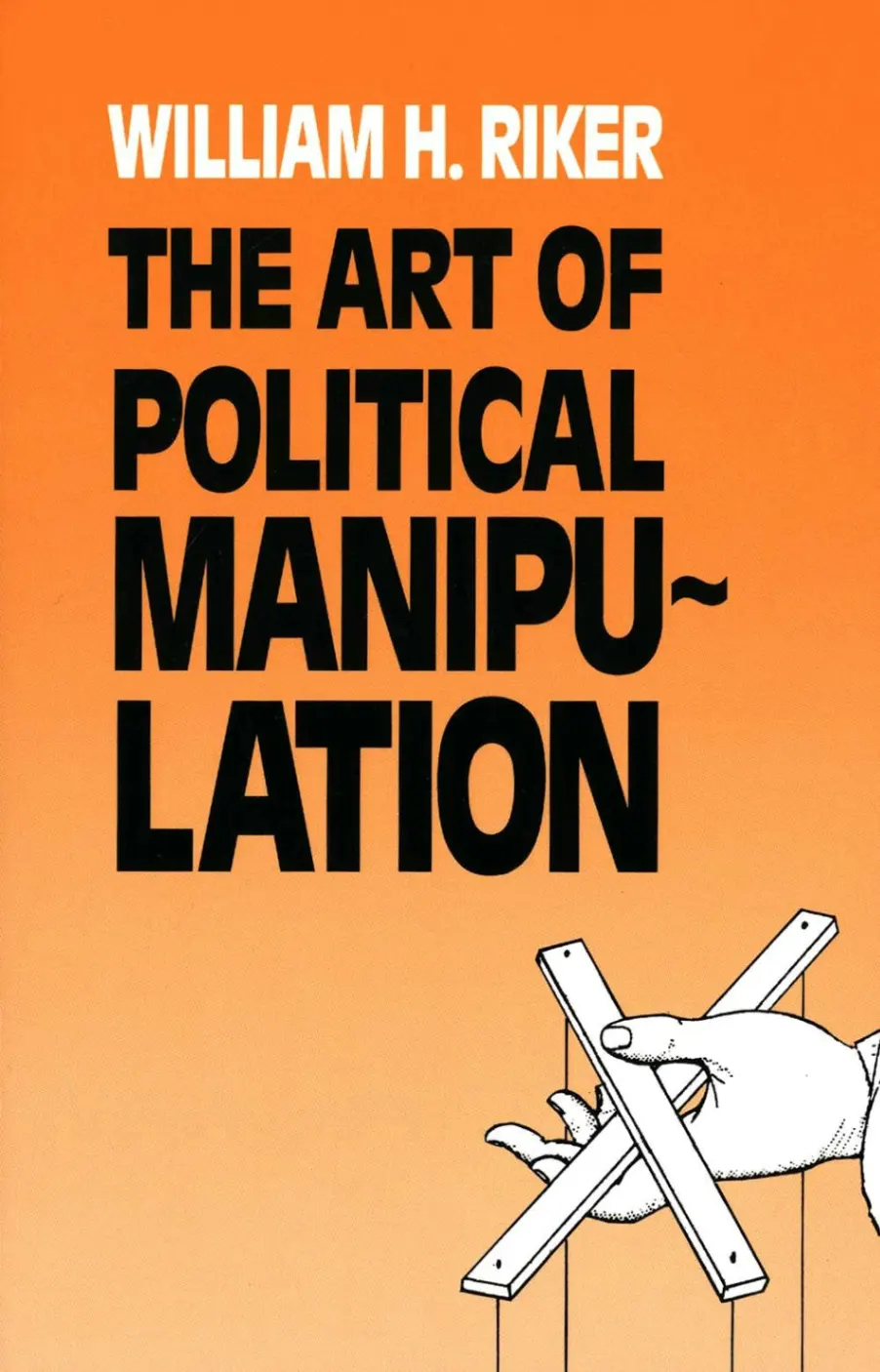
The Art of Political Manipulation
 William H. Riker
The Art of Political Manipulation develops William Riker's concept of heresthetics—the strategic art of structuring choices and manipulating political dimensions so that opponents are forced to support outcomes they would otherwise oppose. Riker's central claim is that political winners are often not those who persuade others of their case but those who rearrange the alternatives, control the agenda, or introduce a new dimension that splits the opposing coalition. Through historical cases from Abraham Lincoln, John Calhoun, and the Federalist ratification fight, Riker shows manipulation operating within constitutional and federal structures—which is why federalism's multiple arenas and amendment rules are themselves heresthetic resources.
Key Details
Related Books
View AllSimilar books from the same category, ranked by shared topics and reader engagement.
.webp?alt=media&token=aa57557c-98c6-4edb-ba61-0189bc741142)
.webp?alt=media&token=fe90549a-9842-4d96-b442-a481f7724ad7)
Key Insights — Read in 10 Minutes
What is the central claim of The Art of Political Manipulation, and what does it reject?
Riker argues that political success often comes not from persuasion but from heresthetics—manipulating the structure of choices, the agenda, or the dimensions of conflict so opponents are forced to accept outcomes they would otherwise reject. He rejects the assumption that politics is primarily about arguing people into agreement. Winners are frequently those who rearrange alternatives or introduce a new dimension that splits the opposing coalition. Manipulation, in Riker's sense, is strategic and structural, not merely rhetorical or deceptive.
What specific concept did Riker introduce, and where is it used today?
Riker introduced heresthetics, the art of political strategy that structures the world so you win—through agenda control, strategic sequencing, dimension manipulation, and redefining the alternatives. It is used today in legislative studies, constitutional design, coalition research, and studies of referendum campaigns. The concept also informs strategic voting analysis and comparative politics, where actors manipulate issue dimensions to build winning coalitions. Heresthetics is one of Riker's most influential contributions and connects directly to his earlier work on coalition size and social choice.
How does The Art of Political Manipulation relate to Riker's federalism theory?
Federalism supplies multiple arenas—national, state, local—that heresthetic actors can use strategically. Riker's account of the Federalist ratification fight shows how Constitution supporters manipulated the ratification rules, state conventions, and the dimension of debate to win against Anti-Federalist majorities. Federal structures themselves—divided authority, amendment procedures, different electoral arenas—are heresthetic resources. The book therefore illustrates how the institutional pluralism of federalism creates opportunities for strategic manipulation, complementing Riker's earlier federal bargain theory.
How has Riker's concept of heresthetics held up since the book's publication?
Heresthetics is widely used and remains central to positive political theory and strategic studies of politics. It has been extended to legislative agenda-setting, Supreme Court decision-making, referendum design, and authoritarian politics. Critics note that Riker's cases are selected to illustrate success and that manipulation is easier to identify in hindsight than to predict. Some argue he overstates the role of structure relative to persuasion and coalition-building. Nevertheless, heresthetics is a standard concept and the book is a recognized classic in rational-choice political science.
What real-world practices does heresthetics explain?
Heresthetics explains agenda control in legislatures, strategic sequencing of votes, packaging of proposals, the design of referendums, and the introduction of new issue dimensions that split opponents. It illuminates constitutional ratification strategies, judicial agenda-setting, and coalition management in multi-party systems. In federal settings, it explains why actors forum-shop among state and national arenas. The concept is also applied to international negotiations, where states manipulate the menu of options to build winning coalitions. It is a practical as well as theoretical tool.
What is a common misconception about The Art of Political Manipulation?
A common misconception is that Riker's heresthetics is simply about lying or deception. Heresthetics is structural: it involves arranging alternatives, dimensions, and agendas so that even honest actors find themselves supporting outcomes they would not have chosen. Another misreading treats the book as a manual for manipulation. Riker is analyzing how political strategy works, not prescribing unethical behavior. The book is a work of positive political theory illustrated by historical cases, not a how-to guide for deceiving voters or opponents.
Wealthy Psyche is an intellectual archive. We do not host, distribute, or sell book copies — physical or digital. We provide structured knowledge to help you think better, faster.