


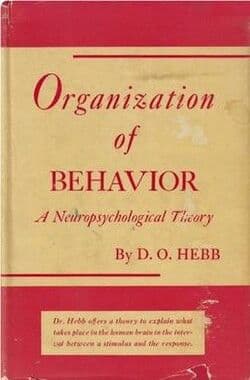
The Organization of Behavior: A Neuropsychological Theory
Hebb argues that behavior cannot be explained by stimulus-response reflexes alone, but requires understanding how the nervous system organizes experience through neural assemblies. The book's central mechanism is the cell assembly: neurons that repeatedly fire together strengthen their connections, forming a distributed representation that can persist after stimulation ends. These assemblies link into phase sequences, corresponding to trains of thought. Hebb's postulate—that synaptic efficacy increases when presynaptic and postsynaptic cells are simultaneously active—provided a physiological mechanism for learning that became foundational to neuroscience, though its details have been revised by subsequent research.
Key Insights
✦What is the central claim of The Organization of Behavior, and what does it reject?
Hebb argues that understanding behavior requires understanding the total action of the nervous system, and that simple stimulus-response reflex models are inadequate. The book rejects the switchboard view of the brain that underpinned strict behaviorism, proposing instead that learning involves the gradual formation of cell assemblies—groups of neurons that strengthen their connections through simultaneous activation . These assemblies can remain active after stimulation ceases, providing a neural basis for imagery, thought, and memory. Hebb's theory was explicitly neuropsychological: it sought to explain psychological phenomena like perception, motivation, and emotional disturbance through physiological mechanisms, without reducing them to conditioned reflexes .
✦What specific concepts did the book introduce, and where are they used today?
The book introduced three interrelated concepts: the cell assembly (a distributed neural representation formed through learning), the phase sequence (assemblies linked into trains of thought), and the Hebbian synapse (the postulate that synaptic strength increases when presynaptic and postsynaptic cells are simultaneously active) . The Hebbian learning rule—popularly summarized as 'neurons that fire together wire together'—became foundational to modern neuroscience, particularly in research on long-term potentiation, synaptic plasticity, and memory formation . The cell assembly concept influenced computational neuroscience and connectionist models of cognition, though the specific neural mechanisms Hebb proposed have been refined by subsequent research.
✦How was the book received by contemporary reviewers, and what criticisms were raised?
Robert Leeper's 1950 review in the Journal of Abnormal and Social Psychology acknowledged the book's high quality and predicted it would have an important influence, but he was cautious about its neurological theorizing. Leeper noted that when anyone attempts to integrate psychology and neurology, they are bound to overstress certain material, and he suggested psychology might still need multiple theories rather than a single unified one . Hebb himself later expressed surprise at the book's warm reception, remarking that he would not have written it the same way had he known how well it would be received . A 1994 retrospective review in PsycCRITIQUES described it as presenting a cohesive neuropsychological theory of modest size but impressive breadth .
✦How does the book relate to the cognitive revolution in psychology?
The Organization of Behavior is widely credited with helping clear the way for the cognitive revolution by challenging behaviorism's refusal to discuss what happens between stimulus and response. Hebb's principled opposition to radical behaviorism and his emphasis on perception, learning, and thinking as legitimate topics of biological psychology contributed to the decline of neo-Pavlovian behaviorism . The cell assembly provided a materialist account of mental representation that did not require invoking a non-physical mind, making thought respectable for scientifically oriented psychologists. One assessment notes that Hebb achieved far more than he intended: his central construct offered a credible description of how information can be acquired, stored, and accessed, which are precisely the questions cognitive psychology would later pursue .
✦Did Hebb's theory of synaptic plasticity turn out to be correct?
The core idea has been vindicated, but the details have required revision. Hebb postulated that synaptic strength increases when a presynaptic terminal and postsynaptic cell are simultaneously active. This principle is now recognized as a fundamental mechanism of learning and memory, and synapses with this property are called Hebbian synapses . However, modern neuroscience has identified additional mechanisms—such as spike-timing-dependent plasticity and intrinsic excitability changes—that operate alongside or instead of Hebbian strengthening in certain contexts . The Hebbian learning rule also inspired artificial neural network models, though these simplify the biology considerably. The theory's enduring value lies less in its precise physiological claims than in its insistence that psychological phenomena must be grounded in neural organization.
✦What editions and reissues exist, and does the edition matter?
The original edition was published by John Wiley & Sons in New York in 1949 . The book went out of print for a period before being reissued by Lawrence Erlbaum Associates in 2002, making it accessible to a new generation . The Erlbaum edition includes a new introduction that contextualizes Hebb's work. For scholarly citation, the 1949 original is standard, but the 2002 reissue is widely available and has the same pagination for the main text. Readers should note that the 1949 edition is the source of the page references commonly cited in the literature; the reissue's supplementary material should be cited separately.
✦Is the book accessible to readers without a neuroscience background?
It is a technical monograph written for psychologists and neuroscientists, not a popular science book. Hebb assumes familiarity with the neuroanatomy and physiology of his time, and the argument proceeds through detailed engagement with experimental literature. A contemporary reviewer noted that the book is 'delightfully written' despite its technical content, suggesting it is more accessible than many monographs of its era . However, readers without background in psychology or neuroscience will find the middle chapters, which develop the cell assembly theory in relation to cortical organization, challenging. Those seeking an accessible introduction to Hebb's ideas might start with a secondary source on the cognitive revolution or the history of neuroscience.
Wealthy Psyche is an intellectual archive. We do not host, distribute, or sell book copies — physical or digital. We provide structured knowledge to help you think better, faster.