


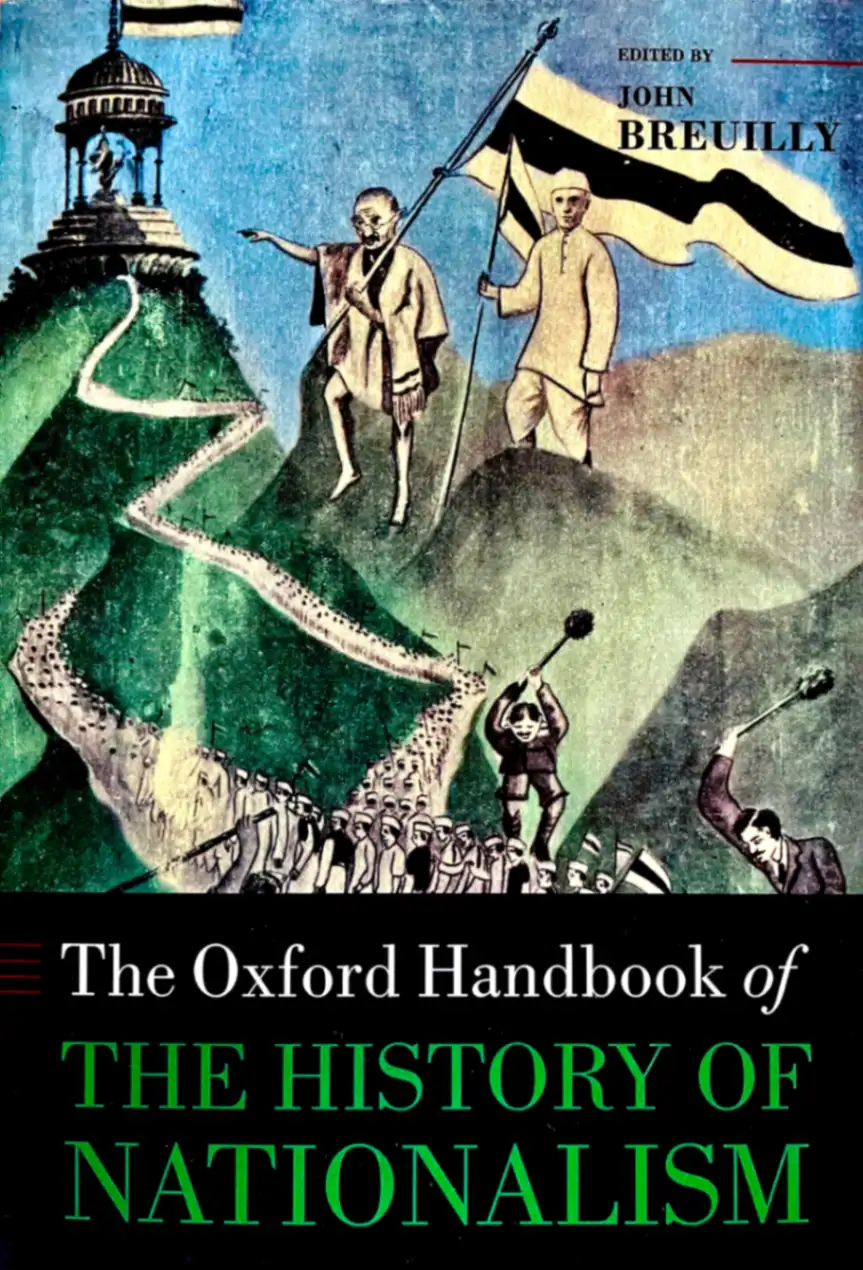
The Oxford Handbook of the History of Nationalism
 John Breuilly
John Breuilly's 2013 Handbook argues that nationalism must be studied as a distinct global historical subject, not as an aspect of national history. Thirty-six essays by leading scholars reject the treatment of nationalism as a mere byproduct of individual nations' stories. Instead, they examine nationalism as politics in particular regions before and after nation-state formation, as ideas and cultural movements, and in relation to themes like religion, socialism, race, and globalization. The volume insists that nationalism is historical, not natural, and that its global reach—from the Americas to Asia and Africa—requires comparative, theoretical analysis rather than national navel-gazing.
Key Details
Related Books
View AllSimilar books from the same category, ranked by shared topics and reader engagement.



Key Insights — Read in 10 Minutes
What is Breuilly's central editorial argument in this Handbook?
Breuilly argues that nationalism has been neglected as a subject in its own right because professional historians treat it as one aspect of national history. This absorption into national historiography fragments the study of nationalism and prevents comparative and theoretical understanding. The Handbook's challenge is to break the link between the history of nationalism and national history while maintaining empirical rigor. Breuilly's solution is to focus on nationalism as politics in particular regions, as ideas and cultural movements, and in relation to other subjects—a framework that treats nationalism as a distinct global historical subject rather than a byproduct of individual nations' stories.
How does the Handbook's structure reflect its argument about studying nationalism globally?
The volume is organised in six parts that embody Breuilly's approach. Part I covers ideas and sentiments before the nation-state. Parts II and III examine nationalist politics regionally, including substantial coverage of the Americas, the Middle East, Asia, and Africa alongside Europe. Part IV addresses nationalism in a world of nation-states, covering international relations and everyday life. Part V examines challenges from socialism, religion, pan-nationalism, and globalization. Part VI concludes with nationalist historiography. Notably, the historical case studies begin with the Americas rather than Europe, reflecting the Handbook's rejection of Eurocentric accounts of nationalism's origins and spread.
What specific contribution does Miroslav Hroch's chapter make to the volume?
Miroslav Hroch, a leading theorist of nationalism, contributes a chapter on national movements in the Habsburg and Ottoman Empires. Hroch's analysis takes its starting point in individual nationalities rather than imperial structures, examining how national movements developed among subject peoples within these multinational empires. His contribution exemplifies the Handbook's commitment to combining detailed regional expertise with comparative and theoretical insight. Hroch's work on small nations and national movements in Central and Eastern Europe has been foundational to the study of nationalism, and his chapter here applies that framework to two of the most complex imperial contexts in modern history.
How was the Handbook received by reviewers?
Reception was strongly positive. Krishan Kumar wrote in International Affairs that 'all students of nationalism will want to possess this volume,' praising the individual contributions and the helpful chronologies and maps. Eric Kaufmann in the LSE Review of Books called it 'a rich account of modern nationalism throughout the world,' noting that no other book offers equal billing to the nationalisms of sub-Saharan Africa, Asia, the Middle East, and the Americas. Ronald Grigor Suny in the English Historical Review described it as 'one of the best places to delve deeply into the murky and turbulent waters of national history.' Peter Thaler in Nations and Nationalism called it 'a massive undertaking' that impresses with its global range.
What is the most common criticism of the Handbook?
The most frequent criticism concerns the sheer scale and density of the volume. At 775-818 pages with thirty-six essays, the Handbook is not designed for casual reading or quick reference. Some reviewers noted that the theoretical considerations, while present, are not the primary focus—the volume prioritises historical case studies and regional examinations over abstract theorising. Peter Thaler observed that most contributors adhere to modernist and political interpretations, which are explicitly written into the introductory research design, though Peter Burke and several others diversify the conceptual approach. The Handbook is best used as a reference work and starting point for research rather than a systematic treatise.
How does this Handbook relate to Breuilly's earlier Nationalism and the State?
The Handbook extends and consolidates the political approach to nationalism that Breuilly developed in Nationalism and the State (1982). Where the earlier book advanced a distinctive political theory—that nationalism is a form of politics opposing the modern state—the Handbook applies that sensibility across a global range of cases and contributors. Eric Kaufmann described Breuilly's earlier work as filling 'the political blanks left by Ernest Gellner, Eric Hobsbawm and Benedict Anderson,' and the Handbook demonstrates how productive that political framework can be when deployed comparatively. The volume is not a systematic application of Breuilly's theory but rather a showcase of how nationalism as politics can be studied across regions and themes.
Wealthy Psyche is an intellectual archive. We do not host, distribute, or sell book copies — physical or digital. We provide structured knowledge to help you think better, faster.