


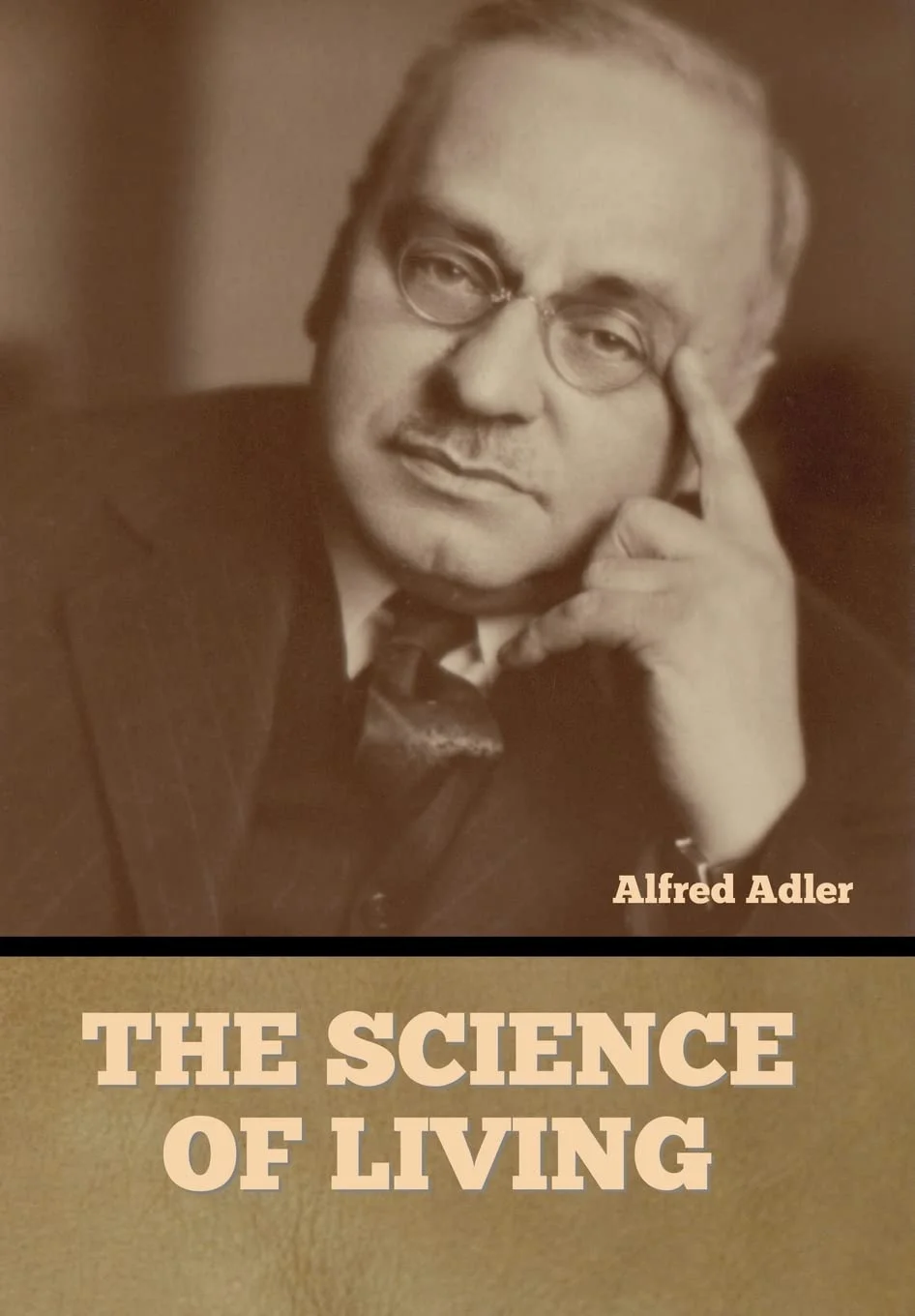
The Science of Living
 Alfred Adler
The Science of Living presents Adler's individual psychology as a practical science of conduct rather than a clinical pathology. Its central argument is that every person is guided by a self-chosen goal of superiority, expressed through a unified 'style of life' that shapes memory, emotion, dream, and habit. The decisive measure of that style is Gemeinschaftsgefühl — social interest — the degree to which a person's striving serves the community rather than a private fiction. Adler applies this framework across childhood education, love, marriage, and sexual problems, treating psychological health as a matter of courage and cooperation.
Key Details
Book Archives
View AllExplore detailed research articles, summaries and analyses from this book.


Related Books
View AllSimilar books from the same category, ranked by shared topics and reader engagement.



Key Insights — Read in 10 Minutes
What is the central claim of The Science of Living, and what does it reject?
Adler argues that psychology should be a practical science of conduct, not a pathology of disease. Every person pursues a self-chosen goal of superiority through a unified 'style of life' that governs memory, emotion, movement, and dream. What the book rejects is the Freudian reduction of mental life to instinctual drive and the Oedipal conflict. For Adler, the decisive question is not what drives a person but where they are headed and whether that direction serves the community. The book's lectures apply this framework to education, marriage, and sexuality as concrete tasks of living.
How does Adler's account differ from Freud's, and what did that dispute cost Adler?
Freud explained behavior through unconscious instinctual drives rooted in early sexual conflict; Adler explained it through a conscious, future-oriented goal and the social context in which it forms. Freud's method was retrospective and archaeological, Adler's prospective and teleological. The dispute was institutional as well as theoretical: Adler was expelled from Freud's Vienna Psychoanalytic Society in 1911, and The Science of Living, delivered as lectures around 1925 and published in 1929, is a mature statement of the independent system he built afterward. Freud later dismissed Adler's approach in 'On the History of the Psycho-Analytic Movement' as superficial and moralistic.
What specific concepts did The Science of Living bring to a general audience?
The book popularized Adler's core vocabulary: the 'style of life' as the person's characteristic pattern of striving, the goal of superiority as compensation for inferiority feelings, and Gemeinschaftsgefühl — social interest — as the measure of mental health. It also presented Adler's method for interpreting 'old remembrances' and dreams as evidence of a person's guiding fiction rather than as repressed wishes. These concepts entered popular psychology through this and Understanding Human Nature, influencing later work on self-esteem, parenting, and personality, often without Adler's name attached.
How has The Science of Living been received, and what critiques have been made?
The book was reviewed in outlets such as The New York Times upon its 1929 publication and later in Contemporary Psychology, where a 1970 reviewer noted its emphasis on amelioration, pragmatism, and educational reform as congenial to American readers . Critics from the psychoanalytic side dismissed Adler's system as anecdotal and moralistic. Later scholars have noted that 'style of life' and 'social interest' resist operationalization for research. Modern readers have also flagged that some of Adler's views on sexuality in the book's later chapters reflect the assumptions of his era rather than contemporary understanding .
What is the textual history of The Science of Living, and how reliable are current editions?
The book originated as a series of lectures Adler delivered around 1925 and was first published in English in 1929 by Greenberg in New York . It was later issued by Garden City Publishing and Allen & Unwin in London, with a note on the author and his work supplied by later editors . Modern reprints vary widely in quality: multiple Amazon reviewers report that recent paperback editions are riddled with typographical and grammatical errors to the point of being difficult to read . Readers should seek the 1929 first edition or a reputable scholarly reprint rather than cheap print-on-demand copies.
What is the most common misreading of The Science of Living?
The most common misreading is that Adler reduces everything to an 'inferiority complex' understood as low self-esteem. In this book, inferiority feelings are universal and can be productive; what becomes problematic is a compensating goal of superiority that has been turned into a private fiction divorced from social usefulness. Readers also mistake Adler's 'will to power' for a drive to dominate others, when he meant a striving for overcoming and mastery. And because the book is conversational and lecture-based, it is often treated as self-help rather than as a systematic statement of individual psychology.
Show 1 more insights
How does The Science of Living relate to Adler's other books?
It extends the popular framework of Understanding Human Nature (1927) into more concrete applied territory — education, marriage, sexuality — while revising the technical apparatus of The Neurotic Constitution (1912) into accessible lecture form. Problems of Neurosis (1929) then deepens the clinical side of the same mechanism, centering neurosis on courage and social interest. Read together, the three books show Adler moving from polemical break with Freud to a settled system that could be taught to teachers, parents, and general readers.
Wealthy Psyche is an intellectual archive. We do not host, distribute, or sell book copies — physical or digital. We provide structured knowledge to help you think better, faster.