


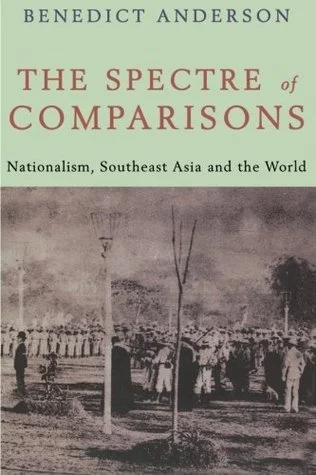
The Spectre of Comparisons: Nationalism, Southeast Asia, and the World
 Benedict Anderson
Benedict Anderson's 1998 essay collection takes its title from José Rizal's phrase 'el demonio de las comparaciones' — the demon of comparisons — describing the disorientation of seeing one's own nation through the lens of an outside other. Anderson argues that nationalism is constitutively shaped by this comparative gaze: nations stir into self-awareness by matching themselves against others, often through an inverted telescope, viewing Europe from the periphery rather than the reverse. The essays range from Indonesian politics and Thai electoral violence to East Timor and the Philippines, developing concepts like 'long-distance nationalism' and the 'logic of seriality' to explain how modern states classify and imagine their populations.
Key Details
Related Books
View AllSimilar books from the same category, ranked by shared topics and reader engagement.



Key Insights — Read in 10 Minutes
What does Anderson mean by 'the spectre of comparisons'?
The phrase comes from José Rizal's novel Noli Me Tangere (1887), where the protagonist returns to Manila from Europe and can no longer see the city's gardens innocently — they are shadowed inescapably by images of their European counterparts. Rizal names this 'el demonio de las comparaciones.' Anderson adopts the phrase to describe a constitutive feature of modern national consciousness: nations become self-aware by measuring themselves against other nations, often through an inverted telescope that views the metropole from the periphery. The spectre is not a distortion to be corrected but the very condition under which nationalist imagination operates.
What is 'long-distance nationalism' and how does it relate to Anderson's earlier work?
Long-distance nationalism describes nationalism conceived by diasporic populations physically or emotionally distant from their homeland. Anderson argues that exile — whether literal or internal — plays a crucial role in generating nationalist feeling, often in more radical and uncompromising forms than nationalism experienced at home. The concept addresses a question left unresolved in Imagined Communities: how do international movements of people, capital, and goods shape nationalism? The Japanese reviewer Kiyoshi Fujiwara notes that this is one of the genuinely new contributions in The Spectre of Comparisons, extending the earlier book's print-capitalism focus to account for migration and diaspora.
How does this book relate to Imagined Communities?
The Spectre of Comparisons is not a sequel in the conventional sense but a collection of essays written between the first and revised editions of Imagined Communities. Only the first three chapters directly develop the earlier book's theoretical framework, introducing concepts like 'bound serialities' (census-based population classification) and 'serialization.' The remaining fourteen chapters are case studies of Southeast Asian politics and culture. Critics like Christophe Jaffrelot argued that the theoretical supplements add little to the original work, while the case studies read as a patchwork. The book is best understood as Anderson's essays on the region that informed his larger theoretical project.
What is 'the logic of seriality' that Anderson develops in these essays?
Anderson introduces seriality to describe how modern states create and classify populations through instruments like the census, thereby making them visible and governable. Unlike the 'imagined community' of the nation, which is a bounded horizontal comradeship, seriality treats individuals as interchangeable units in categories — citizens, taxpayers, ethnic groups. Anderson calls these 'bound serialities.' The concept helps explain how colonial and postcolonial states produced the very social categories they claimed merely to describe, and how nationalism and state bureaucracy operate through different but intertwined modes of imagining collectivities.
How was The Spectre of Comparisons received critically?
Reception was mixed. Christophe Jaffrelot, writing in Critique Internationale, warned that readers hoping for a follow-up to Imagined Communities would be 'cruelly disappointed,' noting that twelve of the seventeen chapters had been published elsewhere and that Anderson himself apologised for the book's 'rather strange form.' A Japanese reviewer observed that Anderson's writing lacks a fixed method and reads like a 'box of sweets' — essays picked up and put down at will, held together by his distinctive sensibility. However, other reviewers praised the book as a brilliant culmination of nationalism studies, capable of leading readers to a vantage point for analysing universal nationalist phenomena.
Why does the book focus so heavily on Indonesia, Thailand, and the Philippines?
These three countries represent Anderson's primary areas of expertise and offer a uniquely comparative set. Indonesia experienced Dutch colonialism and is predominantly Muslim; Thailand (Siam) was never colonised and is predominantly Buddhist; the Philippines experienced Spanish and then American colonialism and is predominantly Christian. This diversity of colonial experience and religious tradition allows Anderson to examine nationalism comparatively without reducing it to a single colonial model. The three cases also share the experience of anti-colonial nationalism in the twentieth century, and Anderson's reading of their nationalist texts, monuments, and electoral politics constitutes the book's empirical core.
Show 1 more insights
What is the significance of the Sukarno-Hitler passage that opens the book?
Anderson recalls hearing President Sukarno, Indonesia's anti-colonial leader, praise Hitler in a public speech as a nationalist who had been 'clever' in depicting his ideals. Anderson was translating the speech for Western diplomats, one of whom could only see Sukarno as a deranged charlatan. Anderson uses this memory to illustrate the spectre of comparisons: he could not return to the conventional Western view of Hitler as simply monstrous, because Sukarno's inverted perspective had forced him to see Hitler through anti-colonial eyes. The passage exemplifies Anderson's method — using moments of disorientation to expose the parochialism of seemingly universal judgments.
Wealthy Psyche is an intellectual archive. We do not host, distribute, or sell book copies — physical or digital. We provide structured knowledge to help you think better, faster.