


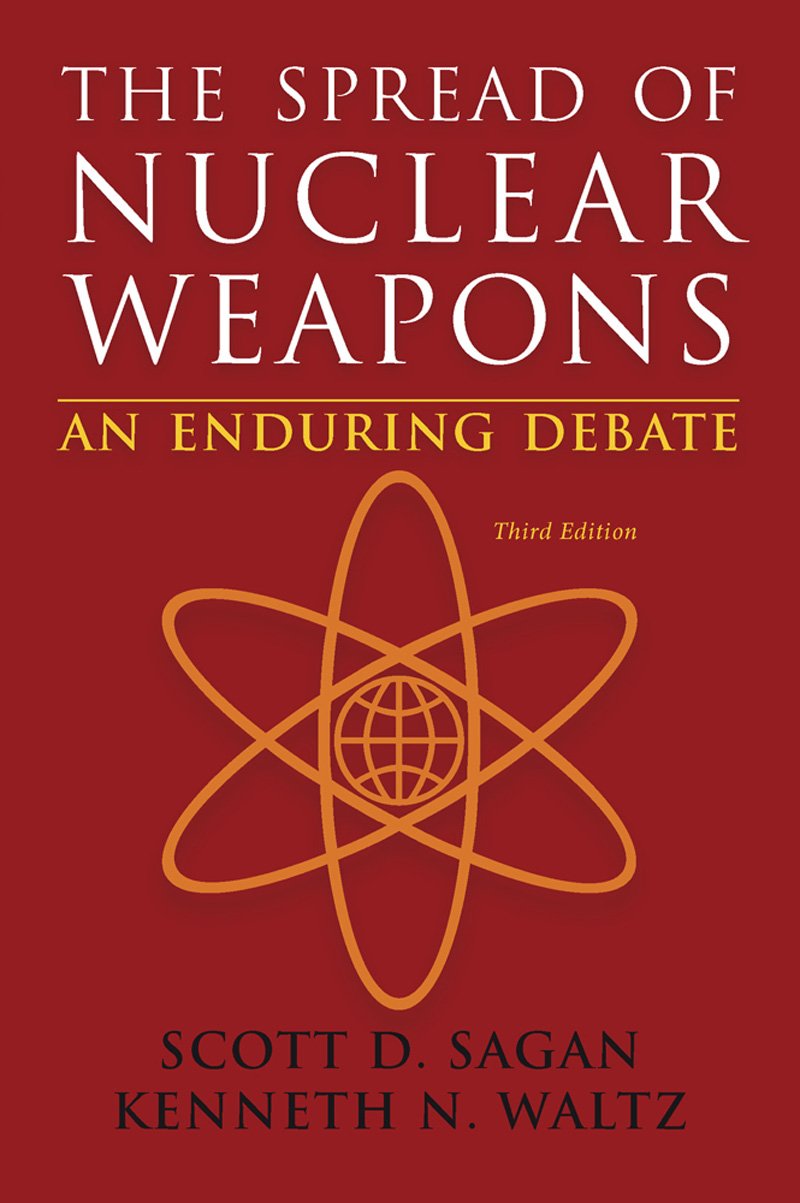
The Spread of Nuclear Weapons: A Debate
 Kenneth N. Waltz
This book stages a direct debate between two competing theories of nuclear proliferation. Waltz, the neorealist, argues that 'more may be better': new nuclear states will use their arsenals rationally to deter attack, making international relations more stable, not less. Sagan, the organizational theorist, counters that 'more will be worse': novice nuclear states lack the command-and-control safeguards to prevent accidents, miscalculation, or unauthorized use. The debate format—opening arguments, rebuttals, and closing essays—crystallizes a fundamental disagreement about whether nuclear weapons are stabilizing instruments of deterrence or inherently dangerous organizational risks.
Key Details
Key Insights — Read in 10 Minutes
What is the central disagreement between Waltz and Sagan in this book?
The debate hinges on whether nuclear proliferation increases or decreases international stability. Waltz argues that nuclear weapons make wars hard to start because the cost of attack becomes prohibitively high. He contends that even radical states will act rationally once they possess nuclear deterrents, and that the gradual spread of nuclear weapons will restore clarity to international politics . Sagan rejects this rationalist framework. Drawing on organizational theory, he argues that new nuclear states will lack the command-and-control systems necessary to prevent accidental or unauthorized use, making proliferation inherently destabilizing regardless of leaders' intentions .
What does Waltz mean by 'more may be better'?
Waltz's provocative phrase captures his argument that the spread of nuclear weapons is not a catastrophe waiting to happen but a potential source of stability. He observes that the nuclear balance of terror helped maintain the 'long peace' between the United States and the Soviet Union during the Cold War, preventing direct great-power conflict . He predicts that new nuclear states—even those with volatile politics or military governments—will use their weapons to deter threats rather than to launch attacks, because the risk of devastating retaliation is too great. For Waltz, nuclear weapons are the ultimate guarantor of national survival .
What is Sagan's organizational critique of nuclear optimism?
Sagan argues that Waltz's rational deterrence model ignores the organizational realities of nuclear command and control. Professional military organizations, he contends, are prone to biases, inflexible routines, and parochial interests that can lead to deterrence failures and accidental war . New nuclear states in particular face acute risks: they may lack secure second-strike capabilities, making their arsenals vulnerable to preemptive attack during crises. Sagan cites historical near-misses and organizational accidents to show that the systems maintaining nuclear safety are fragile, not foolproof. His conclusion is that 'more will be worse' because the statistical odds of catastrophic failure rise with every new nuclear state .
How did this book originate?
The book grew out of two articles published in the early 1990s that took opposing positions on nuclear proliferation. Waltz's essay 'The Spread of Nuclear Weapons: More May Be Better' originally appeared as an Adelphi Paper in 1981 . Sagan's rebuttal, 'The Perils of Proliferation,' argued from organizational theory that new nuclear states would be uniquely dangerous. The editors at W.W. Norton brought the pieces together and asked each author to write rebuttals to the other, resulting in the debate format that has made the book a classroom staple . The original 1995 edition has been updated twice, most recently as 'An Enduring Debate' .
Why has this book become a staple in International Relations courses?
The book's enduring appeal lies in its brevity, accessibility, and crystal-clear articulation of two fundamental theoretical perspectives. As one reviewer noted, it is 'an exceptionally clear distillation of the parameters of proliferation' that makes arcane nuclear policy debates accessible to undergraduates . The debate format—Waltz and Sagan present opening arguments, then rebut each other, then offer closing essays—creates a 'lively and genuine dialogue' that forces readers to confront the strengths and weaknesses of both positions . It is short enough to assign in a single week yet rich enough to sustain extended discussion, a rare combination in academic publishing .
How have the authors' arguments evolved across editions?
The second edition, 'A Debate Renewed' (2003), added new sections on India and Pakistan, terrorism, and missile defense, updating the debate for post-9/11 concerns . The third edition, 'An Enduring Debate,' incorporated discussions of North Korea, Iran, and the renewed push for nuclear zero. Waltz's core argument remained remarkably consistent across four decades; he continued to contend that proliferation would stabilize international politics. Sagan sharpened his organizational critique with fresh case studies of near-misses and command failures. Francis Gavin later argued both authors should engage more deeply with archival evidence to refine their positions .
Wealthy Psyche is an intellectual archive. We do not host, distribute, or sell book copies — physical or digital. We provide structured knowledge to help you think better, faster.