


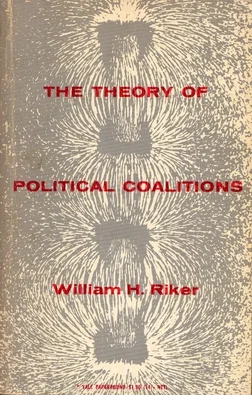
The Theory of Political Coalitions
 William H. Riker
The Theory of Political Coalitions applies game theory to politics, arguing that political actors form coalitions according to a size principle: in zero-sum games, winning coalitions tend toward the minimum size necessary to win, while in non-zero-sum games they tend toward the minimum winning size needed to secure the payoff. Riker's central mechanism is that coalition builders seek to maximize their share of the rewards by excluding unnecessary partners. Though not a book about federalism directly, it supplies the rational-choice foundation for his later federal bargain theory: federal unions are coalitions, and their durability depends on the strategic calculations of the politicians who build them.
Key Details
Related Books
View AllSimilar books from the same category, ranked by shared topics and reader engagement.
.webp?alt=media&token=aa57557c-98c6-4edb-ba61-0189bc741142)
.webp?alt=media&token=fe90549a-9842-4d96-b442-a481f7724ad7)
Key Insights — Read in 10 Minutes
What is the central claim of The Theory of Political Coalitions, and what does it reject?
Riker argues that political coalitions follow a size principle: in zero-sum games, winning coalitions tend toward the minimum size necessary to win, because each member wants to maximize their share of the payoff; in non-zero-sum games, they tend toward the minimum winning size required to secure the benefit. He rejects descriptive, impressionistic accounts of coalition behavior and the assumption that politicians build oversized coalitions for legitimacy or safety. His model treats politics as strategic, rational, and payoff-oriented, with coalition size determined by members' calculation of advantage.
What specific concept did Riker introduce, and how is it used today?
Riker introduced the size principle—that winning coalitions tend toward minimum winning size—as a general proposition about political coalitions. It became a foundational concept in rational-choice political science and is applied to legislative coalitions, parliamentary government formation, party systems, and international alliances. It also informed Riker's later work on federalism as a bargain and on heresthetics—the art of manipulating political dimensions to win. The size principle remains a standard reference in coalition theory, though empirical tests have qualified its scope.
How does this book relate to Riker's theory of federalism?
The Theory of Political Coalitions provides the game-theoretic foundation for Riker's later Federalism: Origin, Operation, Significance. There, federal unions are treated as coalitions formed by elites seeking expansion or security, and the federal bargain is the exchange of autonomy for union. The size principle explains why federal bargains take the form they do: leaders seek the minimum concessions necessary to secure the union. Riker's federalism theory is essentially the coalition model applied to territorial politics, which is why the two books are usually read together.
How has the size principle held up empirically?
The size principle has been influential but contested. Studies of parliamentary coalitions have found many minimum-winning cabinets, but also oversized and minority governments, which the theory struggles to explain. Legislative coalition research shows that minimum-winning behavior is common but not universal, and that ideological proximity, institutional rules, and policy preferences also shape coalition size. Riker himself qualified the principle for non-zero-sum settings. It survives as a powerful baseline model rather than a universal law of coalition formation.
What real-world systems or practices use Riker's coalition theory?
Riker's framework is used in parliamentary government formation, where parties calculate the minimum winning coalition; in legislative bargaining and logrolling in the U.S. Congress; in international alliance formation and burden-sharing; and in coalition-building in multi-party democracies. It also underpins formal models of cabinet stability and party competition. The size principle and its elaborations are standard tools in positive political theory and comparative politics, especially in European coalition studies and in research on coalition governments.
What is a common misconception about The Theory of Political Coalitions?
A common misconception is that Riker claims all coalitions are minimum-winning. He qualifies the principle by distinguishing zero-sum from non-zero-sum games and treats it as a tendency, not a universal law. Another misreading treats the book as a work of federalism; it is a general rational-choice theory of coalitions, and its federalism relevance is indirect, through Riker's later application. Readers looking for a theory of federal institutions will not find it here—they will find the strategic logic that Riker later applied to federal bargains.
Wealthy Psyche is an intellectual archive. We do not host, distribute, or sell book copies — physical or digital. We provide structured knowledge to help you think better, faster.