


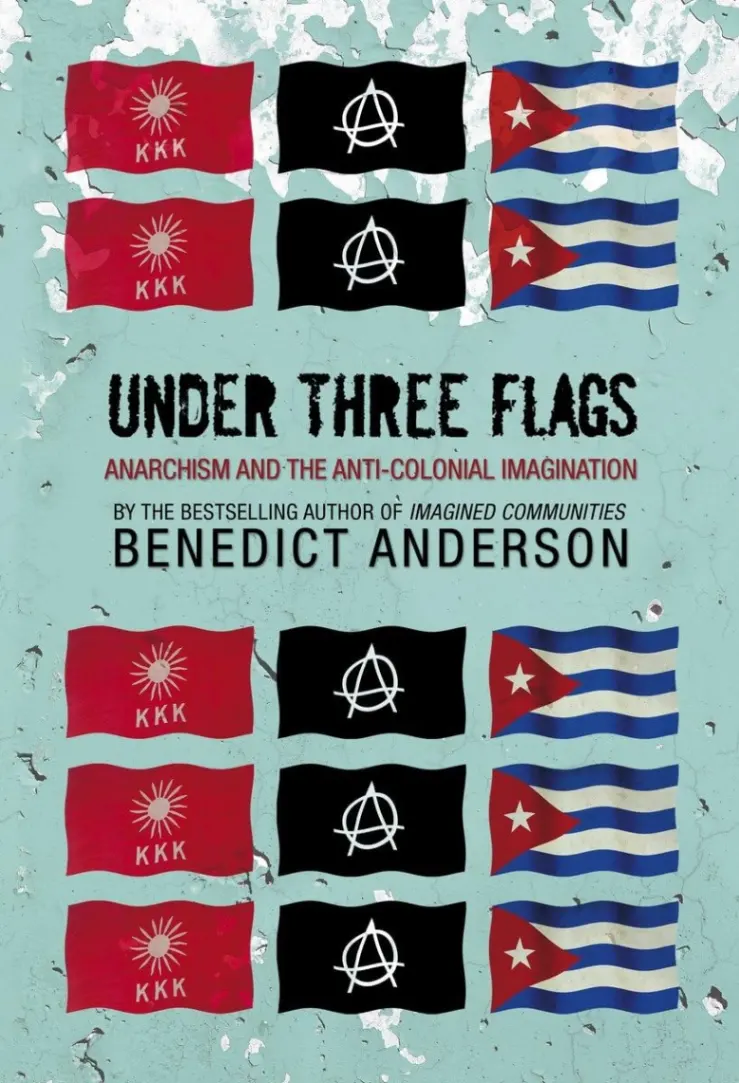
Under Three Flags: Anarchism and the Anti-Colonial Imagination
 Anthony D. Smith
Anderson's 2005 study recasts the themes of Imagined Communities through a global history of fin-de-siècle anarchism and anti-colonial nationalism. The book's central argument is that militant anarchism and nascent anti-colonial movements were not separate phenomena but deeply intertwined, connected through translation, travel, and shared tactics of 'propaganda by the deed.' Anderson maps this 'gravitational force' by following two Filipino intellectuals, José Rizal and Isabelo de los Reyes, as they absorbed avant-garde European politics and literature in Spain, France, and Germany, then returned to the Philippines to mobilise against Spanish colonialism. The book positions nationalism not as an isolated ideology but as a product of transnational intellectual exchange.
Key Details
Related Books
View AllSimilar books from the same category, ranked by shared topics and reader engagement.



Key Insights — Read in 10 Minutes
What is Anderson's central argument in Under Three Flags?
Anderson argues that nineteenth-century anarchism and anti-colonial nationalism were not separate movements but deeply intertwined currents of the same global radical ferment. Through 'propaganda by the deed,' anarchists and anti-colonialists alike believed that exemplary political action—including assassination and terror—could ignite mass resistance. Anderson traces this connection by following José Rizal and Isabelo de los Reyes, Filipino intellectuals who absorbed anarchist and avant-garde European thought during their years in Spain, France, and Germany, then transformed it into Philippine nationalist critique. The book is an experiment in what Anderson calls 'political astronomy,' mapping the gravitational pull of anarchism between militant nationalisms on opposite sides of the planet .
How does Under Three Flags relate to Anderson's Imagined Communities?
Anderson presents Under Three Flags as a 'radical recasting' of themes from Imagined Communities . Where the earlier book offered a universal theory of nationalism grounded in print capitalism, this study narrows its focus to a specific transnational network of anti-colonial intellectuals in the 1880s and 1890s. Anderson deepens the earlier work by showing how nationalism was shaped not only by print and vernacular literacy but by the physical movement of radicals across empires, by the translation of European anarchist ideas into colonial contexts, and by the shared tactical repertoire of 'propaganda by the deed.' The book thus particularises and complicates the abstract model of the 1983 classic.
Why does Anderson focus on José Rizal and Isabelo de los Reyes?
Rizal and de los Reyes represent two contrasting strategies of anti-colonial intellectual work. Rizal, executed by Spanish authorities in 1896, is best known for his novels Noli Me Tangere and El Filibusterismo, which Anderson reads as 'novels of anti-colonial prophecy' shaped by European avant-garde literature and anarchist ideas . De los Reyes, a pioneering folklorist imprisoned in Barcelona alongside Catalan anarchists after the 1896 uprisings, returned to the Philippines to organise the first militant trade unions under the influence of Bakunin and Malatesta . Together they illustrate how the Philippines' nationalist imagination was forged through direct encounters with European radicalism.
How was Under Three Flags received by critics?
Reviews were mixed. Some praised Anderson's meticulous reconstruction of transnational intellectual networks and his vivid depiction of fin-de-siècle radical politics . However, critics like Greg Bankoff observed that while the book's declared aim is to chart anarchism's global influence, it remains primarily a study of the Philippines, with Anderson paying 'very little attention' to the Katipunan or to José Martí's Cuban struggle . A reviewer in Archipel found Anderson's attempt to prove anarchist influence on anti-colonial movements 'not really convincing' . Koichi Hagimoto noted that Anderson's own reading of Rizal's political position seems contradictory—calling El Filibusterismo 'lacking in any coherent political position' while simultaneously emphasising its anti-colonial militancy .
What does the title 'Under Three Flags' refer to?
The title refers to three flags that symbolise the book's intersecting revolutionary currents: the red flag of the Philippine anti-colonial Katipunan movement, adopted in 1894; the black flag of anarchism; and the Cuban flag, adopted in 1902 after the island's independence struggle against Spain . The cover of the Verso edition displays these three flags . Anderson's argument is that these were not parallel but interconnected struggles, linked by shared enemies (Spanish colonialism), shared tactics (propaganda by the deed), and shared intellectual circuits that carried radical ideas across the Caribbean, Imperial Europe, and the South China Sea.
What is the significance of El Filibusterismo in Anderson's analysis?
Anderson treats Rizal's second novel, El Filibusterismo (1891), as a pivotal text in the history of anti-colonial imagination. He describes it as 'probably the first incendiary anti-colonial novel written by a colonial subject outside Europe' . The novel's climax features a jewelled pomegranate packed with nitroglycerine, primed to destroy Manila's colonial elite—an image that Anderson reads as Rizal's engagement with anarchist 'propaganda by the deed' . Yet Anderson also notes that the novel is 'narrow and lacking in any coherent political position,' a tension that Hagimoto identifies as unresolved in the book . The novel's global references—Cuba, Germany, Egypt, Russia, France, China, Japan—make it, in Anderson's term, a 'novela mundial' .
Show 2 more insights
What does Anderson mean by 'political astronomy'?
Anderson describes his method as an 'experiment in political astronomy' that 'attempts to map the gravitational force of anarchism between militant nationalisms on opposite sides of the planet' . The metaphor is deliberate: rather than tracing direct causal chains or organisational links, Anderson is interested in the invisible pulls and affinities that drew anti-colonial radicals toward anarchist ideas and tactics. This approach allows him to study connection without reducing it to influence or imitation. It also reflects his broader view that nationalism must be understood through transnational and comparative frames, not through the lens of a single nation's internal development.
Is Under Three Flags a work of history or of theory?
It is both, but the balance shifts toward history. Unlike Imagined Communities, which advances a general theoretical model, Under Three Flags is built around detailed archival research on specific individuals, texts, and events in the 1880s and 1890s. Anderson draws on Rizal's correspondence, de los Reyes's folklore writings, Spanish anarchist periodicals, and colonial police records to reconstruct the intellectual world of Filipino ilustrados. Yet the book is framed by theoretical questions inherited from Imagined Communities about how anti-colonial nationalism is imagined and mobilised. The result is a hybrid: a work of transnational intellectual history that tests and enriches Anderson's earlier theoretical claims.
Wealthy Psyche is an intellectual archive. We do not host, distribute, or sell book copies — physical or digital. We provide structured knowledge to help you think better, faster.