

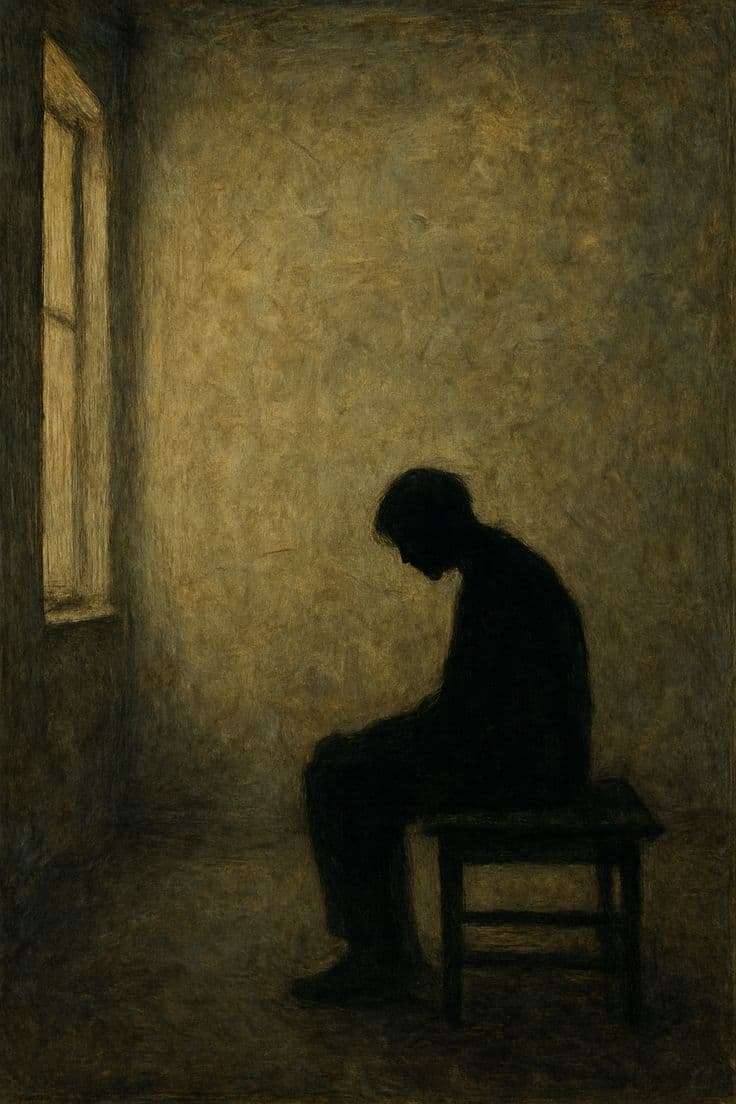
There is a question that almost no one asks, because the moment it becomes audible, it begins to dissolve the questioner. It is not a question that can be answered with a story, a credential, a diagnosis, or a memory. It is not a question that respects the careful architecture of a life. It arrives without warning, often in the silent hours when sleep refuses to come, or in the hollow aftermath of an achievement that was supposed to fix everything, or in the vertiginous stillness that follows a great loss. The question is simply this: If I strip away my thoughts, my emotions, and my entire personal history, what remains? Is there a “me” underneath all of that, or is the “me” precisely the sum of those parts, and the silence after their removal is not a deeper self but simply nothing at all?
This is not a poetic musing. It is the most direct and destabilizing inquiry a human being can undertake. Most of us live our entire lives running sophisticated avoidance patterns around this question. We fill the silence with noise, the emptiness with activity, the uncertainty with dogmatic certainties borrowed from culture, family, and the ambient ideologies of our time. We construct an identity—a meticulously curated collage of opinions, accomplishments, traumas, tastes, and tribal affiliations—and we present it to the world and to ourselves as if it were an immutable, coherent entity. Advaita Vedanta, in its uncompromising clarity, suggests that this identity is not merely incomplete or imperfect. It is a complete misidentification. The “you” that you think you are is a character in a dream, and the dreamer is not another, better version of the character. The dreamer is consciousness itself, formless, timeless, and utterly free of every attribute you have ever used to define yourself.
The Inventory of a Self: What We Mistake for Identity
The Museum of Thoughts
Take a moment to observe the activity we casually call “my thinking.” Notice that thoughts arise without your permission. They appear like weather systems out of a neural sky you neither control nor fully understand. A memory of an embarrassing moment from twenty years ago. A jingle from an advertisement you hate. A rehearsal of a conversation that hasn’t happened. A judgment about the person sitting across from you. A spike of anxiety about a deadline. These mental events parade through awareness, and a curious secondary process immediately claims them: “I am thinking this. This is my thought. This thought says something about who I am.”
But look closely. If you were truly the thinker of your thoughts, you would be able to stop them at will. You would not be ambushed by unwanted ruminations at 3 a.m. You would not have songs stuck in your head for days. The very fact of intrusive, unwanted mental content demonstrates that thinking is largely an autonomic process, a secretion of the brain, not a deliberate act of a sovereign self. The “I” that claims ownership of thoughts is itself a thought—the subtlest and most persistent one, the “I-thought” that flits from object to object, attaching itself like a burr to every passing mental event and declaring, “Mine.”
This is the first radical insight of self-inquiry. You are not your thoughts. Thoughts are objects appearing in awareness. They are perceived, and therefore they cannot be the perceiver. The eye cannot see itself. The tongue cannot taste itself. The awareness that illuminates thoughts cannot itself be a thought. It is the silent, luminous space in which thoughts arise, play out their dramas, and dissolve. Most people spend their entire lives so identified with the stream of thinking that they never notice the stream itself is appearing in something. That something is what you are.
The Weather of Emotions
Emotions feel even more intimately “me” than thoughts. A wave of anger rises, and the whole body-mind seems to become anger. Sadness descends like a fog, and the world turns gray. Joy arrives unannounced, and for a blessed interval, the sense of separation thins. Because emotions are so visceral, so embodied, the identification with them is nearly total. “I am angry. I am sad. I am an anxious person. I am a passionate person.” These statements feel like simple reports of fact.
But again, apply the scalpel of attention. An emotion is a pattern of sensation—tightness in the chest, heat in the face, a quivering in the gut—coupled with a narrative thought. The sensation arises, persists for a time, and then fades. If you were the emotion, you would fade with it. But you don’t. A new emotion takes its place. The screen of awareness remains unchanged. Even the most intense grief, which feels like it will swallow the self entirely, is witnessed by something that is not grieving. There is a part of you that registers “grief is here” without itself being grief-stricken. That part has no voice. It makes no commentary. It simply sees.
This is not a call to suppress emotions or to become a cold, detached observer. It is an invitation to discover a dimension of being that is already free, even while the heart is breaking. The one who is aware of sadness is not sad. The one who is aware of fear is not afraid. Resting as that awareness does not make the sadness disappear. It makes the sadness bearable, even meaningful, because it is no longer “my” sadness threatening to annihilate “me.” It is sadness, a temporary, impersonal configuration of energy, held in the vast, compassionate space of awareness. That space is what you are.
The Archive of the Past
The most seductive component of the false self is the narrative constructed from memory. You have a story—where you were born, who your parents were, the triumphs and traumas of childhood, the relationships that shaped you, the career path you chose or that chose you, the mistakes you made, the lessons you learned. This story feels like the very core of who you are. Without it, you fear you would be an amnesiac ghost, a blank slate with no depth, no character, no identity at all.
But what is memory, actually? It is not a video recording stored in a vault. It is a reconstruction that occurs in the present moment, heavily edited, emotionally colored, and demonstrably unreliable. Every time you recall an event, you modify it slightly. Neuroscientific research on memory reconsolidation has shown that memories are literally altered each time they are retrieved. The past you think of as a fixed, solid foundation is actually a fluid, ever-shifting story told by the present brain. More importantly, the entire archive of memory is something that appears now. When you remember your first day of school, the memory arises as a thought-image in the present moment. The past is never actually experienced as past. It is always a present appearance.
The “you” that is defined by your past is a narrative convenience, not an ontological reality. If all your memories were erased overnight—and this tragically happens in certain neurological conditions—there would still be an awareness, a sense of presence, an “I am” that persists before any story reconstructs itself. That simple, bare sense of existence, prior to the story of “I am this particular person with this particular history,” is closer to the truth of who you are than any biography. The biography is a costume. The wearer is the awareness that was present throughout every scene of the life, unchanged by any of it.
Layer of Identity | What It Actually Is | The Advaitic Insight |
|---|---|---|
Thoughts | Autonomic mental secretions; impersonal neural events. | Objects perceived; you are the perceiving space, not the thoughts. |
Emotions | Patterns of bodily sensation plus narrative labels. | Temporary weather in awareness; the witness is not affected by the storm. |
Memories | Fluid, present-moment reconstructions; highly edited stories. | Appearances in the now; the awareness remembering is prior to the memories. |
Personality | Conditioned patterns of behavior and preference; a useful social interface. | A role played; the actor is consciousness, not the character. |
The Residue of Subtraction: The Direct Inquiry
The Experiment of Now
Let us conduct the inquiry not as an abstract philosophical exercise but as a direct, lived experiment. Right now, as you read these words, there is an undeniable sense of presence. You exist. You are aware. That much is self-evident. Now, for a moment, set aside the thought “I am reading an article.” Set aside the thought “I am a person interested in philosophy.” Set aside the memory of what you did this morning and the anticipation of what you will do later. Set aside the subtle physical sensations—the pressure of the chair, the temperature of the room, the rhythm of the breath. Set aside even the feeling of being a “you” that is setting things aside.
What remains? Do not answer verbally. Do not reach for a concept. Just notice. There is a simple, luminous, open awareness. It has no shape, no color, no location, no gender, no age, no history. It is utterly empty, and yet it is not a void. It is alert, awake, present. This awareness is not a special state you have achieved through effort. It is what has been present all along, the unchanging background of every changing experience. You were this awareness before you were born into this body, in the sense that awareness is not born and does not die. You are this awareness now, in the midst of the apparent drama of a life. You will be this awareness after the body falls away, not as a personal soul, but as the timeless presence that was never confined to a person in the first place.
This is not a belief to adopt. It is an observation to verify. The moment you turn attention back toward its source, the object-oriented mind may rebel. It will say, “This is too simple. This is nothing. Where is the profound spiritual experience I was promised?” That rebellion is the ego, panicking because its non-existence is being exposed. Stay with the simple noticing. The profound is hidden in the simple. The most ordinary awareness of being alive is the miracle that the ego overlooks in its frantic search for a more spectacular truth.
The Fear of Nothingness
The inquiry “Who am I without my thoughts, emotions, and past?” often triggers a primal fear. The mind imagines a terrifying void, a black hole of non-existence, an annihilation of everything familiar and dear. This fear is the single greatest obstacle to self-knowledge. It is the guard dog at the gate of the inner sanctum. But the fear is based on a misperception. The void the mind imagines is itself a thought, a concept. The actual experience of thought-free awareness is not a terrifying emptiness. It is a profound peace, a silent fullness, a homecoming that is more real and more satisfying than any experience the ego has ever chased.
The fear is the ego’s fear of its own dissolution. The ego is a bundle of thoughts, and the prospect of thoughtless awareness is, from the ego’s perspective, identical to death. But you are not the ego. You are the awareness in which the ego appears. When a wave subsides back into the ocean, it does not experience annihilation. It experiences the return to its true nature. The fear of nothingness is the last, most sophisticated trick of Maya—the illusion that makes the infinite, peaceful ground of being appear as a terrifying abyss. The abyss is a mirage. What is actually there when the thinking mind falls silent is a plenitude that thought cannot grasp, a love that is not an emotion but the very fabric of existence, a knowing that is not knowledge but the direct taste of being.
The Psychological Layers of Identification
Attachment Theory and the Constructed Self
The psychological sciences, in their own language, have mapped the construction of the ego that Advaita seeks to dismantle. Attachment theory describes how the infant, lacking a developed sense of self, internalizes the relational patterns with primary caregivers. A child whose needs are met with consistency develops a secure base, a felt sense of safety in the world. A child whose needs are met with inconsistency, neglect, or intrusion develops insecure patterns—anxious clinging, avoidant distancing, or a disorganized confusion. These patterns are not just behavioral strategies. They become the very architecture of the developing self. The anxiously attached child grows into an adult whose identity is organized around the pursuit of validation and the fear of abandonment. The avoidantly attached child becomes an adult whose identity is organized around self-sufficiency and the fear of intimacy.
From the Advaitic perspective, these attachment patterns are the earliest and most deeply ingrained layers of the ego illusion. They are the primal stories that the organism tells itself about who it is and what it needs to survive. Psychotherapy, at its best, helps the individual become conscious of these patterns, work through the associated emotional wounds, and develop more secure internal models. This is invaluable work. A fragile, dysregulated nervous system is not a suitable vehicle for the rigors of self-inquiry. However, even the most perfectly secure attachment style is still an egoic construct. It is a healthy ego, a well-functioning dashboard, but it is still a dashboard. The final liberation Advaita points to is not the perfection of the ego but the recognition that the ego, whether healthy or wounded, is an appearance in consciousness, not consciousness itself. The healed ego can finally relax enough to see through itself.
Cognitive Fusion and the Prison of Identification
In Acceptance and Commitment Therapy, the term “cognitive fusion” describes the state of being so entangled with a thought that the thought and the self become indistinguishable. You don't have the thought “I am a failure.” You are the failure. The thought wears your face. The world constricts around it. This is not merely a description of a clinical symptom. It is a precise account of the default mode of human consciousness. Most people live in a state of near-continuous cognitive fusion. They are blended with every passing mental event, whipped around by the volatile weather of the mind, never realizing there is a space between the thinker and the thought.
The practice of cognitive defusion—learning to observe thoughts as thoughts, as mental events rather than truth-claims about reality—is a step toward liberation. “I notice I am having the thought that I am a failure” creates a tiny but crucial gap. That gap is the beginning of awakening. Advaita takes this to its logical conclusion. It asks not just “What is the thought?” but “Who is the one noticing the thought?” The defusion from individual thoughts leads to the defusion from the thought of the individual self. The ultimate defusion is the recognition that the one who is aware of all thoughts, feelings, and sensations is not itself a thought, feeling, or sensation. It is the unconditioned awareness in which the entire conditioned drama of a life unfolds. This is not a psychological technique to be applied. It is a fundamental shift in identity that recontextualizes all techniques.
The Identity That Was Never There: Advaita Vedanta’s Radical Deconstruction
The Pancha Kosha Revisited
The Taittiriya Upanishad's teaching of the five sheaths is the classic Vedantic method for systematically dismantling false identification. It leads the student inward, layer by layer, until nothing is left to identify with—and in that nothing, the true Self is discovered as the ever-present witness.
The outermost sheath is the physical body, the Annamaya Kosha. We say “I am tall,” “I am sick,” but we also say “my body,” implying an owner distinct from the owned. The body is an object perceived. You are not the body.
The second sheath is the vital energy, the Pranamaya Kosha. We say “I am tired,” “I am hungry,” but these are passing states. In deep sleep, the vital energy continues, but “you” are not aware of it. It is an object. You are not the prana.
The third sheath is the mind, the Manomaya Kosha, the realm of thoughts and emotions already examined. Perceived. Passing. Not the perceiver.
The fourth sheath is the intellect, the Vijnanamaya Kosha, the faculty of discernment, belief, and self-narrative. “I am a rationalist.” “I am a seeker.” This is the subtlest and most seductive identification. But beliefs change. The intellect falls silent in shock or awe. It is an object. You are not the intellect.
The fifth sheath is the bliss body, the Anandamaya Kosha, experienced in deep sleep and deep meditation as a state of undifferentiated peace. This is the final refuge of the spiritual ego, which clings to bliss as its true nature. But bliss, too, comes and goes. It is an object of experience. You are the witness of the bliss, not the bliss itself.
When all five sheaths are negated—neti, neti, not this, not this—what remains is not a nihilistic zero. What remains is the Atman, the pure witness-consciousness that is the substratum of all sheaths, the light in which all experience occurs. It is not a thing among things. It is the very condition of there being any experience at all. You are that.
The Three States and the Fourth
Another powerful Vedantic analysis is the examination of the three states of consciousness: waking, dreaming, and deep sleep. In the waking state, the world of objects appears, and the ego functions in its full, active mode. In the dream state, a different world appears, a purely mental projection, and a dream-ego navigates it, experiencing real fear, real joy, within the dream context. In deep sleep, both the world and the ego vanish. There is no experience of objects, no self-awareness. And yet, upon waking, you report, “I slept deeply. I was peaceful.” There is a continuity of existence that spans the gap.
That continuity cannot be the waking ego, because the waking ego disappears in deep sleep. It cannot be a dream ego. What is it that persists? Advaita calls it Turiya, the fourth state, which is not really a state but the ever-present ground of the other three. It is pure, objectless awareness, the silent witness of the presence and absence of all phenomena. You taste this every night. It is not an exotic mystical attainment. It is the most ordinary, familiar, and overlooked aspect of your existence. The practice of self-inquiry is simply to become conscious of this Turiya not just in deep sleep but in the midst of waking and dreaming as well. To recognize that the awareness witnessing the waking world is the same awareness that was peaceful in deep sleep, untouched by the drama currently playing on its surface.
The Emptiness After Achievement: A Modern Case Study in Misidentification
The Burnout of the High Achiever
The modern epidemic of achievement burnout provides a vivid, painful illustration of what happens when the self is constructed entirely from thoughts, emotions, and past successes. Consider the archetypal high achiever: the founder who sold her startup, the lawyer who made partner, the academic who received tenure, the athlete who won the championship. In each case, the goal structured an entire identity. The striving was not just a thing they did; it was who they were. The thoughts were consumed with strategy and problem-solving. The emotions were organized around the drama of the chase—exhilaration at progress, anxiety at setbacks. The past was a narrative of rising accomplishment.
And then the goal is achieved. The champagne goes flat. The applause fades. For a few days or weeks, there is a strange, hollow silence. The structuring principle of the psyche has vanished. The thoughts, no longer needed for the grand project, turn inward and become critical. “What now? Is this all there is? What’s wrong with me that I’m not happier?” The emotions, deprived of their external focus, collapse into a diffuse depression. The past, which was supposed to culminate in this moment of permanent fulfillment, suddenly feels like a story without a satisfying ending.
This is the crisis of the constructed self. The self that was built on achieving has achieved, and in achieving, has eliminated its own reason for being. The only way to survive psychologically is to immediately find a new goal, a new mountain to climb, a new identity to construct—and so the cycle repeats, each summit a little less satisfying than the last, until the body or the mind breaks. The Advaitic diagnosis is direct: the suffering is not caused by choosing the wrong goal. It is caused by the fundamental misidentification of the self with the achiever. As long as you believe you are the one who achieves, you will be on a hamster wheel of desire and disappointment. The only exit is to discover who you are prior to achievement—the awareness in which both the striving and the success appear.
The Social Media Self and the Exhaustion of Performance
Another modern arena where the constructed self becomes visible in its pathology is social media. Here, the self is explicitly curated. Images are selected, captions crafted, a persona projected. The goal is validation: likes, comments, shares, the measurable approval of an audience. For many, this online persona becomes more real than the private, uncurated experience. The self is now literally an object to be managed, optimized, and marketed.
The exhaustion that heavy social media users often report is not just information overload. It is the exhaustion of constantly maintaining an illusion. The persona must be fed. It must be defended against criticism. It must be compared with rival personas, a process that inevitably generates envy or superiority. The private self, the simple awareness of being alive, is completely eclipsed by the public, performed self. The thought-stream is hijacked by the question “How will this play?” The emotional life is yoked to the volatile metrics of the platform. The past becomes a highlight reel that must be lived up to. This is Maya operating in high gear, a hall of mirrors where no one is seeing anyone clearly, and everyone is exhausted by the effort of being an image.
Dropping the persona, even for an afternoon, can feel like a profound relief. A walk in nature without the phone. A conversation where you don't try to impress. A morning where you simply sit and feel the breath moving, without documenting it. In these moments, the performance relaxes, and something genuine shines through. That genuineness is the simple sense of “I am,” prior to the thought “I am an influencer” or “I am a success” or “I am a failure.” It is the awareness that was there before you ever posted anything, and it will be there after all the accounts are deleted. It is what you are, unadorned.
The Neuroscience of No-Self
The Default Mode Network and the Narrative I
The default mode network is a set of interconnected brain regions—medial prefrontal cortex, posterior cingulate cortex, angular gyrus—that are highly active when the brain is not engaged in a specific external task. This is the network that generates mind-wandering, self-referential thought, and the construction of the autobiographical narrative. It is, in essence, the neural correlate of the constructed self. When you are lost in thought about your past or future, when you are ruminating about your inadequacies or rehearsing your triumphs, the DMN is humming along, weaving the story of “me.”
Neuroimaging studies of experienced meditators show a marked decrease in DMN activity during meditation. More strikingly, long-term practitioners show reduced DMN connectivity even at rest, suggesting a persistent shift away from the narrative self and toward present-moment, non-self-referential awareness. The brain is not generating the self and then quieting it. The brain, under the influence of sustained attention and inquiry, is literally rewiring itself to support a different mode of being—one in which the self is experienced not as a solid entity but as a transparent, useful, and ultimately optional construction.
This is the neuroscientific echo of the Advaitic truth. The self is not a fixed biological fact. It is a process, a pattern of neural firing, a habit of the brain. Habits can be changed. The brain can be trained to rest in awareness rather than in narrative. The one who trains is not the ego. The training is a surrender of the ego's control, a gradual relaxation of the mental grip, facilitated by practices that quiet the DMN and reveal the awareness that is its silent backdrop.
Psychedelic Ego Dissolution and the Glimpse of the Unconstructed
Recent research into psychedelics, particularly psilocybin, has documented a phenomenon researchers call “ego dissolution” or “oceanic boundlessness.” Under the influence of the substance, the DMN becomes desynchronized, and the sharp boundaries of the self dissolve. Subjects report merging with their surroundings, losing the sense of being a separate individual, and experiencing a profound sense of unity and peace. For many, this is a life-altering event that reduces anxiety, depression, and the fear of death.
Advaita Vedanta would recognize this as a chemically induced glimpse of Turiya, the unconditioned awareness. It is a taste of what is possible when the constructed self temporarily goes offline. The value of such an experience is that it demonstrates, viscerally, that the ego is not the whole of what you are. The limitation is that the glimpse is drug-dependent and temporary. The ego, with its DMN scaffolding, reassembles itself when the drug wears off. The Advaitic path aims for a natural, stable, and permanent recognition of the same truth, without dependence on an external substance. The practice is to discover that the ego is dissolving all the time—in deep sleep, in flow, in moments of surprise or beauty—and to stabilize the attention in that which does not dissolve, which is the awareness itself.
The Fear of Losing the Story
The Terror of Unknowing
Why, if this truth is so liberating, is it so difficult to stabilize? Why does the mind recoil even from a genuine glimpse? The answer lies in the very structure of the ego. The ego is a survival mechanism, and its survival depends on knowing. It must know who it is, where it belongs, what it values, what threatens it. To be stripped of all thoughts, emotions, and past is to be stripped of every reference point. The ego interprets this as a death sentence. It would rather be a miserable but known “someone” than a peaceful but unknown “no one.”
This existential terror is well-documented in contemplative traditions. Christian mystics called it the “dark night of the soul.” Buddhist practitioners know it as the “fear of annihilation.” It is a phase of the path, not a permanent destination. The mind, having touched its own groundlessness, panics and retreats. The teacher’s role, in many traditions, is to reassure the student that this dissolution is not death but birth, not the end but the beginning of a deeper, truer life. The terror itself is a thought, an emotion, a passing storm in the very awareness that remains serene beneath it. The one who is terrified is the one who is dissolving. That one is not you. You are the awareness that witnesses the terror with infinite compassion.
The Grief of Letting Go
Even when the fear subsides, a subtler emotion often arises: grief. The constructed self, for all its suffering, was familiar. It was the story you told yourself about who you were. Letting it go can feel like losing a lifelong companion. The specific texture of your neurosis, the particular flavor of your ambition, the familiar ache of your core wound—these are not just afflictions. They are identity. To release them is to step into a freedom that can initially feel like a void, a loss of the only self you ever knew.
This grief must be honored, not bypassed. The path of non-duality is not a path of emotional denial. The tears that come when the old self begins to dissolve are real tears, and they have a healing function. They are the washing away of a lifetime of accumulated tension. Beneath the grief is a vast, impersonal love that is not an emotion but the nature of reality. But to reach it, one must pass through the grief, not around it. The guru Ramana Maharshi, when asked about his own awakening, spoke of a sudden fear of death that seized him as a young boy. Instead of running from it, he lay down, surrendered to it, and investigated what it was that dies. The inquiry led not to death but to the immortal Self. The willingness to face the death of the ego, without flinching, is the final and most courageous act the ego can perform. On the other side of that act is not a void but a peace that passeth understanding.
Living from the Unconstructed Self
Action Without the Actor
The most pressing practical question is this: if I am not my thoughts, emotions, and past, how do I function? How do I make decisions? How do I relate to people? How do I earn a living? The fear is that the discovery of the unconstructed self will lead to a kind of catatonic passivity, a withdrawal from the world into a solipsistic bliss. This is a misunderstanding. The body-mind organism, with its unique conditioning and capacities, does not vanish upon awakening. It continues to function. What vanishes is the sense of a separate doer.
Action arises, but it is no longer experienced as “my” action. It is the spontaneous, appropriate response of the whole to the needs of the moment. The liberated sage does not wander around in a fog, unable to decide whether to eat lunch. When hungry, the body eats. When tired, the body sleeps. When a situation requires a response, the response arises naturally from the intelligence of the organism, uninhibited by the second-guessing, self-conscious, fearful interference of the ego. In fact, the action of the sage is often described as more precise, more effective, and more compassionate than the action of the ego-driven person, because it is not distorted by personal agendas, fears, and the constant need for self-validation.
This is the ideal of Karma Yoga lived to its ultimate fruition. The action is offered to the totality. The fruit is received as the totality's grace. There is no one taking credit, and no one to blame. There is simply life living itself, and the astonishing discovery that life, when unimpeded by the illusion of a separate controller, flows with a wisdom and a harmony that the ego could never have orchestrated.
Love Without the Lover
In the realm of relationship, the dissolution of the constructed self brings not coldness but an intimacy so complete it can barely be spoken of. The beloved is no longer an object to possess, to extract validation from, or to mold into an image that fulfills a need. The beloved is recognized as none other than the Self, appearing in a particular, precious, and temporary form. There is no longer a distinction between self-love and other-love. There is only love, shining without a source, moving without a mover, recognizing itself in every face.
This does not mean relationships become perfect or free of conflict. The personalities involved still have their conditioned patterns. Arguments may still happen. But the suffering that comes from attachment—the jealousy, the fear of loss, the resentment of unmet expectations—dissolves. What remains is a clear, tender appreciation for what is, without clinging. If the beloved stays, it is a gift. If the beloved leaves, the love does not leave, because the love was never dependent on the form. It was always the substance of one's own being. This is not a cold philosophy. It is the most secure and liberating foundation for love that a human being can discover.
Domain of Living | From the Constructed Self | From the Unconstructed Awareness |
|---|---|---|
Decision-Making | Agonized, fear-based, ego-invested. | Spontaneous, clear, appropriate to the whole. |
Work/Ambition | Driven by lack; burnout and anxiety common. | Effortless action; intense but without inner friction. |
Relationships | Transactional; need for validation; fear of loss. | Unconditional; intimate yet free; love as being, not needing. |
Suffering | Compounded by narrative; the "second arrow." | Pain felt fully without the story; suffering ends with the self. |
Sense of Self | Contracted, vulnerable, always under threat. | Expansive, unshakable peace; the person as a useful, temporary costume. |
The Practical Path of Self-Inquiry
The Question “Who Am I?”
The core practice of Advaita Vedanta, as taught by Ramana Maharshi, is the simple, relentless inquiry: “Who am I?” When a thought arises, instead of engaging with its content, ask, “To whom does this thought arise?” The answer will be, “To me.” Then ask, “Who am I? What is the source of this ‘I’?” The attention turns inward, not to find an answer in the form of a thought, but to rest in the felt sense of “I am” prior to any qualification. The thought dissolves in the light of this attention, and what remains is the silent, peaceful awareness that is the true Self.
This is not an intellectual exercise. It is an energetic, devotional turning of attention toward its own source. The mind will rebel. It will get bored. It will demand results. It will generate endless metaphysical questions. The instruction is to ignore the content of the mind and keep returning to the question, “Who is aware of this?” The persistence is not the effort of the ego. It is the natural pull of the Self, drawing attention back to itself. Over time, with practice and grace, the identification with the mind loosens, and the background awareness that was always present becomes the foreground of experience.
The Gap Between Thoughts
A simpler, gentler entry into the same recognition is the practice of noticing the gaps between thoughts. The mind is a stream of verbal and imaginal content. Between each thought, there is a brief, silent gap. It may last only a fraction of a second. In that gap, there is no “I.” There is just pure, alert presence. The practice is to pay attention to these gaps, to become interested in them. Don't try to prolong them or grasp at them. Simply notice. As interest in the gaps grows, they seem to widen naturally. The thoughts lose their compulsive grip. The silence that was the background becomes the felt reality, and the thoughts become the foreground appearances. This is not a state of blankness. It is a state of vibrant, peaceful aliveness, in which the world is experienced more directly, more vividly, without the constant commentary of the narrative self.
The Final Recognition
The question “Who are you without your thoughts, emotions, and past?” is not a question to be answered with a new and improved identity. It is a question designed to dissolve the questioner. It is a solvent, not a survey. The answer is not a concept to be grasped. It is a reality to be lived. And the lived reality is this: You are not a thing. You are not a person in the way you thought you were. You are the awareness in which the entire drama of personhood appears and dissolves. You are the light, not the shadow. You are the screen, not the movie. You are the ocean, not the wave.
This recognition does not make you special. It does not make you superior. It makes you ordinary in the most radical sense—returned to the simple, unadorned fact of being, which is the common inheritance of all living things. The difference is that the suffering born of mistaken identity falls away. The desperate search for meaning and validation in external forms loses its urgency. Life is lived with a lightness, a humor, a deep and abiding peace that is not dependent on circumstances. This is not a distant goal to be attained after decades of effort. It is the immediate, available truth of this very moment. Stop. Notice the awareness that is reading these words. That awareness is not a thought. It is not an emotion. It has no past. It is the silent, luminous presence that you have always been, and it is home.
