

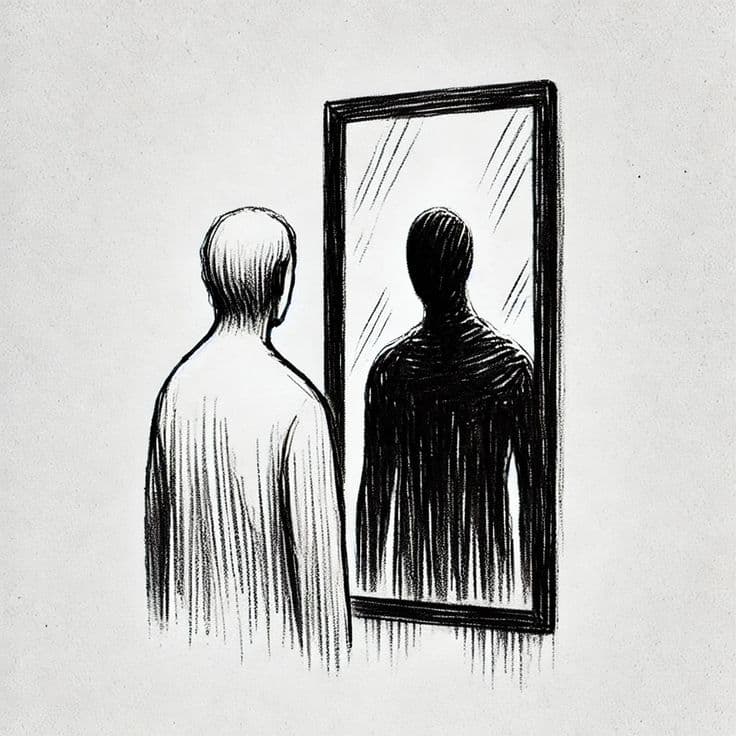
There is a person you believe yourself to be. This person has a name, a history, a set of preferences, a list of accomplishments and failures, a reputation to maintain, and a future to secure. This person wakes up each morning already inside a story—a story that feels so intimate, so continuous, so self-evident, that questioning it seems absurd. You are this person. Of course you are.
You are not.
The person you think you are is a narrative construction. A useful one, for navigating a world of other narratives. But it is not what you are. It is what you appear to be when consciousness forgets itself and mistakes its temporary contents for its eternal nature. This is not a metaphor. It is the most direct, empirically verifiable fact about your existence—verifiable not through belief but through patient, honest attention. And the recognition of this fact is the single most liberating discovery available to a human being.
The Narrative Self: How You Became Someone
You were not born with a self. You were born with awareness and the raw capacity for sensation. The self—the "I" that has a name and a story—was assembled over time. It began with your name, repeated until you learned to answer to it. It grew through your parents' reactions, which taught you what made you "good" or "bad." It solidified through school, through peer comparisons, through early successes and failures that were woven into a coherent story of who you must be.
The Brain's Autobiographical Engine
The neuroscience of self is clear: there is no single "self center" in the brain. Instead, the sense of a continuous self is generated by the default mode network (DMN)—a distributed set of regions that weave together memories, future projections, bodily sensations, and social evaluations into a seamless narrative. The DMN is most active when you are doing nothing in particular, which is precisely when the story of "me" runs in the background. You are not hearing the story. You are the story.
But the story is not reality. It is a useful fiction. The map is not the territory. The menu is not the meal. And the narrative of "you" is not what you are. It is what consciousness looks like when it takes itself to be an object.
The Narrative Self | What It Actually Is |
|---|---|
A continuous, solid identity | A constructed story updated moment to moment |
The source of thoughts | Thoughts arising in awareness |
The owner of experiences | Experiences arising and subsiding |
A stable entity from birth to death | A pattern, not a thing |
What you are | What you appear to be to yourself |
The Illusion of Continuity
You feel like the same person you were ten years ago. But are you? The cells of your body have mostly been replaced. Your memories have been edited, consolidated, and partially fabricated. Your beliefs have shifted. Your preferences have changed. What, exactly, has continued? Not a thing. A pattern has continued. A pattern of self-reference. The thought "I" has arisen repeatedly, and each time it carries with it the entire weight of previous "I" thoughts. That weight is the illusion of continuity.
Why Change Is So Terrifying
If you are truly a stable self, change should be no threat. But you experience change—especially change imposed from outside—as a kind of death. This is because the self is not stable. It is a dynamic process that requires constant maintenance. Every new piece of information that contradicts the narrative must be assimilated, distorted, or rejected. The effort of this maintenance is what you experience as anxiety, defensiveness, and fatigue.
This is why criticism hurts more than a slap. A slap affects the body. Criticism threatens the narrative. And the narrative is what you mistake for yourself. When someone says "you are wrong" or "you are not enough," they are not attacking you. They are attacking a story. But you have forgotten it is a story. So it feels like death.
How the Ego Manufactures Desire to Survive
The ego—the sense of a separate self—cannot exist in a state of pure presence. It requires movement. It requires lack. It requires the belief that something is missing, so that it can strive to fill the gap. Desire is not accidental to the ego. It is the ego's metabolic fuel.
The Structure of Egoic Wanting
Notice what happens when all desires are temporarily satisfied. There is a moment of peace. Then, almost immediately, the mind generates a new desire. A new problem. A new standard to meet. This is not because you are broken. It is because the ego cannot rest. Rest is its dissolution. So the ego constantly projects fulfillment into the future, keeping itself alive through the endless pursuit of an endlessly receding horizon.
Every "I'll be happy when" is a survival mechanism of the false self. The promise of future happiness guarantees that you are not happy now. And not being happy now means the ego has work to do. There is a gap to close. A mountain to climb. A person to become. The ego loves becoming because becoming is not being. Being would reveal the ego's emptiness. Becoming keeps it busy.
Egoic State | Psychological Experience | Hidden Function |
|---|---|---|
Craving | Desire, anticipation | Keeps ego reaching outward |
Achieving | Brief satisfaction, then letdown | Temporary relief, then renewed craving |
Comparing | Envy or superiority | Reinforces separate self through difference |
Defending | Righteousness, anger | Protects narrative from contradiction |
Resting | Boredom, restlessness | Ego fears its own absence |
The Dopamine Trap: Why More Never Satisfies
The neurochemistry of desire mirrors the ego's structure. Dopamine is released not upon reward but upon anticipation of reward. The chase feels better than the catch. This is not a design flaw. It is a design feature for an organism that needs to keep seeking resources. But the feature becomes a prison when the seeking is endless and the resources are symbolic—status, validation, identity markers.
The Hedonic Treadmill as Spiritual Curriculum
You have experienced this a hundred times. A promotion arrives. For a day, a week, you feel expanded. Then the new normal sets in. The pleasure fades. And now you need the next promotion to feel the same lift. The treadmill does not stop. It accelerates. And the entire time, the voice in your head says "this time will be different." It never is. Not because you are unlucky. Because the treadmill is not designed to arrive. It is designed to run.
Advaita Vedanta calls this samsara—the cycle of birth, death, and rebirth, but also the cycle of craving, achieving, habituating, and craving again. You are not trapped in a cosmic cycle. You are trapped in a psychological one. And the way out is not a better strategy on the treadmill. It is seeing that the one running on the treadmill is not you.
Social Validation and the Mirrored Self
You have a social media following, or you want one. You have a reputation, and you protect it. You have a status relative to others, and you monitor it. This is not shallow. It is deeply human. But it is also deeply mistaken. You are seeking validation for a self that does not exist.
The Infinite Regress of Approval
The logic of social validation is impossible to satisfy. You want others to see you a certain way. But even if they do, you need to know that they see you that way. And to know, you need their explicit or implicit feedback. But their feedback is just more appearances. You then need to validate the validation. There is no end. You are asking the world to confirm something that cannot be confirmed because it is not real. The self is not a thing to be seen. It is a request for seeing.
This is why celebrities—the most validated people on earth—are often the most miserable. They have received the external confirmation that the ego craves. And it did nothing. The emptiness remained. The only difference is that now they cannot pretend that more validation will fix it. The illusion is exhausted. But the ego, being resourceful, usually turns to other objects: drugs, affairs, extreme sports, or spiritual seeking. Anything but facing the fact that the self seeking validation was never there.
Validation Source | What It Promises | What It Delivers |
|---|---|---|
Social media likes | Being seen as valuable | Fleeting micro-high, then withdrawal |
Career recognition | Lasting self-worth | Temporary expansion, then new status anxiety |
Romantic approval | Completion of self | Projection, dependency, fear of loss |
Peer admiration | Social safety | Performance pressure, comparison |
Luxury possessions | Identity confirmation | Brief pleasure, then normalization |
Achievement Burnout: When Success Becomes Suffering
You know the high-functioning person who has everything and feels nothing. The startup founder who sold the company and now feels lost. The executive who reached the top and discovered it was lonely. The artist who got the recognition and then couldn't paint. This is not ingratitude. It is the collision between expectation and reality.
The Collapse of the Saving Project
Every achievement carries a hidden promise: "When I have this, I will finally be complete." The achievement arrives. The completeness does not. And now you are faced with a terrifying possibility: maybe the completeness was never going to come from outside. Maybe the incompleteness is not a problem to solve but a structure to see through. Most people cannot face this. They generate a new achievement goal. They double down. They burn out. Or they quietly numb themselves.
Advaita Vedanta offers a different diagnosis: the incompleteness is real only for the ego. The ego is constituted by lack. Without lack, it has no function. The feeling of emptiness you are trying to fill with achievement is not a sign that you need more achievement. It is a sign that you are identified with something that is, by its very nature, empty. The solution is not to fill the emptiness. The solution is to see that you are not the empty one.
The Body Trap: Identity in Flesh and Form
Few attachments are as visceral as attachment to the body. You have a body. You are not your body. But try feeling that distinction when you look in the mirror and see aging, or weight gain, or a feature you have always disliked. The identification is immediate. The body becomes "me."
The Body as Project vs. Body as Guest
Modern success culture has turned the body into a project. Optimize it. Sculpt it. Measure it. Compare it. The gym is not a place of movement and health. It is a laboratory of identity management. Every rep, every calorie, every supplement is a statement: "I am someone who looks like this." The fear beneath the project is simple: if the body changes, who am I?
You can care for the body without being owned by it. The distinction is whether the body serves you or you serve the body's image. When you are attached, you spend psychic energy maintaining an illusion of permanence in an inherently impermanent vehicle. When you are free, you care for the body as a guest—grateful for its service, attentive to its needs, but not collapsing when it changes. The body will change. That is not tragedy. That is biology. The tragedy is believing that you are the body and therefore doomed to die. You are not the body. You are what witnesses the body. And that witness does not age.
Relationship to Body | Identity Statement | Underlying Fear |
|---|---|---|
Attachment to appearance | "I am this image" | Fear of aging, judgment |
Body as project | "I am what I achieve physically" | Fear of failure, loss of control |
Body as enemy | "I am trapped in this flawed vessel" | Shame, self-rejection |
Body as guest | "I care for this temporary vehicle" | None—acceptance of impermanence |
The Relationship Illusion: Completing the Incomplete
Romantic love is one of the most powerful amplifiers of the false self. The ego projects its own incompleteness onto another person and then believes that this person will complete it. "You complete me" is not a romantic sentiment. It is a diagnosis of pathology.
Why Relationships Trigger So Much Suffering
When you believe you need another person to be whole, you have handed them the keys to your psychological state. Their mood becomes your mood. Their attention becomes your oxygen. Their potential departure becomes your annihilation. This is not love. This is dependency. And it explains why so many relationships are sites of anxiety, jealousy, control, and resentment. You are not fighting with your partner. You are fighting with your own sense of incompleteness, projected onto them.
Non-attached love—love that does not demand completion—is radically different. It says "I am already whole. I choose to share my wholeness with you." There is no desperation. No control. No collapse if they leave. There is grief, because grief is human. But there is not annihilation. The self was never in the other. It was always here, whole, waiting to be recognized.
Love as Dependency | Love as Wholeness Sharing |
|---|---|
"I need you" | "I want you" |
Jealousy as proof of caring | Trust as foundation |
Fear of abandonment drives behavior | Freedom drives behavior |
Collapse if relationship ends | Grief without destruction |
Identity fused with partner | Identity intact, relationship chosen |
The Silence Beneath the Noise of Identity
All of this—the striving, the comparing, the performing, the clinging—is noise. It is the sound of the ego trying to convince itself that it is real. Beneath the noise, there is silence. Not the absence of sound. The absence of self. And that silence is not empty. It is full of awareness.
How to Hear What Is Always Here
You do not need to achieve silence. You need to stop running from it. Sit for a few minutes without a task, without a screen, without a plan. The mind will produce noise immediately. Thoughts, urges, memories, plans. Do not fight them. Do not follow them. Simply notice that they are arising in something. That something is awareness. It is not disturbed by the thoughts. It is the space in which they appear. And you are that space. Not the thoughts. Not the noise. The space.
This is not a special state. It is the most ordinary thing in the world. So ordinary that you overlook it. You are looking for a special experience, a mystical state, a transformed identity. But the recognition is simpler: you are not any identity. You are the awareness of identity. And awareness has no identity. It is free.
What You Think You Are | What You Actually Are |
|---|---|
A person with a name and history | Awareness in which name and history appear |
A body that will age and die | The witness of the body, which does not age |
A mind filled with thoughts | The space in which thoughts arise and subside |
A set of achievements and failures | The unchanging presence that notices achievements and failures |
A self that seeks completion | Completeness itself, misrecognized as lack |
The Fear of No-Self
If you have followed this far, you may feel a subtle resistance. A fear. "If I am not this person, then who am I? What happens to my relationships, my ambitions, my responsibilities? Will I become a zombie?" This fear is understandable. It is also the ego's last defense.
The Difference Between Annihilation and Liberation
The ego hears "you are not the person you think you are" as a death sentence. It believes that without the narrative, there will be nothing. But the ego is wrong. Without the narrative, there is everything. Without the filter of the self, you are not less present. You are more present. Not less capable. More capable. Not less loving. More loving, because love is no longer contaminated by need.
The fear of no-self is the fear of waking up from a dream. In the dream, you are a character with problems and desires. Waking up does not destroy the character. It reveals that the character was never real. You are not the dream. You are the dreamer. And the dreamer was never in danger.
How to Live Without the Illusion of Self
You cannot live without the narrative self entirely. It is too useful for practical affairs. You need to sign your name, remember your appointments, and distinguish your toothbrush from someone else's. The question is not whether to have a self. It is whether to believe in the self as a solid, permanent, fundamental reality.
Functional Self vs. Ontological Self
Use the self functionally. Say "I" when it is useful. Plan for your future. Learn from your past. But do not mistake the functional self for what you ultimately are. The functional self is a tool. The ontological self—the belief that there is a separate, enduring entity inside you—is an illusion. The tool is fine. The illusion causes suffering.
This is the difference between healthy ambition and egoic desperation. The functional self can want, achieve, and enjoy. The ontological self must achieve to prove it exists. The functional self can fail and adapt. The ontological self collapses when it fails because its existence was contingent on success. The functional self is flexible. The ontological self is brittle.
Functional Self (Useful) | Ontological Self (Illusion) |
|---|---|
Uses "I" as a practical convention | Believes "I" refers to a solid entity |
Plans, learns, remembers | Must prove its existence through achievement |
Adapts to failure | Collapses under failure |
Feels emotions fully | Is owned by emotions |
Grieves loss | Is destroyed by loss |
Acts with clarity | Acts from desperation |
The Recognition That Ends the Search
You have been searching for yourself your entire life. In achievements, relationships, possessions, spiritual experiences. You have been looking for something that will finally make you feel real, complete, at home. The search has failed, over and over, not because you are unlucky but because you are looking for what is already here.
You are not the person you think you are. You are the awareness that knows the person. The person comes and goes. Awareness does not. The person changes. Awareness does not. The person suffers. Awareness observes suffering without suffering. You are not the wave. You are the ocean. The wave will rise and fall. The ocean remains.
This is not a belief to adopt. It is an investigation to perform. Right now, without believing anything, notice that you are aware. That awareness has no name, no history, no achievements, no failures. It is simply here. Always has been. Always will be. You have been looking for yourself in the waves. Look instead at the water.
