


Hans J. Morgenthau
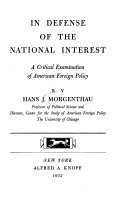
Hans J. Morgenthau (1904–1980) founded classical realism in International Relations, insisting that international politics is governed by objective laws rooted in human nature and the relentless pursuit of power. In *Politics Among Nations* (1948), he articulated the six principles of political realism, most centrally that interest defined as power is the universal category of political action. He distinguished realism from both liberal idealism (which believes in the harmony of interests) and legalistic-moralistic approaches (which mistake the rhetoric of international law for actual state behavior). Morgenthau argued that statesmen must think in terms of prudence and balance of power, and he famously criticized the Vietnam War as a failure of realist calculation. A professor at the University of Chicago, he remains the foundational theorist of international relations.


✦What are Morgenthau's six principles of political realism?
Morgenthau's six principles are: 1) Politics is governed by objective laws rooted in human nature; 2) Interests are defined in terms of power; 3) Interest defined as power is universally valid; 4) Universal moral principles cannot be applied to state action without considering historical circumstances; 5) No particular nation can claim its moral values are universally applicable; 6) The political sphere must be understood autonomously, not as a subset of economics or law. These principles collectively distinguish realism from legalism, moralism, and idealism.
✦How does Morgenthau's classical realism differ from Kenneth Waltz's neorealism?
Morgenthau grounded realism in human nature—the innate lust for power and the tragic imperfections of the human condition—making his theory philosophical and normative. Waltz's neorealism, by contrast, locates the causes of state behavior in the anarchic structure of the international system, treating states as functionally identical units driven by survival. Morgenthau was interested in the statesman's judgment and prudence; Waltz sought a parsimonious, scientific theory. They share a belief in power politics but differ on its ultimate source.
✦What is Morgenthau's concept of the 'balance of power' and why is it central?
For Morgenthau, the balance of power is not merely a descriptive pattern but a normative principle: statesmen must actively seek to maintain equilibrium among competing powers to prevent hegemony and preserve the system's stability. He argued that power is a relational concept—its effectiveness depends on relative capabilities and perceptions. The balance of power is not automatic; it requires diplomatic skill, military preparedness, and the willingness to use power. This emphasis on statecraft distinguished his realism from more structural approaches.
✦Why did Morgenthau criticize American intervention in Vietnam?
Morgenthau argued that Vietnam did not threaten vital American interests and could not be won at acceptable cost; it was an ideological crusade that violated the realist principle of acting with prudent restraint. He saw the war as a failure to align ends and means—a classic error of moralistic-legalistic idealism that tries to transform societies. This opposition led to his marginalization from the Johnson administration and presaged his later status as an anti-war voice within the realist tradition.
✦What is the relationship between Morgenthau's realism and the concept of 'national interest'?
Morgenthau defined national interest as the 'final yardstick' of statecraft, but he warned against reducing it to a narrow, materialistic calculus. The interest is always 'defined in terms of power,' but its content is historically and culturally determined. He insisted that moral principles must be filtered through national interest—a state cannot pursue universal justice without first securing its own survival. This made his realism subtle and anti-dogmatic, rejecting both isolationism and crusading interventionism.
✦What is a common misconception about Morgenthau's realism?
A common misconception is that Morgenthau was an amoral cynic who believed states should ignore ethics. In fact, he wrote extensively on the morality of statecraft, arguing that political ethics requires prudence—the calculation of consequences—not the application of abstract absolutes. He believed that a statesman who fails to consider the consequences of action is immoral. He also rejected value-neutral social science, insisting that realism must engage with moral questions. His realism was tragic, not nihilistic: it accepted the tension between power and morality as permanent.
✦How has Morgenthau's work been used in contemporary International Relations?
Morgenthau's concepts remain central to debates on American foreign policy, humanitarian intervention, and the role of international law. His critique of legalism and moralism is often cited to justify pragmatic engagement, while his skepticism about the Wilsonian project continues to inform anti-interventionist thought. Recent scholarship has revived his interest in fear, reputation, and the psychological dimension of power, distinguishing his approach from the more structural realism of Waltz. His emphasis on prudence has been invoked to criticize nation-building and overextension.