


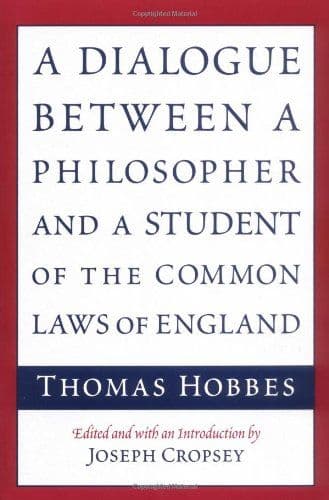
A Dialogue between a Philosopher and a Student of the Common Laws of England

Hobbes's late dialogue argues that the common law's claim to autonomous reason is incoherent, and that all law derives its authority from the sovereign's command, not from the accumulated wisdom of judges. The central mechanism is the reduction of legal reason to sovereign will: where Coke and the common lawyers posit an artificial reason embedded in precedent, Hobbes's Philosopher insists that law is command, and that the sovereign alone is the ultimate judge of what serves the commonwealth. The dialogue form pits philosophical absolutism against the common law tradition.
Key Insights
✦What is the central argument of the Dialogue, and who are the interlocutors?
The dialogue is between a Philosopher, who speaks for Hobbes, and a Student of the Common Laws of England, who defends the common law tradition. The central argument is that the common law's claim to an autonomous 'artificial reason'—developed through precedent and the learned wisdom of judges—is incoherent. For Hobbes, law is the command of the sovereign, and reason is not an independent source of authority but an instrument that the sovereign uses to determine what serves the commonwealth. The Philosopher systematically reduces the Student's appeals to precedent, custom, and judicial reason to the single foundation of sovereign will. The dialogue form allows Hobbes to stage the confrontation between philosophical absolutism and the common law tradition, with the Philosopher ultimately prevailing .
✦Why did Hobbes target Sir Edward Coke, and what does the Dialogue reveal about the political stakes of legal theory?
Coke was the great champion of the common law's autonomy, arguing in Dr. Bonham's Case (1610) and elsewhere that the common law had its own reason, superior even to statute and the sovereign. Hobbes saw this as a dangerous doctrine that divided sovereignty and undermined political order. The Dialogue is a sustained attack on Coke's position, arguing that if judges can declare laws void by their own reason, then sovereignty is fractured and the commonwealth is threatened. The political stakes are thus the same as in Leviathan: the unity of sovereign power is the only guarantee of peace. The Dialogue shows Hobbes applying his political theory to a concrete legal and constitutional dispute, revealing that his absolutism is not merely abstract but directed at a specific rival tradition .
✦How was the Dialogue published, and why does its posthumous status matter?
The Dialogue was published posthumously in 1681, two years after Hobbes's death. It had been written much earlier, probably in the late 1660s, during the period when Hobbes was barred from publishing on political subjects after the controversy over Leviathan . The posthumous publication meant the work could not be revised in response to criticism, and its arguments were not subjected to the scrutiny Hobbes had faced with his earlier works. The 1681 edition was printed in London, and the work has since been edited by Joseph Cropsey for the University of Chicago Press (1971) and included in the Clarendon Edition of Hobbes's works. The posthumous status is significant because the Dialogue represents Hobbes's mature, considered position on law, freed from the need to avoid offending his critics .
✦How does the Dialogue relate to Leviathan's theory of law and sovereignty?
The Dialogue extends Leviathan's theory of law into a sustained critique of the common law tradition. In Leviathan, Hobbes defines law as the command of the sovereign, and he distinguishes between law and counsel, right and law. The Dialogue applies these distinctions to the English legal system, arguing that the common law's claim to be a body of reason independent of the sovereign is a dangerous fiction. The Dialogue is thus an application of the framework of Leviathan to a specific constitutional question: who has the final authority to interpret the law? Hobbes's answer is unequivocal—the sovereign, not the judges. The Dialogue is valuable because it shows Hobbes working out the implications of his theory for the institutional structure of English law, rather than simply asserting the theory in the abstract.
✦What are the main criticisms of Hobbes's position in the Dialogue, and how have legal historians assessed it?
The main criticism is that Hobbes's reduction of law to sovereign command ignores the actual complexity of the common law and the genuine role of judicial reason in interpreting and developing legal rules. Legal historians have noted that Hobbes's reading of Coke and the common law tradition is selective and often caricatures the position he attacks. Coke did not claim that judges could simply override the sovereign; he argued that the common law was the embodiment of reason accumulated over centuries, and that this reason was a constraint on arbitrary power. Hobbes's insistence on undivided sovereignty leads him to dismiss this possibility, but critics argue that his account does not do justice to the way the common law actually operates. The Dialogue is thus a powerful statement of one position in a debate that continues, not a resolution of it.
✦Is the Dialogue still relevant to contemporary debates about law and sovereignty?
It remains relevant because the tension it dramatizes—between the sovereign as the ultimate source of law and the judiciary as the guardian of legal reason—is a perennial question in constitutional theory. Contemporary debates about judicial review, the rule of law, and the limits of parliamentary sovereignty echo the confrontation between Hobbes's Philosopher and the Student. Hobbes's argument that divided sovereignty leads to conflict anticipates modern concerns about the fragmentation of authority. Readers interested in the philosophical foundations of legal order will find the Dialogue a clear and uncompromising statement of the case for unitary sovereignty. It is not a historical curiosity but a contribution to an ongoing argument about where the final authority to interpret law should lie.
Wealthy Psyche is an intellectual archive. We do not host, distribute, or sell book copies — physical or digital. We provide structured knowledge to help you think better, faster.