


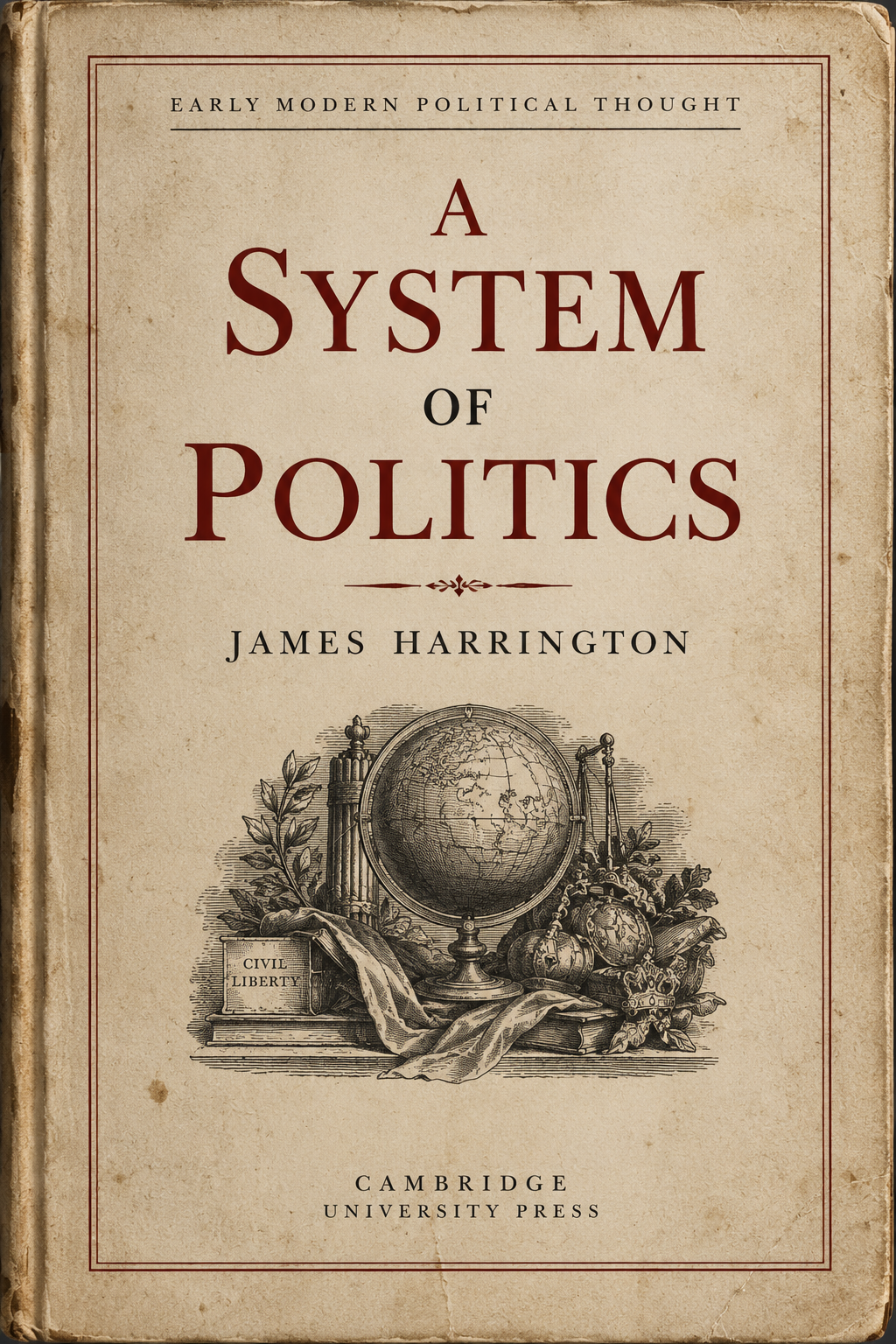
A System of Politics
 James Harrington
Harrington's A System of Politics is his final work, written after the Restoration and published posthumously, condensing his political theory into a series of aphorisms. It argues that all government rests on interest, and that the interest of the people — the most general and inclusive interest — is closest to right reason. Where his earlier Oceana builds the institutional machinery of a republic, this compact scheme presents the philosophical foundations: the empire of laws versus the empire of men, the balance of property, and the claim that popular government alone aims at the common good rather than the advantage of a ruler or nobility.
What is the central argument of A System of Politics, and how does it relate to Oceana?
A System of Politics argues that every government is moved by interest, and that the interest of the people — being the most general and inclusive — is closest to right reason. It presents a typology of three interests: the king's interest in absolute monarchy, the nobles' interest in aristocracy, and the people's interest in democracy. Unlike Oceana's elaborate constitutional machinery, this late work offers the philosophical foundations in aphoristic form: the empire of laws versus the empire of men, the balance of property, and the claim that popular government alone aims at the common good rather than the advantage of a part.
What is the 'empire of laws' versus the 'empire of men' distinction?
Harrington defines government according to ancient prudence as an empire of laws, where a civil society is preserved upon common right or interest. Government according to modern prudence is an empire of men, where some men rule a nation according to their private interest. The distinction turns on whose interest the laws serve: where the public interest governs, law prevails; where a king's or a faction's private interest governs, men prevail. John Adams quoted this passage extensively in his Defence of the Constitutions, treating it as a foundational statement of republican principle.
Why was A System of Politics written after the Restoration and published posthumously?
Harrington wrote the work around 1661, after Charles II's restoration ended the republican experiment he had theorized in Oceana. The timing shaped its character: it is a retrospective summary rather than a program for immediate action, distilling his system into compact aphorisms. He could not publish it during his lifetime — the Restoration regime had little tolerance for republican theory, and Harrington himself was imprisoned in 1661 on suspicion of conspiracy. The work appeared posthumously in 1700, and its aphoristic form made it especially influential on eighteenth-century American and English opposition thought.
How does Harrington's interest theory in A System of Politics differ from his balance of property thesis?
The balance of property explains which class holds power; interest theory explains what motivates the exercise of that power. In A System of Politics, Harrington distinguishes the king's interest (maintaining absolute power), the nobles' interest (securing status), and the people's interest (achieving the common good). The argument is that only the people's interest coincides with the general good because it is the most encompassing. The balance of property remains the structural foundation — the many must hold land for popular government to be possible — but interest theory explains why a popular government, once established, pursues the common good rather than a faction's advantage.
What is the most common misconception about A System of Politics?
A common misconception treats the work as a mere summary or abridgment of Oceana. In fact, it develops ideas that remain implicit in the earlier work, particularly the theory of interest as the mover of the will. Harrington argues that since reason is nothing but interest, and the interest of mankind is the right interest, the reason of mankind must be right reason. This Stoic-inflected argument provides the ethical grounding for popular government that Oceana assumes rather than demonstrates. The System is not a digest but a philosophical foundation, written from a different vantage point after the republic's collapse.
How has A System of Politics been received and used in later political thought?
The work circulated widely in manuscript and print among eighteenth-century republican thinkers. John Adams quoted its definition of government at length in his Defence of the Constitutions of Government of the United States, and American revolutionaries drew on Harrington's argument that liberty requires the empire of laws rather than the rule of any man or faction. Scholars have noted that the aphoristic form made it portable: its propositions could be extracted and deployed in pamphlets and constitutional arguments without requiring readers to absorb Oceana's elaborate fictional frame. Pocock's 1977 edition restored the text to its context in Harrington's complete political works.
Wealthy Psyche is an intellectual archive. We do not host, distribute, or sell book copies — physical or digital. We provide structured knowledge to help you think better, faster.