


James Harrington
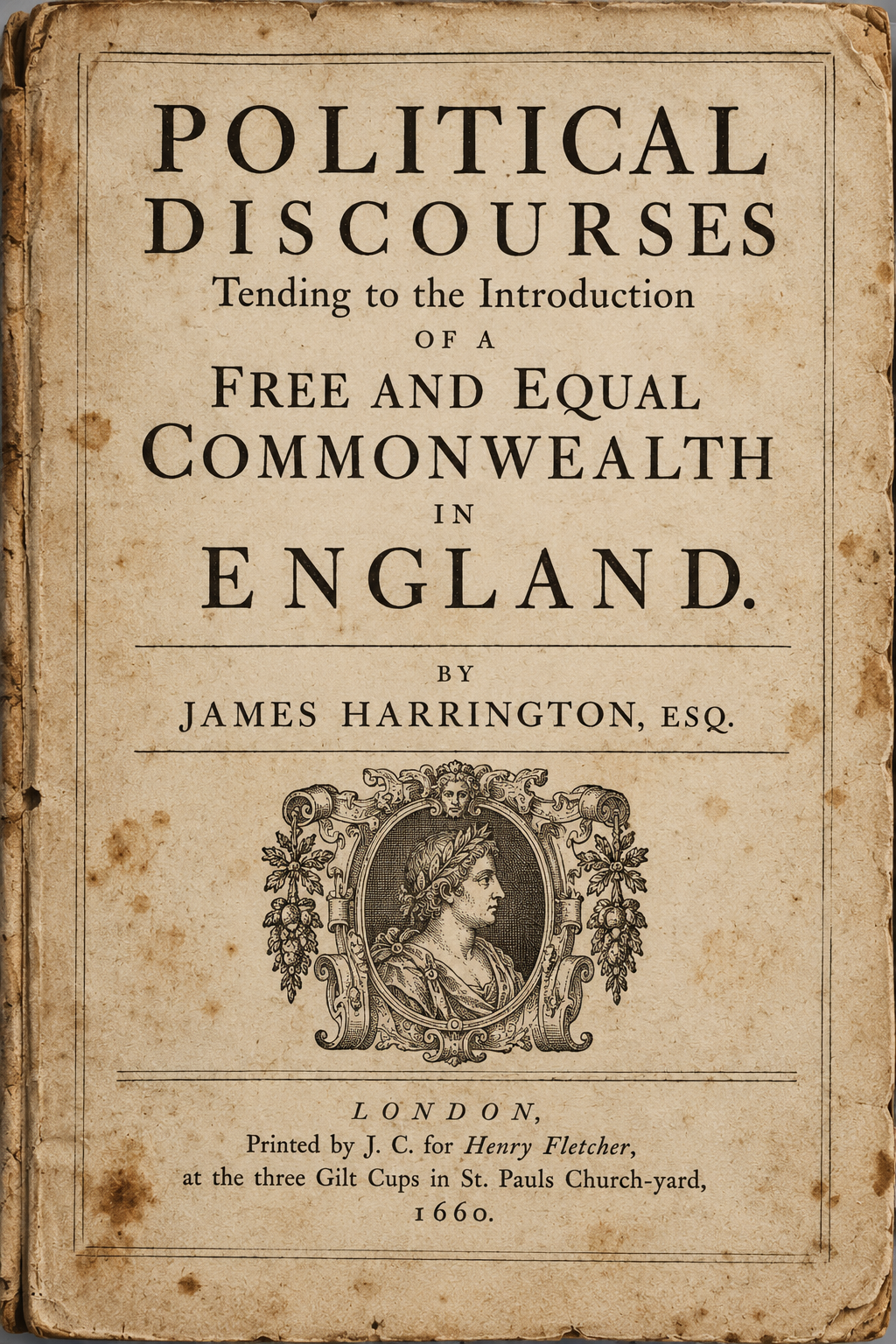
James Harrington (1611–1677) reoriented republican theory around the distribution of property, specifically land, arguing that political power follows economic dominion. In *The Commonwealth of Oceana* (1656), he posited that a republic is structurally determined by the balance of landed wealth—when land is broadly held among the gentry and yeomanry, a commonwealth is both possible and necessary. To secure this republic, he devised an institutional architecture: an agrarian law to prevent feudal concentration, secret ballot for elections, bicameral debate, and mandatory rotation of magistrates. This mechanical, socio-economic model of constitutional order—where property *determines* power—marked a decisive break from both Hobbesian absolutism and purely virtue-based classical republicanism.



.webp?alt=media&token=446479e7-ffcc-4102-b760-4ca7ef90127a)

✦What is Harrington's fundamental law of political power?
Harrington's axiom is that 'empire follows the sword' but the sword is wielded by the owner of the land. Specifically, political power (dominion) follows the distribution of property—those who own the land control the militia. If a few nobles own most land, monarchy follows. If the gentry and yeomanry broadly own it, a commonwealth is inevitable. His entire project in *Oceana* was to design a constitution that matched the actual English land distribution of his day, preventing a slide back to feudalism or a descent into oligarchy.
✦How does Harrington's republicanism differ from Hobbes's absolutism?
Hobbes derived sovereignty from rational self-preservation against a state of nature, yielding an absolute sovereign above the law. Harrington rejected the state of nature entirely, deriving political order from historical-economic causality. Where Hobbes saw anarchy as the fundamental threat, Harrington saw oligarchy or feudal re-concentration. Hobbes's solution was a univocal Leviathan; Harrington's was a balanced commonwealth with explicit institutional mechanics to forcibly prevent power consolidation, relying on constitutional engineering rather than authoritarian command.
✦What was Harrington's 'agrarian law' and why was it central?
Harrington's agrarian law was a constitutional limit on the accumulation of landed wealth, designed to prevent any single individual or family from owning sufficient land to dominate the state. In *Oceana*, he specified a maximum landholding (such as £2,000 per annum) and mandated that land must be continuously balanced. Unlike modern land reform, this was not about social equality, but about maintaining the structural prerequisite for a republic: a broad, independent landholding class capable of bearing arms and voting without being beholden to a feudal lord.
✦What specific institutional mechanisms did Harrington propose for his republic?
Harrington proposed a bicameral legislature where citizens vote by secret ballot. Importantly, his system featured a rotating Senate—one-third of the senators were to be replaced annually, ensuring fresh perspectives and preventing entrenched oligarchy. He also designed a strict debate sequence: propositions moved through rotating committees to the Senate for deliberation, then to the people for approval by ballot. These mechanical rules were designed to force reasoned deliberation rather than factional shouting, distinct from the purely virtue-based civic humanism of previous thinkers.
✦How did Harrington's ideas influence the American Founding Fathers?
John Adams was Harrington's most prominent American disciple, explicitly crediting his property-based theory of representation in *A Defence of the Constitutions of Government*. Harrington's model of bicameralism, balanced powers, and rotating terms directly shaped Adams's constitutional proposals for Massachusetts. The American insistence on representation based on population rather than feudal estates, and the emphasis on property qualifications for voting, trace directly to Harrington's premise that political legitimacy requires aligning power with the distribution of economic resources.
✦What did Harrington get wrong, and what remains valid today?
Harrington spectacularly failed to predict the rise of industrial and financial capital, over-focusing entirely on real estate. He could not foresee that non-landed wealth (mercantile, and later corporate) would displace land as the primary source of political power, making his specific agrarian law irrelevant as a contemporary policy. However, his core insight—that the distribution of economic resources fundamentally determines the distribution of political power—remains the foundation of political economy, prefiguring Marx and modern institutional economics in linking economic base to political superstructure.
✦Was Harrington a democrat or an aristocrat?
A common misconception is that Harrington was a proto-democrat. He was emphatically not. He believed the people were fit to vote (for approval) but unfit to deliberate. He proposed a natural aristocracy of the educated elite to originate and debate legislation, presenting it to the people only for a yes-or-no ballot. This is distinctly republican, not democratic—he feared mob rule as much as monarchy. His system rests on institutional filtering of popular will through a deliberative Senate, a mechanism echoed in the US electoral college and Senate structures.