


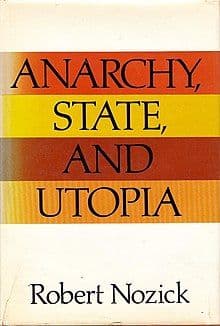
Anarchy, State, and Utopia
Nozick's central argument is that individual rights are inviolable side constraints, and that any state more extensive than the minimal 'night-watchman' state violates them by coercively redistributing property. The book's distinctive mechanism is the entitlement theory: a distribution is just if it arises from just acquisition and voluntary transfer, regardless of its pattern. Against Rawls's patterned justice, Nozick deploys the Wilt Chamberlain argument to show that free exchange will inevitably disrupt any end-state pattern, making redistribution a form of forced labour. The minimal state is defended as a framework for utopia, not as a compromise.
Key Insights
✦What is the entitlement theory of justice, and how does it differ from Rawls's approach?
Nozick's entitlement theory holds that a distribution is just if it arises from just initial acquisition, just transfer, and rectification of past injustices. It is historical and unpatterned: justice depends on how holdings came about, not on whether they match a preferred end-state like equality or need . Rawls's justice as fairness is what Nozick calls a 'patterned' theory—it specifies a distribution according to a principle (the difference principle) and requires continuous interference to maintain it. Nozick argues that liberty upsets patterns: people's voluntary choices will inevitably disrupt any fixed distribution, and enforcing the pattern requires constant coercion. The disagreement is not merely about inequality but about whether distributive justice is a coherent ideal at all.
✦What is the Wilt Chamberlain argument, and why is it central to Nozick's critique of redistribution?
Nozick asks us to imagine a distribution D1 that satisfies some preferred pattern, say equality. Then Wilt Chamberlain, a basketball star, signs a contract: each home game, fans pay an extra 25 cents specifically to see him. Over a season, Chamberlain earns $250,000 while everyone else's share remains as before. The resulting distribution D2 is the product of fully voluntary exchanges from D1, yet it no longer matches the original pattern . To restore the pattern, the state must either forbid such transactions or tax Chamberlain's earnings—both of which interfere with liberty. Nozick's conclusion is that any patterned theory must either prohibit free exchange or continuously redistribute, making it incompatible with the side constraints that protect individual choice.
✦How did the book respond to Rawls, and did Nozick acknowledge Rawls's achievement?
Nozick explicitly framed his book as a response to A Theory of Justice, which he called a work of extraordinary power: 'Political philosophers must now either work within Rawls' theory or explain why not' . He acknowledged that Rawls's theory was 'undeniably a great advance over utilitarianism' but argued it still failed to take seriously the distinction between persons . The core objection is that Rawls's original position, by bracketing natural talents and social position, treats individuals as if their abilities were collective assets rather than their own. Nozick's entitlement theory is presented as the alternative that respects self-ownership and the separateness of persons, which he and Rawls both saw utilitarianism as violating.
✦What was the initial reception of the book, and how did critics respond to its conclusions?
Reception was mixed: reviewers praised the book's elegance and originality while attacking its conclusions from across the political spectrum . Brian Barry delivered a scathing critique, describing Nozick's proposals as having 'a sort of cuteness that would be wearing in a graduate student and seems to me quite indecent in someone who, from the lofty heights of a professorial chair, is proposing to starve or humiliate ten percent or so of his fellow citizens' by eliminating transfer payments . The book won the National Book Award in 1975, and its influence has been enormous despite the hostility of many critics. Thirty years later, Ellen Frankel Paul observed that the affirmative argument for the minimal state was 'so thin and undefended as to read, often, as nothing more than a placeholder,' even as the book remained the central text of academic libertarianism .
✦How does Nozick's state of nature argument differ from Locke's, and what does it aim to prove?
Nozick begins from a Lockean state of nature in which individuals have natural rights to life, liberty, and property, including the right to punish violations. He argues that rational individuals would form mutual protection associations, which would evolve into commercial protection agencies, and eventually a single 'dominant protection agency' would emerge through competition and merger . This agency would prohibit independents from enforcing their own rights (to prevent unreliable justice) but must compensate them by extending protection services. The result is an 'ultra-minimal state' that satisfies two conditions: a monopoly on legitimate coercion and protection for nearly all. Nozick's aim is to show that the minimal state could emerge without violating anyone's rights—refuting the anarchist claim that any state is illegitimate.
✦What does Nozick mean by the minimal state as a 'framework for utopia'?
Nozick's third project is to show that the minimal state is not merely just but inspiring. He argues that libertarianism provides a framework within which people may voluntarily form any community they wish—communes, religious orders, market societies—provided they do not coerce others . The minimal state does not impose a single vision of the good life; it protects the background rights that allow diverse utopian experiments to flourish. This is why the book's title ends with 'Utopia': Nozick presents libertarianism not as a cold economic doctrine but as a political order that maximizes the space for human flourishing and voluntary association. Critics have questioned whether this vision is coherent, but it remains the book's most distinctive contribution to libertarian thought.
Wealthy Psyche is an intellectual archive. We do not host, distribute, or sell book copies — physical or digital. We provide structured knowledge to help you think better, faster.