


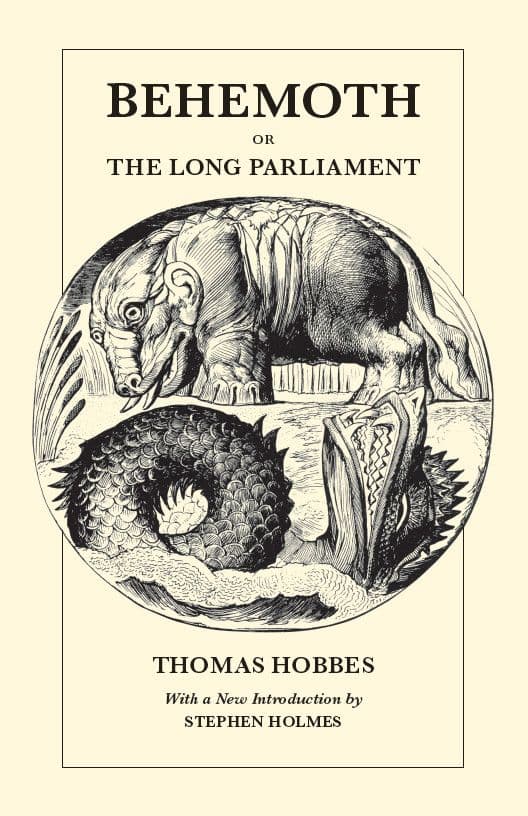
Behemoth, or The Long Parliament

Hobbes's dialogue argues that the English Civil War was caused less by economic grievance than by the 'stubborn irrationality' of key actors and the seditious opinions they propagated. The central mechanism is Hobbes's claim that 'the power of the mighty hath no foundation but in the opinion and belief of the people'—authority rests on captivation of the mind, not coercion of the body. Applying the framework of De Cive and Leviathan to the events of 1640–1660, the book shows how religious doctrine and political ambition combined to dissolve sovereign authority into chaos.
Key Insights
✦What is the central argument of Behemoth, and how does it apply Hobbes's political theory to the Civil War?
Behemoth is Hobbes's systematic application of the analytical framework developed in De Cive and Leviathan to the English Civil War . The central argument is that the war was caused not primarily by economic interests but by the 'stubborn irrationality' of key actors and the seditious opinions they spread . Hobbes's most striking formulation is that 'the power of the mighty hath no foundation but in the opinion and belief of the people'—political authority rests on captivation of the mind rather than coercion of the body . The dialogue form allows Hobbes to trace how religious doctrines and political ambitions eroded the opinions sustaining sovereign authority, producing the chaos the book's title evokes.
✦Why was Behemoth not published during Hobbes's lifetime, and what does its publication history reveal?
Hobbes completed Behemoth around 1668 but it remained unpublished at the request of Charles II, and it did not appear in print until after Hobbes's death, in 1682 . The delay is significant: the book is not a neutral history but, as the Oxford edition notes, it 'conceals a vigorous attack on the values of the religious and political establishment of Restoration England' . Hobbes had already been accused of atheism and heresy after Leviathan, and Behemoth's unsparing treatment of the clergy—Presbyterian ministers are called 'impious hypocrites' seeking power to 'fill their purses'—would have inflamed his enemies further . The posthumous publication allowed the critique to circulate without exposing Hobbes to prosecution.
✦What is the significance of the dialogue form, and how does it shape the book's argument?
Behemoth is cast as a series of dialogues between a teacher and his pupil, a form Hobbes also used in other late works . The dialogue allows Hobbes to present his interpretation of the Civil War as a process of instruction, guiding the reader through the causes and course of the conflict while maintaining a veneer of neutrality. The teacher's voice is authoritative, but the pupil's questions create space for objections and clarifications. More substantively, the form mirrors Hobbes's theory of opinion: the reader is being persuaded, not coerced, just as sovereign authority must be sustained through belief rather than force. The dialogue is thus both a literary device and an enactment of the book's central thesis about how political power operates.
✦How does Stephen Holmes's introduction reframe Behemoth's place in Hobbes's thought?
Holmes argues that a fresh consideration of Behemoth dispels persistent misreadings of Hobbes, including the idea that humans are motivated solely by self-preservation . Behemoth shows that the principal cause of the Civil War lay less in economic interests than in the stubborn irrationality of key actors. Holmes also contends that the book demonstrates, more vividly than any of Hobbes's other works, the importance of religion in his theories of human nature and behaviour . This challenges the reading of Hobbes as a purely secular or materialist thinker. The introduction thus positions Behemoth not as a minor historical footnote but as essential evidence for understanding the full scope of Hobbes's political science.
✦What is the textual history of the work, and which edition should scholars consult?
The standard scholarly edition for over a century was Ferdinand Tönnies's 1889 edition, reprinted by the University of Chicago Press in 1990 with Stephen Holmes's introduction . However, a new critical edition appeared from Clarendon Press in 2010, based on Hobbes's own presentation manuscript. The publisher's description notes that it is 'the first fully scholarly edition of the work, and the first new edition of the text since 1889,' and that it includes for the first time an accurate transcription of the passages Hobbes had deleted in the text, along with notes made by early readers . Scholars should consult the 2010 Clarendon edition for textual accuracy, while the Chicago edition remains useful for Holmes's interpretive essay.
✦Why is the book titled 'Behemoth,' and how does the title relate to Leviathan?
The title invokes the biblical monster Behemoth, counterpart to Leviathan in the Book of Job. In Hobbes's usage, Leviathan represents the absolute sovereign state that preserves order and traces of individual rights, while Behemoth represents 'a chaotic non-state marked by utter anarchy' . The contrast is deliberate: Leviathan is the mortal god who imposes order; Behemoth is the land-monster whose lawlessness and disorder engulf England during the Civil War. The title thus signals the book's subject—the dissolution of sovereignty—and its relationship to Hobbes's masterwork. Behemoth is the negative image of Leviathan, showing what happens when the opinions that sustain authority are corrupted and the commonwealth collapses into the state of nature.
Wealthy Psyche is an intellectual archive. We do not host, distribute, or sell book copies — physical or digital. We provide structured knowledge to help you think better, faster.