


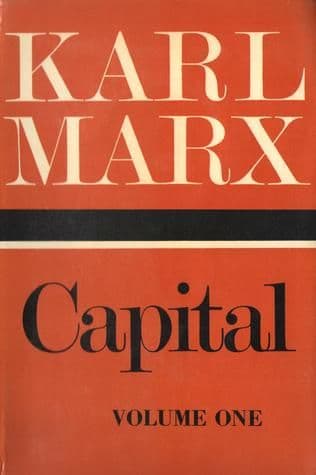
Capital: A Critique of Political Economy, Volume I
Marx's central argument is that capitalism is not an exchange of equivalents but a system of exploitation grounded in the unique commodity labour-power, whose value is determined by the labour time needed to reproduce the worker, while its use creates more value than it costs. The mechanism is surplus value: the difference between what labour produces and what it is paid. Capital's drive to accumulate surplus value generates its own contradictions—crises, concentration, and the immiseration of the proletariat—that point toward its historical transcendence. The book's distinctive method is to begin with the commodity and unfold capitalism's inner logic from that cell-form.
Key Insights
✦What is the central mechanism of exploitation in Capital, and why does it require the concept of labour-power?
Marx's argument hinges on the distinction between labour and labour-power. Labour-power is the capacity to work; its value, like any commodity's, is determined by the socially necessary labour time to reproduce it—the food, shelter, and training needed to keep the worker alive and working. But when the capitalist purchases labour-power for a day, he acquires the right to its use for that day. If the worker can produce the equivalent of his wage in, say, four hours but is made to work eight, the surplus four hours create value for which the capitalist pays nothing. This is surplus value. Marx insists this is not cheating: the exchange of labour-power for wages is formally equal. Exploitation is structural, not a matter of individual villainy.
✦Why does Marx begin with the commodity, and what does the method reveal about his approach?
Marx begins with the commodity because it is capitalism's 'cell-form'—the simplest social relation that contains, in embryonic form, the contradictions of the whole system. A commodity has both use-value (its capacity to satisfy a need) and exchange-value (its proportion in exchange with other commodities). The puzzle is that exchange-value cannot be derived from use-value, since qualitatively different use-values are exchanged quantitatively. Marx's solution is that exchange-value expresses the abstract human labour embodied in commodities. Beginning with the commodity allows him to unfold the logic of money, capital, and surplus value without presupposing what he aims to explain. The method is dialectical: each category generates the next through its internal contradictions.
✦What is the transformation problem, and why has it been the subject of such sustained debate?
The transformation problem concerns the relationship between values (determined by labour time) and prices of production (the prices at which commodities actually sell under capitalism, which tend to equalize profit rates across industries). Marx argued that total value equals total price and total surplus value equals total profit, even though individual prices diverge from values. Critics, beginning with Eugen Böhm-Bawerk, argued that Marx's transformation procedure in Volume III is logically inconsistent. The debate has generated an enormous literature, with neo-Ricardian critics and Marxist defenders offering competing reconstructions. The issue matters because it bears on whether labour is the sole source of value and whether exploitation can be measured independently of prices. Marx did not live to complete his own treatment of the problem.
✦How does the English translation history of Capital affect how readers encounter the text?
The first English translation, by Samuel Moore and Edward Aveling under Engels's supervision, appeared in 1887 and was based on the third German edition . It became the standard English text but uses Victorian diction and is often quite literal. Ben Fowkes's 1976 Penguin translation, based on the fourth German edition, became the most widely used scholarly version for decades, though critics note it sometimes blunts Marx's rhetorical force . A new Princeton translation by Paul Reitter and Paul North (2024) claims to be the first based on Marx's own second German edition of 1872—the last version Marx himself revised—rather than the posthumous editions Engels assembled . Readers should know which German edition their English text follows, as Marx revised substantially between 1867 and 1872.
✦What does Marx mean by 'primitive accumulation,' and why is it central to his argument?
Primitive accumulation is Marx's term for the historical process that created the preconditions of capitalism: the separation of producers from their means of production. Before capitalism, peasants had access to land and tools; capitalism requires 'free' labourers—free in the double sense of being emancipated from feudal bonds and free of any property that could sustain them. Marx argues this separation was not a peaceful process of gradual improvement but a history of expropriation, enclosure, colonization, and violence. He writes that the history of this expropriation is 'written in letters of blood and fire' . The concept is central because it shows that capitalism's origins are not natural or contractual but historical and coercive—undermining the ideology of free exchange that legitimates the system.
✦Is Capital primarily an economic treatise or a work of political philosophy, and does the distinction matter?
The distinction matters because Capital is deliberately both, and reducing it to one misreads its project. The subtitle—'A Critique of Political Economy'—signals that Marx is not adding a new theory within economics but interrogating the categories economics takes for granted: value, money, capital, labour. He treats these not as natural facts but as historically specific social relations. The book is a work of political philosophy insofar as it asks what kinds of social relations capitalism produces, how they shape human freedom and domination, and what historical tendencies they generate. But the argument is conducted through economic analysis, not moral exhortation. Readers who approach it expecting either a pure economics textbook or a political pamphlet will find something more unsettling: a philosophical critique conducted in the medium of economic theory.
Wealthy Psyche is an intellectual archive. We do not host, distribute, or sell book copies — physical or digital. We provide structured knowledge to help you think better, faster.