


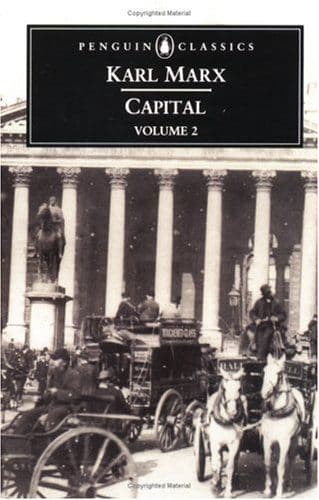
Capital: A Critique of Political Economy, Volume II
Capital Volume II, edited posthumously by Engels from Marx's manuscripts, shifts analysis from production to circulation, arguing that capital must pass through the circuits of money, production, and commodities to realise surplus value. Its central contribution is the schema of simple and expanded reproduction, showing how the two departments of social production—means of production and means of consumption—must exchange in specific proportions for capitalism to reproduce itself. The volume's distinctive mechanism is the analysis of turnover time, revealing how the circulation period shapes the annual rate of surplus value and the scale of accumulation.
Key Insights
✦What is the central argument of Volume II, and how does it differ from Volume I?
Volume II shifts focus from the production of surplus value to its realisation through circulation. Marx argues that capital is not a static stock but a process: it must continuously pass through the circuits of money-capital, productive capital, and commodity-capital, returning to its starting point expanded. The volume's distinctive contribution is the analysis of turnover—how the time capital takes to complete its circuit affects the annual rate of surplus value. Its most important theoretical innovation is the reproduction schemas, which show that for capitalism to reproduce itself, Department I (means of production) and Department II (means of consumption) must exchange in specific proportions. Volume I explains exploitation; Volume II explains how the system sustains itself over time .
✦How did Engels assemble Volume II from Marx's manuscripts, and what does MEGA² reveal about his editorial choices?
Engels faced a daunting task: Marx left multiple incomplete drafts, including a first draft from 1865, a second from 1868–70, and fragments from 1877–81, but no definitive version . Engels constructed the published text primarily from Manuscript II (1868–70), which Marx himself had designated as the basis, supplementing it with the later Manuscript VIII for the reproduction section . MEGA² scholarship shows Engels made thousands of textual changes, mostly necessary given the fragmentary state of the manuscripts . One analysis concludes Engels was 'cautious' and that 'no fundamental differences' between Marx's intentions and Engels's edition have been identified, though Engels did smooth over open questions Marx had left unresolved .
✦What are the reproduction schemas, and why are they central to Marxist economics?
The reproduction schemas, developed in Part III, model how a capitalist economy can reproduce itself over time. Marx divides social production into Department I (means of production) and Department II (means of consumption). For simple reproduction, Department I's variable capital and surplus value must equal Department II's constant capital—the value of consumption goods produced must match the consumption demands of workers and capitalists in both departments. For expanded reproduction, a portion of surplus value must be reinvested in additional means of production and labour-power, requiring a different proportionality. The schemas are central because they show that capitalism's reproduction is a fragile, proportion-dependent process, and they underpin later Marxist theories of crisis and disproportionality .
✦Why is Volume II the least read of Capital's three volumes, and is that neglect justified?
John Fox notes that Volume II is 'the least read of the three main volumes' and that this neglect is 'unfortunate' . The reasons are partly stylistic: Volume II lacks the historical and political richness of Volume I and the dramatic claims about crisis and falling profit of Volume III. It is also more technical, consisting largely of abstract schemas and turnover calculations. But the neglect is not justified on theoretical grounds. Fox argues that Volume II addresses issues central to contemporary Marxism: the distinction between productive and unproductive labour, the causes of economic crises, the conceptualisation of fixed capital, and the treatment of social reproduction. Moreover, a full understanding of Volume III depends on concepts developed in Volume II .
✦How does Volume II treat economic crisis, and does it support an underconsumptionist reading?
Volume II does not present a systematic theory of crisis, but it contains crucial passages on the possibility of crisis arising from the separation of purchase and sale. Marx explicitly rejects underconsumptionist explanations. Raya Dunayevskaya notes that Marx argued crises are 'always preceded by a period in which wages rise generally,' which underconsumptionism cannot explain . Marx's reproduction schemas show that production and consumption are connected only indirectly, through the proportionality between departments. A crisis can arise from disproportionality, not from workers receiving too little. This anti-underconsumptionist stance in Volume II became important in later debates, particularly against Rosa Luxemburg's accumulation theory.
✦What is the publication history of Volume II, and which English translation should readers use?
The first German edition appeared in 1885, edited by Engels; a second German edition followed in 1893 . The first English translation was by Ernest Untermann for Charles H. Kerr in Chicago in 1907. The standard modern English translation is by David Fernbach for Penguin, published in 1978, based on the second German edition. Progress Publishers in Moscow issued a translation by I. Lasker in 1956, which is the version available on the Marxists Internet Archive . Readers should note that Volume II's unfinished state means editorial decisions about arrangement and terminology vary across editions, and the MEGA² critical edition (volumes II/11, II/12, II/13) now provides the fullest scholarly apparatus.
Wealthy Psyche is an intellectual archive. We do not host, distribute, or sell book copies — physical or digital. We provide structured knowledge to help you think better, faster.