


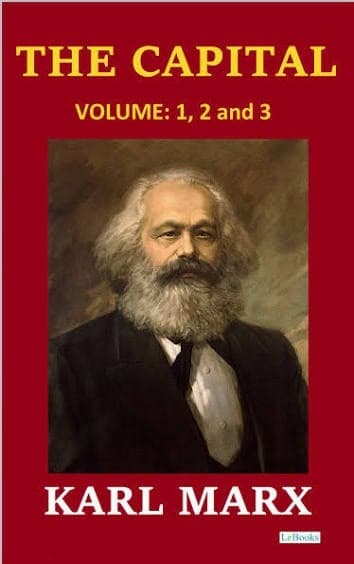
Capital: A Critique of Political Economy, Volume III
Capital Volume III, edited posthumously by Engels from Marx's manuscripts, argues that the capitalist process of production as a whole generates a tendency for the rate of profit to fall as organic composition rises, even as counter-tendencies offset it. The volume's distinctive contribution is the resolution of the apparent contradiction between Volume I's value theory and the observable prices of production: surplus value is redistributed across sectors through competition, forming a general rate of profit. It also analyzes credit, fictitious capital, and ground rent, completing the critique of political economy as a totality.
Key Insights
✦What is the central argument of Volume III, and how does it complete the project begun in Volume I?
Volume III analyzes 'the process of capitalist production as a whole,' integrating the production of surplus value (Volume I) with the circulation of capital (Volume II) . Its central claim is that the capitalist system generates a tendency for the average rate of profit to fall as the organic composition of capital rises—more machinery, less living labour relative to total capital. This tendency is offset by counter-tendencies (increased exploitation, cheaper inputs, foreign trade), so the fall is never mechanical. The volume's decisive move is to show how surplus value, extracted in production, is redistributed across sectors through competition to form a general rate of profit, yielding prices of production that diverge from values. This resolves the apparent contradiction between Volume I's value theory and observable prices.
✦What is the 'transformation problem,' and why has Volume III been the site of a century-long debate?
The transformation problem concerns whether Marx's procedure for deriving prices of production from values in Volume III is logically consistent. Critics from Eugen Böhm-Bawerk onward have argued that Marx 'failed to transform the inputs'—that he calculated output prices using value-based inputs while assuming prices of production, creating circularity . The debate remains unresolved after 125 years . Defenders like Fred Moseley argue that Marx's logical method is macro-monetary: the total surplus value is determined at the level of the total economy, then distributed through competition, so there is no inconsistency . Others, like David Laibman, argue the way forward is to develop value theory rather than treat Marx's texts as 'sacred scripture' . The stakes are whether labour is the sole source of value and whether exploitation can be measured independently of prices.
✦How did Engels edit the manuscripts, and what did MEGA² reveal about his interventions?
Engels published Volume III in 1894, four years after Marx's death, claiming to have restricted his role to faithful presentation. The MEGA² critical edition made Marx's 1864–65 manuscript available in 1993, enabling direct comparison. Michael Heinrich's analysis found that Engels made 'significant modifications' despite his claim: he designed headings, inserted subheadings, transposed text, and made omissions and insertions that have 'real impacts' on crisis theory, credit theory, and the relation between capitalism and commodity production . Engels also changed the subtitle from Marx's 'The Shapes of the Whole Process' to 'The Process of Capitalist Production as a Whole,' and inserted unmarked opening sentences to support it . Readers should know they are encountering an edited reconstruction, not Marx's unmediated text.
✦What does Volume III contribute to Marx's theory of crisis, and how has it been received?
Volume III contains Marx's most developed analysis of crisis, linking the falling rate of profit to overproduction, credit expansion, and the contradiction between production's expansion and consumption's limits. Engels emphasized this dimension, and it became central to later Marxist crisis theory (Luxemburg, Grossman, and others). However, Heinrich's comparison with the manuscript shows that Marx's thinking on crisis was 'far more ambivalent and much less developed' than Engels's edition suggests, and it is 'doubtful whether the materials were available to complete Capital' . This does not invalidate the volume's arguments but complicates any claim that Volume III represents Marx's finished position. It is a reconstruction of an unfinished project, and its tensions are part of its interest.
✦How does Volume III treat credit and fictitious capital, and why does that matter today?
Volume III contains Marx's most sustained discussion of the credit system, including the distinction between commercial credit, bank credit, and fictitious capital (claims to future surplus value that circulate as assets). Marx argues that the credit system, while enabling capitalist expansion, also creates the conditions for speculative bubbles and financial crises by divorcing claims to value from the productive base. This analysis has been taken up by contemporary scholars of financialization, who see in Marx's account of fictitious capital a precursor to modern analyses of derivative markets and debt-driven instability. The section is fragmentary—Marx never completed a systematic theory of credit—but it is one of the volume's most suggestive and least dogmatic parts, opening questions that Capital's more formal sections leave aside.
✦Is Volume III accessible to readers who have not mastered Volume I, or does it presuppose the earlier work?
Volume III presupposes Volume I, and to a lesser extent Volume II. Its opening chapters assume familiarity with the labour theory of value, surplus value, and the distinction between constant and variable capital. The transformation problem, which occupies Part II, is unintelligible without the value categories of Volume I. Readers new to Marx should begin with Volume I and, ideally, with a secondary guide to the transformation debate before tackling Volume III's middle sections. That said, Parts IV and V (on credit and ground rent) can be read with profit by those interested in financial crisis or agrarian political economy, even without full command of the earlier volumes. The book is not a standalone text but the culminating panel of a triptych.
Wealthy Psyche is an intellectual archive. We do not host, distribute, or sell book copies — physical or digital. We provide structured knowledge to help you think better, faster.