


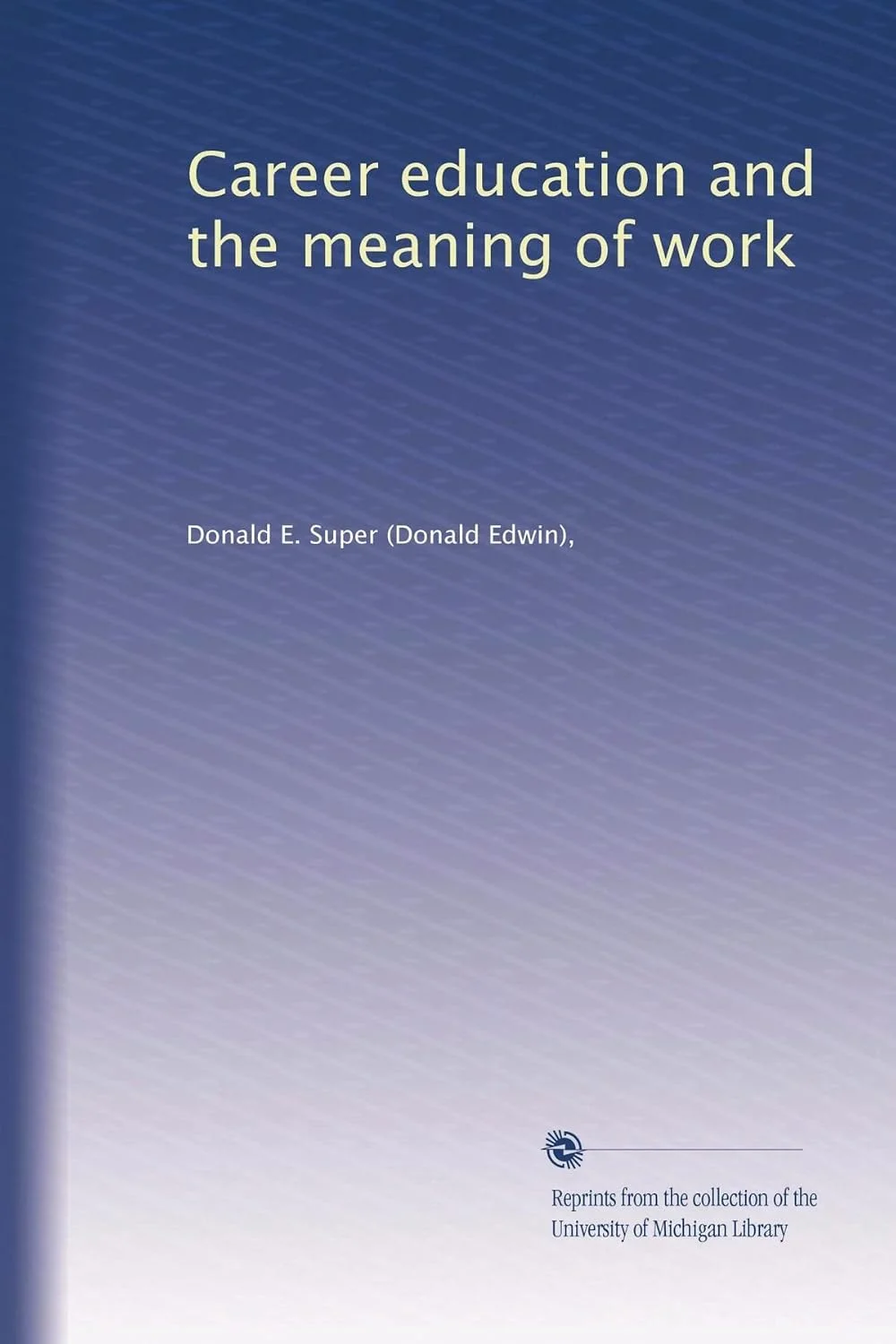
Career Education and the Meanings of Work
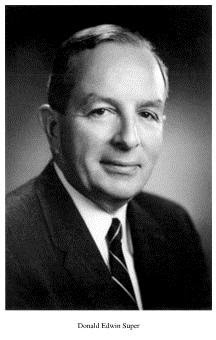 Donald Edwin Super
Super's 1976 monograph argues that career education must be grounded in career development theory rather than narrow job preparation. Its central claim is that work carries multiple meanings—economic, psychological, social, and self-actualizing—and that career educators must clarify these meanings to avoid confusing students about the relationship between education and employment. The essay reviews definitions of work, career, occupation, job, leisure, and vocation, then applies life-stage theory to show how work's meanings shift across the lifespan, concluding with six objectives for career education in a changing society.
Key Details
Related Books
View AllSimilar books from the same category, ranked by shared topics and reader engagement.



Key Insights — Read in 10 Minutes
What is the central claim of this monograph, and why did Super begin with definitions?
The central claim is that career education must be built on career development theory, not on narrow job preparation, and that clarifying the meanings of work is a prerequisite for coherent educational policy. Super opens with a review of the many meanings of work, career, occupation, and job, then extends the analysis to leisure, play, and avocation . His rationale is explicitly pedagogical: if the behavior sciences are to contribute to education, and if career education is to make an enduring contribution rather than be a passing fad, the terminology of career development must be clarified and standardized . The essay surveys usage, identifies distinctive meanings, proposes standard definitions, and examines social trends.
What specific definition does Super propose for 'career,' and how does it differ from conventional usage?
Super defines career as the sequence of major positions occupied by a person throughout their preoccupational, occupational, and postoccupational life, including work-related roles such as student, employee, and pensioner, together with complementary avocational, familial, and civic roles . This definition is deliberately broader than conventional usage. Super emphasizes that careers exist only as people pursue them and are person-centered . He also distinguishes between continuous and discontinuous careers, noting that the conventional stable career is most common in skilled, clerical, executive, and professional fields, while discontinuous careers—unstable, multiple-trial, interrupted—are more common at lower socioeconomic levels .
How does the monograph apply life-stage theory to the meanings of work?
Super treats life stages, developmental tasks, and career patterns as the theoretical basis of career education . The meanings of work shift across the lifespan: what work signifies to a youth exploring occupations differs from what it means to a mid-career professional or a retiree. The monograph examines the importance of work to semi-skilled workers, office workers, executives, and professionals, as well as to youth, the elderly, the handicapped, ethnic minorities, and women . It also considers the competing and complementary roles provided by family, leisure, and civic life, and how society-maintaining workers may find new life meanings through these non-occupational aspects of their careers .
What are the six objectives of career education that conclude the monograph?
The ERIC abstract states that the monograph concludes with a listing of six objectives of career education made necessary by the diverse meanings of work in a changing society . While the specific wording of each objective is not reproduced in the available catalog summaries, their framing is significant: they are derived from the analysis of work's multiple meanings rather than from economic or manpower considerations alone. This structure reflects Super's argument that career education policy must be grounded in developmental theory and the full range of work's significance in human life, not merely in preparing students for their first jobs.
What does Super say about the relationship between work and other life roles?
Super insists that work must be understood within the total life-space of roles. The monograph takes up leisure, play, and avocation alongside occupational concepts . It examines how family, leisure, and civic life provide competing and complementary roles to paid employment . A key implication is that career education efforts must include helping persons discover ways of meeting the human need to work in other life roles—family member, community volunteer, citizen—not only in paid employment . This position reflects Super's mature life-span, life-space theory, in which careers are shaped by the interaction of multiple roles across the lifespan.
What are the bibliographic details of this monograph?
The monograph was published in June 1976 by the U.S. Department of Health, Education, and Welfare, Office of Education, in Washington, D.C., as part of the Monographs on Career Education series . It runs iv + 47 pages (ERIC records list 52 pages including covers) and includes a bibliography on pages 43–47 . The Superintendent of Documents stock number is 017-080-0155-4, originally priced at $0.75 plus $0.25 postage . It is available in full view through HathiTrust from multiple university library copies .
Show 2 more insights
Who was the intended audience for this publication, and how does its format reflect that?
The monograph was published by the U.S. Office of Education, indicating its intended audience was career education policymakers, curriculum developers, and practitioners in the educational system, not primarily academic researchers. The ERIC record classifies it as a government publication distributed through the ERIC Clearinghouse . Its compact 47-page format and its conclusion with policy-relevant objectives rather than empirical findings reflect this applied orientation. Super wrote it as a theoretical foundation for the career education movement of the 1970s, translating his decades of vocational development research into guidance for educational reform.
How does this monograph relate to Super's life-span, life-space theory?
This 1976 monograph represents an intermediate stage in Super's theoretical development. The Psychology of Careers (1957) established the developmental stages and self-concept implementation. Career Development: Self-Concept Theory (1963) operationalized the self-concept. This monograph adds the life-space dimension explicitly: the recognition that people occupy multiple roles—worker, family member, citizen, leisurite, student—and that work's meanings must be understood in relation to these other roles. By 1980, Super had formalized this into the life-span, life-space theory, with the Life Career Rainbow depicting the interaction of roles across the lifespan. The 1976 monograph is thus the policy-oriented bridge between Super's developmental theory and his mature multi-role framework.
Wealthy Psyche is an intellectual archive. We do not host, distribute, or sell book copies — physical or digital. We provide structured knowledge to help you think better, faster.