


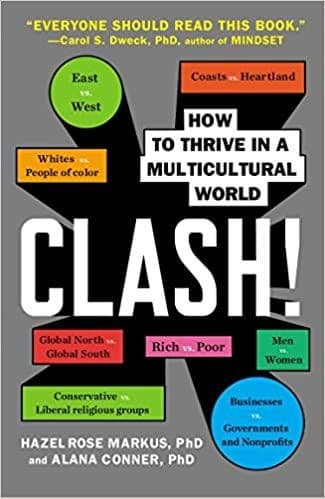
Clash!: How to Thrive in a Multicultural World

Markus and Conner argue that many of the world's most intractable conflicts—between East and West, men and women, rich and poor, liberals and conservatives—share a single root: the collision between independent and interdependent selves. Independent selves prize uniqueness, control, and self-expression; interdependent selves prize relationships, adjustment, and fitting in. The book's mechanism is diagnostic and prescriptive: it first shows how these two cultural orientations generate predictable clashes across eight domains, then argues that thriving in the twenty-first century requires everyone to cultivate both sides rather than defending one against the other.
Key Insights
✦What is the central claim of Clash!, and what does it reject?
Markus and Conner argue that a single underlying tension—between independent and interdependent selves—generates many seemingly unrelated cultural conflicts. Independent selves are defined as individual, unique, influencing others, free from constraints, and equal yet great; interdependent selves are relational, similar to others, adjusting to situations, rooted in traditions and obligations, and ranked in hierarchies . The book rejects the assumption that these conflicts are separate problems requiring separate solutions. Instead, it contends that clashes between East and West, men and women, rich and poor, and liberals and conservatives all stem from the same root. The proposed remedy is not victory for one orientation but integration: everyone must cultivate both independence and interdependence to thrive .
✦How does the book's argument relate to Markus and Kitayama's earlier self-construal theory?
Clash! popularizes and extends the independent-interdependent self-construal framework that Markus developed with Shinobu Kitayama in their landmark 1991 Psychological Review paper. That paper established the theoretical distinction; Clash! (2013) translates it for a general audience and applies it to eight concrete domains of social conflict. The book extends the earlier framework in two ways: it argues that everyone possesses both orientations in varying degrees, rather than belonging to one type, and it proposes that the goal is balance rather than cultural replacement. This extension is consistent with the trajectory of Markus's work, which moved from documenting cultural differences in self-concept toward prescriptive questions about how individuals and institutions can integrate multiple cultural models.
✦How was Clash! received by reviewers, and what criticisms were raised?
Kirkus Reviews called it a 'grab-bag, pop-psych look at cultural determinism' with 'plenty of smart if debatable observations,' while noting that 'a tighter and better-organized argument would have helped' . A more substantive critique appeared in the Stanford Social Innovation Review: while praising the book's scope and readability, the reviewer argued that Markus and Conner assert within-group diversity but 'show little recognition of the nuances that help to define different cultural outlooks,' and that they 'downplay the degree to which cultural outlooks include non-conscious aspects that are not freely chosen' . The book also received enthusiastic endorsements from figures including Jonathan Haidt, Amy Chua, and Carol Dweck, suggesting its appeal to educated general readers exceeded its traction among specialists .
✦What are the 'eight cultural conflicts' the book identifies, and does it treat them equally?
The book's subtitle in its original hardcover edition was '8 Cultural Conflicts That Make Us Who We Are,' though the paperback edition dropped the number and adopted the subtitle 'How to Thrive in a Multicultural World' . The conflicts span East versus West, men versus women, whites versus people of color, rich versus poor, conservatives versus liberals, religious versus secular, business versus nonprofit, and global North versus South . Kirkus observed that 'the authors do not always have their eyes on this prize'—meaning the eight-conflict structure is not consistently maintained . The book is better understood as using the independent-interdependent distinction as a recurring lens rather than as a rigorously partitioned taxonomy of eight equal categories.
✦What is the 'culture cycle' framework the book introduces, and how does it work?
The culture cycle is Markus and Conner's model for how culture and self constitute one another. It posits that culture operates through cycles of ideas, institutions, and interactions that shape individual thoughts, feelings, and actions, which in turn reinforce or modify the cultural cycle . In Clash!, the culture cycle explains why cultural orientations are not simply chosen: individuals are immersed in institutional practices and interaction patterns that cultivate particular selves. The book argues that understanding this cycle is the key to softening clashes—by intervening at the level of institutions and interactions, not merely by asking individuals to change their attitudes. The framework draws on Markus's earlier work on how sociocultural contexts shape psychological processes, applied here to practical problems of diversity and conflict.
✦Does the book argue that independence is superior to interdependence, or vice versa?
Neither. The book's prescriptive argument is that both orientations are necessary and that thriving requires integration. Markus and Conner contend that 'to build a more prosperous and peaceful world, everyone must be both independent and interdependent,' meaning that independently oriented people must hone their interdependence while interdependently oriented people must polish their independence . However, the SSIR reviewer observed that the book's model ultimately offers 'a more complete rationale for a Western liberal policy agenda than it does for any competing agenda,' suggesting an implicit normative tilt despite the explicit call for balance . The book is careful to avoid declaring one orientation superior, but its framing of integration as the ideal reflects a particular cultural standpoint.
✦How does the paperback edition differ from the original hardcover, and does that matter?
The hardcover, published by Hudson Street Press in May 2013, carried the subtitle '8 Cultural Conflicts That Make Us Who We Are' and identified eight specific conflict domains . The paperback, published by Plume in June 2014, adopted the subtitle 'How to Thrive in a Multicultural World' and the cover copy shifted from enumerating conflicts to emphasizing practical solutions . The content is substantially the same, but the reframing signals a marketing shift from analytical taxonomy to self-help applicability. Readers citing the book should specify which edition they used, as the subtitle change affects how the book is catalogued and searched. The paperback's broader subtitle may also obscure the specificity of the eight-conflict structure for readers encountering the book secondhand.
Wealthy Psyche is an intellectual archive. We do not host, distribute, or sell book copies — physical or digital. We provide structured knowledge to help you think better, faster.