


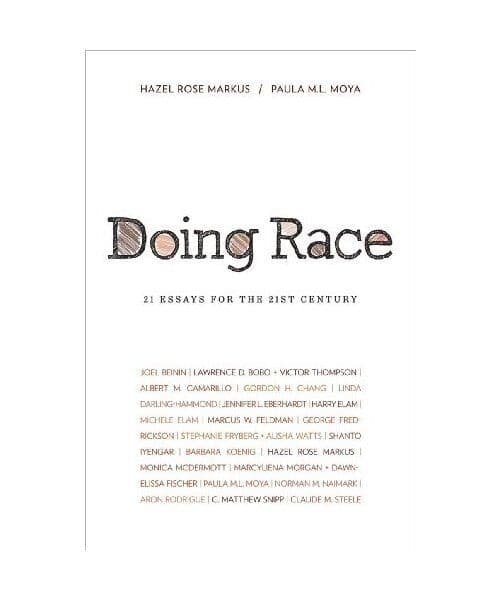
Doing Race: 21 Essays for the 21st Century

Markus and Moya assemble an interdisciplinary volume arguing that race is not a biological essence or a fixed identity but something people *do*—enacted through everyday institutional practices, interpersonal encounters, and cultural representations. The book's mechanism is to trace how racial categories are made real through five levels: invention (census, law, science), racing difference (othering), institutionalization (schools, media, prisons), identity (stereotypes, self-concept), and re-presentation (art, performance). Rather than asking what race *is*, it asks what race *does*, and shows that because race is produced by human action, it can also be done differently.
Key Insights
✦What is the central claim of Doing Race, and what does it reject?
The volume's organizing argument is that race and ethnicity are not things people possess or are, but sets of actions people perform—hence 'doing' race . It rejects two common positions: the biological essentialist view that race is rooted in DNA, and the 'post-race' claim that race no longer matters because a Black president was elected. Moya and Markus argue that race is a social construction, but insist that social constructions have real consequences: they structure who attends which schools, who is incarcerated, who is trusted, and who belongs . The book's twenty-one essays are organized to demonstrate how race is done across five domains: invention, racing difference, institutionalization, identity, and re-presentation .
✦How did the book originate from the editors' teaching, and what problem was it designed to solve?
Doing Race grew out of Stanford's 'Introduction to Comparative Studies in Race and Ethnicity,' team-taught by Markus and Moya. They noticed that students were persistently challenged by claims that studying race 'divides people,' is unnecessary in a 'post-race' world, and isn't relevant to white students . The editors also observed that students became more comfortable discussing race as they gained exposure to scholarship across disciplines. They designed the volume to present the latest race scholarship in an accessible format for undergraduates and the general public, addressing the gap between academic knowledge and popular conversation. The introductory essay specifically dissects eight common but misleading conversational scripts about race, such as 'It's a black thing—you wouldn't understand' and 'That's just identity politics' .
✦How was the book received by academic reviewers, and what did they identify as its strengths?
Clovis L. White, reviewing in the Du Bois Review (2010), called it an 'important addition' to the study of race, praising its comprehensive, multi-angle approach to a phenomenon that must be examined anthropologically, sociologically, and historically to be understood . White noted that the book provides insight into the continuous significance of race at a time when racial tensions are rising despite claims of a post-racial society, and that it offers an array of possible solutions or models for addressing racial conflict. The volume also received strong endorsements from major scholars: Henry Louis Gates Jr. called it 'absolutely necessary' and predicted it would become a landmark, while Michael Omi praised its comprehensive and accessible coverage .
✦What role does Hazel Markus play in the volume beyond co-editing, and how does her chapter relate to her other work?
Markus co-writes the introduction with Moya and contributes a chapter titled 'Who Am I? Race, Ethnicity, and Identity' . Her chapter examines how people come to identify by race and ethnicity, how these identifications shape self-perception, and how they signal 'where we belong' in society . This chapter applies the self-construal framework Markus developed with Kitayama—the distinction between independent and interdependent selves—to racial identity, asking how cultural models of selfhood interact with racialized experience. It also connects to her work in Facing Social Class, where she argues that social categories operate as cultures enacted in interaction. The volume as a whole reflects Markus's conviction that psychological processes cannot be understood apart from the social and cultural structures that give them meaning.
✦Is the volume's interdisciplinary structure a strength or a weakness for its argument?
The interdisciplinary structure is the argument's substance, not merely its packaging. The contributors include psychologists, historians, legal scholars, biologists, education researchers, and drama and English scholars . This composition enacts the claim that race cannot be captured by a single disciplinary lens: a biological account of ancestry without historical context misses how racial categories were politically constructed; a legal account without psychology misses how stereotypes shape perception and judgment. The risk is fragmentation—a reader might treat the essays as discrete case studies rather than as a cumulative argument. The editors mitigate this with the introduction's theoretical scaffolding and the five-part organizational structure, which groups the essays under clear conceptual headings. The result is a volume that models, rather than merely describes, the multidisciplinary approach it advocates.
✦How does the book's title concept—'doing race'—differ from saying race is a 'social construct'?
The 'social construction' thesis is often heard as saying race isn't real—it's just an idea. 'Doing race' resists that interpretation by locating race in concrete, observable practices. Race is done when a real estate agent steers a family to a particular neighborhood, when a news program chooses which crimes to report, when a school district draws attendance boundaries, when a comedian performs a racial stereotype, or when an individual checks a box on a census form . The point is not that race is unreal but that its reality is produced and sustained through action. This framing has a practical implication that 'social construction' alone lacks: because race is something people do, it is something people can stop doing, or do differently. The volume's final section on art and performance is crucial here, showing how literature, hip-hop, comedy, and theater can re-present racial realities and open possibilities for change .
Wealthy Psyche is an intellectual archive. We do not host, distribute, or sell book copies — physical or digital. We provide structured knowledge to help you think better, faster.