


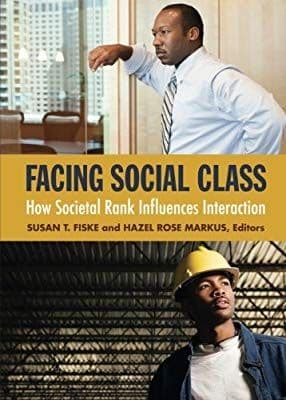
Facing Social Class: How Societal Rank Influences Interaction

Fiske and Markus assemble an interdisciplinary volume arguing that social class is not a background demographic variable but a culture that is enacted face-to-face. The book's distinctive mechanism is to trace how class shapes interaction through four levels—pervasive ideas, institutions, interactions, and individuals—showing that middle-class institutions reward an independent model of selfhood while working-class styles of speech, trust, and self-presentation are systematically misread. Rather than treating inequality as a macro-economic abstraction, it examines how class distinctions are communicated and reproduced in everyday encounters, from parent-teacher conferences to cross-class handshakes.
Key Insights
✦What is the central claim of Facing Social Class, and what does it reject?
The volume argues that social class operates as a culture—a set of shared practices, meanings, and interactional styles—rather than merely as a demographic category or economic rank. It rejects the American assumption that class does not matter, showing instead that class distinctions are enacted in face-to-face encounters and institutional practices. Markus and Fiske organize the book around four levels: pervasive ideas, institutions, interactions, and individuals . At each level, the contributors demonstrate that class shapes how people talk, dress, trust strangers, and present themselves, and that these interactional differences are systematically misread in ways that reproduce disadvantage. The book's intervention is to make visible what is usually invisible: the cultural mechanisms of class reproduction in daily life.
✦How does the volume's interdisciplinary composition shape its argument?
The book brings together social psychologists, sociologists, anthropologists, linguists, and legal scholars, and this composition is central to its claim that class cannot be understood from a single disciplinary vantage . Sociologists like Paul DiMaggio and Annette Lareau analyze institutional and cultural capital mechanisms; linguists like Peggy Miller examine how low-income children's verbal abilities are misrecognized; social psychologists like Nicole Stephens and Hazel Markus show how middle-class models of independence disadvantage working-class Americans . The interdisciplinary structure enacts the book's argument: class is too pervasive to be captured by psychology alone, and the interactional level where psychology operates is embedded in institutional and cultural structures that sociology and anthropology describe.
✦What specific chapter or finding is most often cited from this volume, and why?
The chapter by Nicole Stephens, Stephanie Fryberg, and Hazel Markus, 'It's Your Choice: How the Middle-Class Model of Independence Disadvantages Working-Class Americans,' is among the most cited contributions . It argues that institutions—schools, workplaces, universities—are structured around a middle-class model of independent selfhood that rewards choice, self-expression, and personal control. Working-class Americans who were raised with a more interdependent model, emphasizing adjustment to circumstances and attending to others' expectations, are therefore disadvantaged not because they lack ability but because institutional expectations are culturally specific. This chapter crystallizes the volume's broader argument: the reproduction of class inequality operates through cultural mismatch, not merely through material deprivation.
✦How was the book received by reviewers, and what criticisms were raised?
A review in the Norwegian sociological journal Sosiologi i dag offered a measured critique. The reviewer praised the book's focus on the psychological and interpersonal mechanisms that create and maintain class differences, calling it an interdisciplinary step forward . However, the reviewer argued that the editors do not successfully justify why the differences they examine are specifically class differences rather than general social inequality, and that the book engages insufficiently with classical class analysis—class consciousness is barely mentioned, and Weber's work on status receives only one reference . The reviewer also noted that the book is about class in the United States and is not fully transferable to European welfare states, though its perspectives may still have relevance.
✦How does this volume relate to Markus's other work on culture and self?
Facing Social Class applies the independent-interdependent self-construal framework that Markus developed with Kitayama to the domain of social class. In earlier work, independence and interdependence were treated as cultural orientations varying primarily across national cultures (e.g., North America vs. East Asia). Here, Markus and her co-authors argue that social class within a single society—the United States—also cultivates these orientations: middle-class contexts foster independence, while working-class contexts foster interdependence . This extends the framework's reach and sharpens its political implications, showing that the same cultural dimension that explains cross-national differences also explains within-society stratification. The book thus applies and extends Markus's career-long argument that self-construal is culturally constituted.
✦Does the book offer solutions, or is it primarily diagnostic?
It is primarily diagnostic, though the publisher's description indicates that it addresses 'what can be done to alleviate its effects' . The individual chapters are empirical and analytical, documenting how class operates at each level rather than proposing interventions. The introduction by Markus and Fiske frames the volume as a wide-angle lens on the psychology of social class , suggesting that the first task is to make visible what has been rendered invisible. The book's contribution is to establish that class is a cultural and interactional phenomenon, which is a precondition for any effective intervention. Readers seeking concrete policy proposals will need to look elsewhere, but the volume provides the conceptual groundwork for understanding why well-intentioned policies often fail when they ignore interactional and cultural mechanisms.
Wealthy Psyche is an intellectual archive. We do not host, distribute, or sell book copies — physical or digital. We provide structured knowledge to help you think better, faster.