


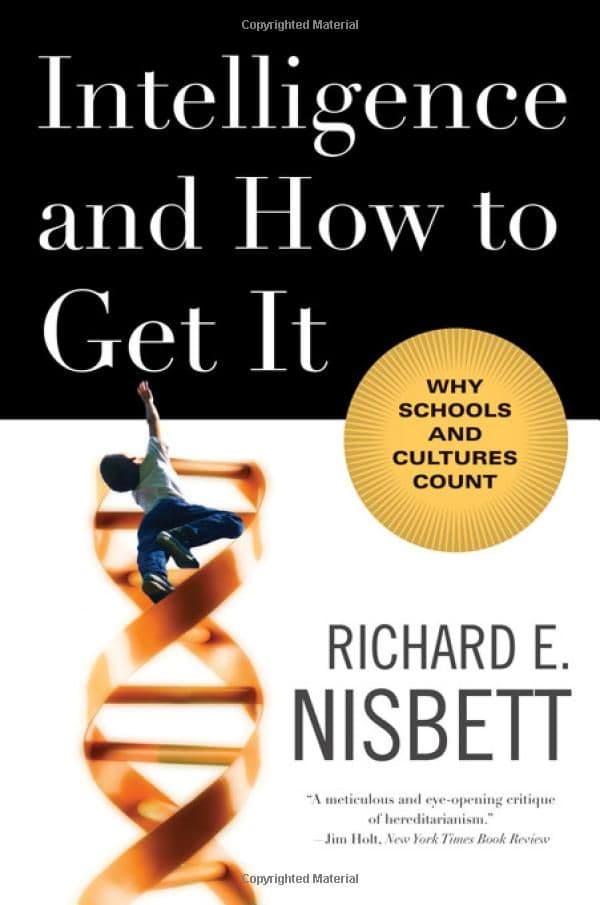
Intelligence and How to Get It: Why Schools and Cultures Count

Nisbett argues that intelligence is far more malleable than hereditarians claim, and that culture—schools, parenting, social class, and national traditions—is the decisive lever. The book's mechanism is a sustained empirical rebuttal: it challenges the high heritability estimates of The Bell Curve, presents the Flynn Effect as proof of environmental power, and shows that adoption, early education, and reduced social stress can raise IQ. Rather than denying any genetic contribution, Nisbett insists that heritability places no constraint on modifiability, making the case that the cognitive gaps between groups are products of circumstance, not essence.
Key Insights
✦What is the central claim of Intelligence and How to Get It, and what does it reject?
Nisbett argues that intelligence is substantially malleable and that cultural and environmental factors—schools, parenting practices, social class, and national traditions—play a far greater role than hereditarians acknowledge. The book rejects the core thesis of The Bell Curve: that IQ differences between individuals and groups are largely genetic and therefore resistant to social intervention. Nisbett does not deny that genes contribute to individual differences; his key argument is that heritability estimates place no constraint on modifiability . He offers a sustained critique of the high heritability figures cited by hereditarian researchers, arguing that the real figure is below 50 percent, and presents evidence from adoption studies, the Flynn Effect, and educational interventions to show that cognitive ability can be raised .
✦How was the book received by reviewers, and what criticisms were raised?
Reception was sharply divided along ideological and disciplinary lines. Jim Holt, writing in The New York Times, called it 'a meticulous and eye-opening critique of hereditarianism' and praised Nisbett's forceful marshaling of evidence favoring 'the new environmentalism' . Earl B. Hunt, reviewing in Intelligence, acknowledged that Nisbett writes well for a general audience but argued he 'goes too far in attacking discussions of the genetics of intelligence' . Wendy Johnson, in Gifted Child Quarterly, was harsher, describing the book as 'a fascinating example of a scholarly exercise in wishful thinking' and faulting Nisbett for ignoring studies with contrary results and disregarding replication requirements . J. Philippe Rushton and Arthur Jensen published a lengthy point-counterpoint rebuttal in The Open Psychology Journal, defending a 50-50 genetic-environmental model and concluding that group differences are 50 to 80 percent heritable .
✦What is the Flynn Effect, and why does Nisbett treat it as central evidence?
The Flynn Effect is the well-documented, steady rise in average IQ scores across generations throughout the twentieth century. Nisbett uses it as a cornerstone of his argument because it demonstrates that populations can gain substantially in measured intelligence over relatively short periods—far too short for genetic change to be responsible. In a 2011 presentation, Nisbett noted that Raven's Progressive Matrices, often touted as 'culture-free,' has been the measure most subject to the Flynn Effect, proving that it is 'drenched in culture' . The gains, he argues, reflect real increases in cognitive skills driven by schooling, more complex media environments, and greater exposure to abstract problem-solving. If environments can produce such massive shifts in a century, Nisbett reasons, they can also account for differences between groups within a society.
✦How does the book address the racial IQ gap, and what is the appendix's role?
Nisbett argues that the Black-White IQ gap in the United States is entirely environmental in origin, and he devotes a substantial appendix to making that case explicitly . He draws on evidence including the narrowing of the gap in recent decades, adoption studies showing IQ gains when Black children are raised in advantaged families, and the effects of stereotype threat and social class on test performance. This is the book's most contested argument. Rushton and Jensen specifically targeted the appendix in their rebuttal, defending the hereditarian position across fourteen topics including trans-racial adoption, brain size, and reaction-time measures . The appendix's presence and the intensity of the response to it indicate that Nisbett intended the book not merely as a general treatment of intelligence but as a direct intervention in the race-and-IQ debate.
✦What practical recommendations does the book offer for raising intelligence, and are they supported by the evidence?
The book's practical chapters address improving schools, parenting practices, and reducing the cognitive effects of poverty. Nisbett discusses interventions such as the Perry Preschool program and Reading Recovery, and he emphasizes the importance of reducing stress on children from low socioeconomic backgrounds—stress that he argues causes permanent damage to the prefrontal cortex, which supports fluid intelligence . He also notes factors like breastfeeding (worth roughly six IQ points over nine months) and maternal exercise during pregnancy. Reviewers acknowledged the recommendations were grounded in evidence but noted a limitation: the parents most likely to follow advice about cognitive stimulation are already advantaged, potentially widening rather than closing gaps . The book is thus stronger as a diagnosis of environmental mechanisms than as a blueprint for equalization.
✦How does this book relate to Nisbett's earlier work on culture and cognition?
Intelligence and How to Get It extends Nisbett's career-long interest in how culture shapes cognition, but shifts the focus from perceptual and reasoning styles to measured intelligence and its social determinants. The Geography of Thought (2003) documented East Asian holistic versus Western analytic cognition; the 2009 book applies a similar cultural-environmental framework to the question of why some groups and nations score higher on IQ tests. Nisbett's chapter on 'Advantage Asia?' and his discussion of Jewish intellectual traditions ('People of the Book') reflect this continuity . The book's central claim—that culture counts—is the same conviction that animated his cross-cultural research, now directed at a policy debate with high stakes for education and inequality.
✦What editions and translations exist, and does the edition matter?
The first edition was published by W.W. Norton in 2009, with a Norton paperback in 2010 . A Korean translation appeared in 2015 under the title 무엇이 지능을 깨우는가, based on a previous translation titled 인텔리전스 . The edition matters primarily for citation and for the appendix's availability; the core argument is consistent across English editions. Readers should be aware that the book was published before the replication crisis in social psychology fully unfolded, and some of the studies Nisbett cites—particularly on stereotype threat and priming—have since been subjected to replication scrutiny. The book's central claims about the Flynn Effect and adoption studies, however, rest on more robust evidence.
Wealthy Psyche is an intellectual archive. We do not host, distribute, or sell book copies — physical or digital. We provide structured knowledge to help you think better, faster.