


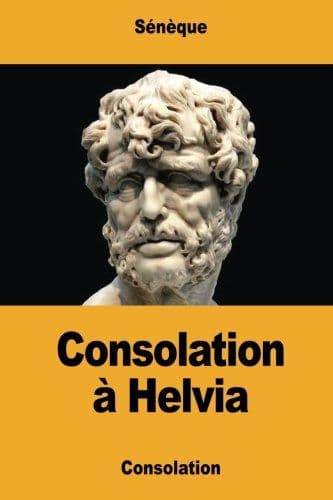
Consolation to Helvia

Seneca's Consolation to Helvia is a paradox: a letter of comfort written by the very person causing the grief. Exiled to Corsica, Seneca writes to his mother not to lament his absence but to argue that she should not mourn at all. The work's central mechanism is the Stoic reclassification of exile: it is not a misfortune but a 'change of place,' and the mind's freedom remains untouched by geographical displacement. Seneca dismantles Helvia's grief by attacking the false judgments underlying it, arguing that her sorrow stems from opinion rather than from any genuine evil that has befallen him.
Key Insights
✦What is the central argument of the Consolation to Helvia, and what does it reject?
Seneca argues that his exile to Corsica is not a genuine misfortune and that his mother Helvia should not grieve over it. The text rejects the common assumption that exile constitutes a real evil. Seneca reframes exile as merely a 'change of place,' insisting that the mind's freedom and virtue remain unaffected by geographical displacement [citation:11]. He tells his mother that he himself feels no grief, and therefore she has no reason to mourn his absence [citation:6]. The consolation systematically dismantles Helvia's sorrow by attacking the false judgments underlying it, arguing that her grief stems from opinion rather than from any actual harm that has befallen him. The work is as much a self-consolation as a letter to his mother.
✦How does the Consolation to Helvia relate to Seneca's other consolations?
The Consolation to Helvia is one of Seneca's three consolatory works, alongside the Consolation to Marcia and the Consolation to Polybius, all written around 40–45 AD [citation:1]. The Helvia is distinctive because Seneca is both the consoler and the cause of the suffering he addresses—a paradox he acknowledges in the text [citation:6]. The Marcia consoles a mother for the death of her son; the Polybius consoles a freedman for the death of his brother. The Helvia consoles a mother for her son's exile. All three follow the Consolatio literary tradition and incorporate Stoic doctrine, but the Helvia is unique in its focus on exile rather than death as the occasion for grief.
✦What is the historical context of Seneca's exile and the letter's composition?
Seneca was charged with adultery with Julia Livilla, sister of Emperor Caligula, in 41 AD and was exiled to Corsica shortly afterward [citation:6][citation:11]. Scholars date the Consolation to Helvia to roughly 42/43 AD, during his years on the island [citation:6]. Some scholars have suggested that Seneca's positive outlook on exile in the letter may have been motivated in part by a desire to gain favor and contrive a return from exile, rather than purely by Stoic conviction [citation:6]. He was eventually recalled in 49 AD and appointed tutor to the young Nero [citation:1]. The letter's rhetorical sophistication and its circulation in Rome may have contributed to his rehabilitation.
✦How does Seneca console his mother specifically, given that he is the cause of her grief?
Seneca acknowledges the paradox directly: he is both the consoler and the one inflicting suffering [citation:6]. His strategy is to deny that any real harm has occurred. He tells Helvia that he does not feel grief, so she should not mourn on his behalf . He refers to exile as merely a 'change of place' and assures her that it has brought him no feelings of disgrace [citation:11]. He also appeals to her character, noting her strong virtue as a resource that will allow her to bear his absence. The letter thus works by reclassifying the event: if exile is not an evil, then grief over it is a false judgment, and Helvia's sorrow is a mistake she can correct through Stoic reasoning.
✦What is the textual history of the Consolation to Helvia, and how has it been transmitted?
The Consolation to Helvia is preserved as part of Seneca's Dialogi, a collection of treatises that includes the three consolations. The standard critical edition of the Latin text is Emil Hermes's Teubner edition (1923), which is available through the Perseus Digital Library [citation:3]. The work also survives in medieval manuscripts, including a fifteenth-century paper manuscript in the Österreichische Nationalbibliothek in Vienna, where it appears alongside other Senecan texts . The first widely used English translation was Aubrey Stewart's 1900 version, published by George Bell and Sons . Modern translations include C.D.N. Costa's Penguin Classics edition, which collects the Consolation alongside On the Shortness of Life and On Tranquility of Mind [citation:2].
✦What is a common misconception about the Consolation to Helvia?
A common misconception is that the letter is primarily a warm, personal expression of filial affection. In fact, it is a formal Stoic exercise in therapeutic argument, written more like an essay than a personal letter . Seneca's tone is notably detached, preoccupied with presenting facts about the universe and the human condition rather than offering intimate solace. This detachment may reflect both his Stoic commitment to reason over emotion and his awareness that the letter would circulate publicly and could serve his political interests [citation:6]. Readers expecting personal warmth may be surprised by the letter's philosophical rigor, but understanding its genre as a Consolatio clarifies why Seneca prioritizes argument over sentiment.
Wealthy Psyche is an intellectual archive. We do not host, distribute, or sell book copies — physical or digital. We provide structured knowledge to help you think better, faster.