


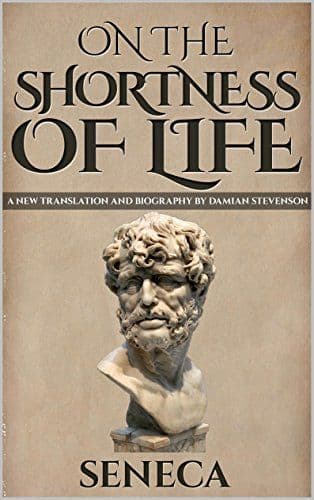
On the Shortness of Life (De Brevitate Vitae)

Seneca's essay argues that life is not inherently short but is made short by our squandering of it on pointless pursuits. The central mechanism is a revaluation of time as the one possession truly ours: we guard our money jealously but let others steal our hours through trivial business, social obligations, and the pursuit of wealth or glory. Seneca contends that only the philosopher, who lives in the present and converses with the great minds of the past, truly lives, while the busy man merely exists. The text is a protreptic, urging the reader to withdraw from the crowd's distractions and claim ownership of his life.
Key Insights
✦What is the central argument of On the Shortness of Life, and what does it reject?
Seneca argues that life is not short by nature but is made short by our misuse of it. The text rejects the common complaint that nature has given us too little time. Seneca contends that if we managed our time as carefully as we manage our money, we would find life long enough for the highest pursuits [citation:1]. The problem is that people squander their hours on trivial business, social obligations, and the pursuit of wealth or reputation, leaving no time for philosophy or self-possession. Only the wise person, who lives in the present and claims ownership of his time, truly lives; the rest merely exist, always preparing for life rather than living it [citation:5][citation:6].
✦Who was Paulinus, and why did Seneca address this essay to him?
The essay is addressed to Pompeius Paulinus, likely Seneca's father-in-law, who held the demanding post of praefectus annonae (supervisor of the grain supply) [citation:1][citation:12]. Seneca writes to urge Paulinus to retire from public life and devote his remaining years to philosophy. The dating of the essay hinges on when Paulinus held this office, with scholars proposing either around 49 AD or 62 AD [citation:12]. Seneca's choice of addressee is strategic: by addressing a man of advanced age and high public responsibility, he makes the argument about time's value concrete and urgent, not merely abstract.
✦What is the textual history of the essay, and what is the standard English translation?
The essay survives as part of Seneca's Dialogi. The first English translation was a verse rendering by Sir Ralph Freeman, published in 1636 and reprinted in 1663 [citation:4]. The standard modern translations are John W. Basore's Loeb Classical Library edition and C.D.N. Costa's Penguin Classics volume. More recent translations include James Romm's version for Princeton University Press's Ancient Wisdom for Modern Readers series (2022), which pairs the essay with selections from other moral works [citation:14]. The essay's brevity and aphoristic style have made it a popular entry point to Seneca, and it is often published alongside On the Happy Life and On Providence.
✦How does the essay's argument about time relate to Stoic physics?
Seneca's argument is not merely practical advice but follows from Stoic physics. For the Stoics, time is a continuous present, and the past and future are not ours to control. Seneca's insistence on living in the present is grounded in the Stoic conception of the cosmos as a rational whole in which the sage aligns his will with nature. The essay's famous claim that the philosopher can attain a kind of immortality by conversing with the great minds of the past reflects the Stoic idea that virtue and wisdom connect the individual to the eternal rational order [citation:10]. The essay is thus a popularization of Stoic doctrine, not a departure from it.
✦What is a common misconception about the essay's message?
A common misconception is that Seneca advocates withdrawal from all social and political life. In fact, his target is not engagement as such but engagement that is compulsive, trivial, or undertaken for the wrong reasons. Seneca himself was deeply involved in Roman politics as Nero's advisor, and he does not condemn public service categorically. The essay's criticism is aimed at the occupati—those who are busy for the sake of being busy, or who serve others' ambitions rather than their own. The wise man, for Seneca, can engage with the world while remaining detached from its distractions, claiming his time as his own even amid activity.
Wealthy Psyche is an intellectual archive. We do not host, distribute, or sell book copies — physical or digital. We provide structured knowledge to help you think better, faster.